
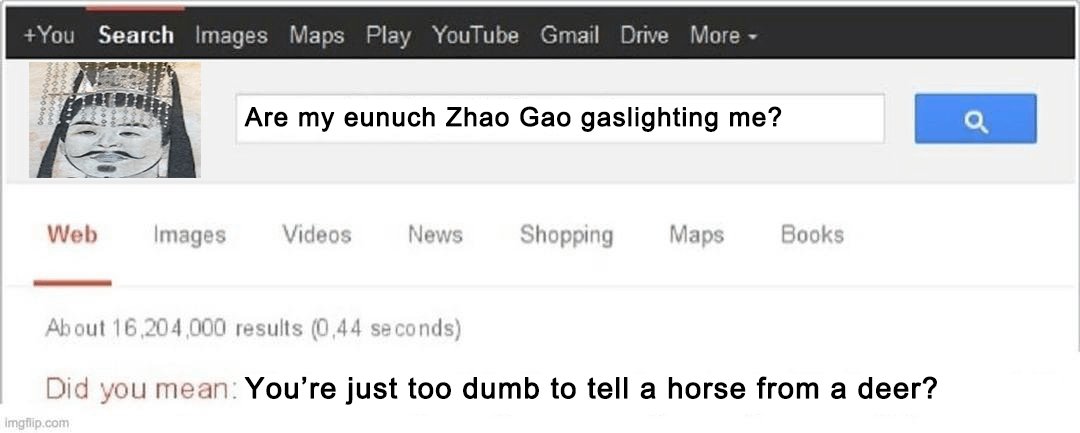
Context: In 210 BCE, Qin Shi Huang—the first emperor of a unified China and founder of the Qin Empire—died suddenly during an inspection tour, without publicly naming a clear successor. Seizing the opportunity, the eunuch Zhao Gao, the chancellor Li Si, and the emperor’s eighteenth son, Huhai, conspired to alter the imperial will, falsely proclaiming Huhai as the chosen heir.
After the imperial retinue returned to the capital, Huhai took the throne as the Second Emperor of Qin (Qin Er Shi). Zhao Gao was soon promoted to Chamberlain for Attendants, and a year later—after framing Li Si on charges of treason and having him executed—he himself assumed the chancellorship, becoming the most powerful man in the empire after the emperor.
To consolidate power entirely in his own hands, Zhao Gao worked to undermine Huhai’s confidence, persuading him that he was unfit to govern. A famous episode is recorded in Lu Jia’s New Discourses. Zhao Gao once presented the emperor with a deer, deliberately calling it a horse. When Huhai laughed and pointed out the obvious error, those present either remained silent or sided with Zhao Gao, insisting that it was indeed a horse. In the end, Huhai found himself unable to trust his own eyes and accepted Zhao Gao’s claim. This episode gave rise to the Chinese idiom zhi lu wei ma (指鹿为马, "callling a deer a horse"), meaning the reversal of truth. It may also be connected with the Japanese word baka (馬鹿, "horse-deer"), meaning “fool.”
Under Zhao Gao’s manipulation, Huhai withdrew into the inner court and handled affairs of state largely through Zhao Gao, which pushed the Qin Empire toward crisis. In the first year of Huhai’s rule, large-scale rebellions erupted across the empire. Zhao Gao attempted to minimize their severity, but by the third year rebel forces were closing in on the capital, and all six former kingdoms conquered by Qin had declared independence.
At this point, concealment was no longer possible. Huhai tried to reassert control and voiced anger at the situation. In 207 BCE, fearing he would be held responsible, Zhao Gao arranged Huhai’s assassination and installed a new puppet ruler, Ziying. Five days later, Ziying—fearing that he would meet the same fate—struck first and had Zhao Gao killed. Three months after that, the Qin Empire itself collapsed, defeated by the rebel forces led by Liu Bang.
by Zealousideal_Pen2614
4 Comments
Good meme and great explanation
Does Zhao Gao translate to “Black Adder” by any chance?
Baka in japanese means stupid. Literally it mean horse deer.
Adding to this, it wasn’t just gaslighting. It was an overt, incredibly unsubtle power move in court, basically an open challenge for anyone to call him out and make it clear that they weren’t willing to fall in line.
The ones who did point out it was a deer were summarily purged. There was a reason why the Qin empire had almost a zero percent approval rating.
TLDR; “They don’t even bother to lie badly anymore.”