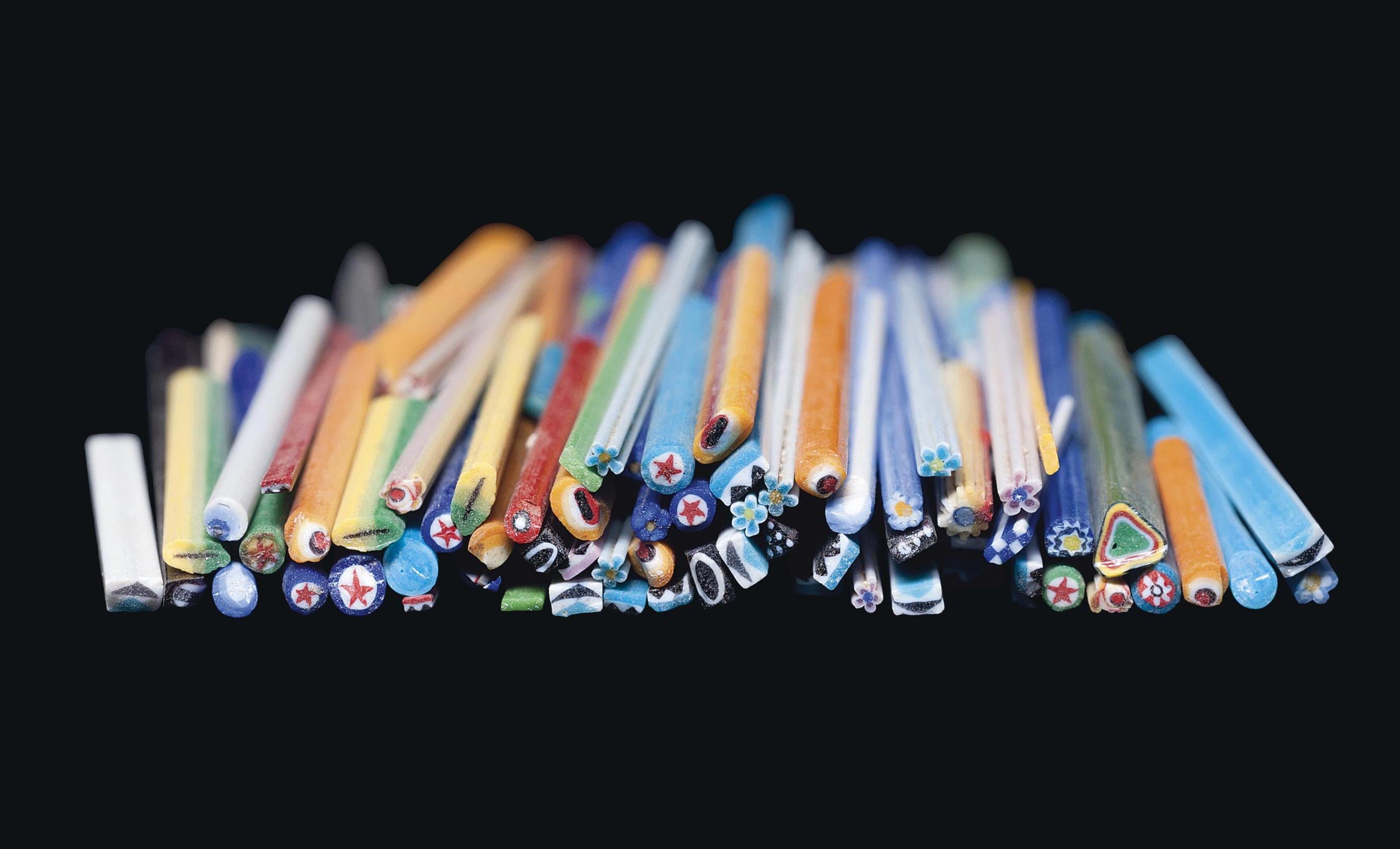
[https://www.britishmuseum.org/blog/glorious-glass-worth-more-gold](https://www.britishmuseum.org/blog/glorious-glass-worth-more-gold) “To create certain designs, Egyptian glassworkers began stretching lumps of glass into long thin rods called canes. These canes could later be re-heated and moulded, and were sometimes used to decorate vessels, or shaped to create earrings.”
Millefiori designs, invented in Egypt, fused slices of rods, which were coloured and patterned in layers, like sticks of rock, to form patterns likened to a thousand flowers – millefiori. [https://www.antiquities.co.uk/shop/ancient-glass/romano-egyptian-millefiori-glass-fragment/](https://www.antiquities.co.uk/shop/ancient-glass/romano-egyptian-millefiori-glass-fragment/)
MiXiaoMi on
This is simply amazing
ArthvrVandal on
Forbidden candy
lotsanoodles on
Estimated at 500 pounds. Sold for 10,600 pounds.
Someone really wanted those glass rods.
Catatafish on
That’s the Blue Star Line logo 🚢
bluehelmet on
It really needed that credible source for me to believe it. Looks exactly like candy before being cut. The estimate seems very low, for a 1,000 pounds, I would have bought it without thinking twice. Really cool!
TroubleMagpie on
I want them. I want them bad.
Edit: I work with glass.
Regeatheration on
Makes me think of that tile maker I think he’s somewhere central or South America but I may be wrong. Makes shapes and tubes stuff like this and makes like a long ass like roll and then cuts slices which are all beautiful scenes on tiles

9 Comments
Do you have a link to the auction page?
[https://www.britishmuseum.org/blog/glorious-glass-worth-more-gold](https://www.britishmuseum.org/blog/glorious-glass-worth-more-gold) “To create certain designs, Egyptian glassworkers began stretching lumps of glass into long thin rods called canes. These canes could later be re-heated and moulded, and were sometimes used to decorate vessels, or shaped to create earrings.”
Millefiori designs, invented in Egypt, fused slices of rods, which were coloured and patterned in layers, like sticks of rock, to form patterns likened to a thousand flowers – millefiori. [https://www.antiquities.co.uk/shop/ancient-glass/romano-egyptian-millefiori-glass-fragment/](https://www.antiquities.co.uk/shop/ancient-glass/romano-egyptian-millefiori-glass-fragment/)
This is simply amazing
Forbidden candy
Estimated at 500 pounds. Sold for 10,600 pounds.
Someone really wanted those glass rods.
That’s the Blue Star Line logo 🚢
It really needed that credible source for me to believe it. Looks exactly like candy before being cut. The estimate seems very low, for a 1,000 pounds, I would have bought it without thinking twice. Really cool!
I want them. I want them bad.
Edit: I work with glass.
Makes me think of that tile maker I think he’s somewhere central or South America but I may be wrong. Makes shapes and tubes stuff like this and makes like a long ass like roll and then cuts slices which are all beautiful scenes on tiles