
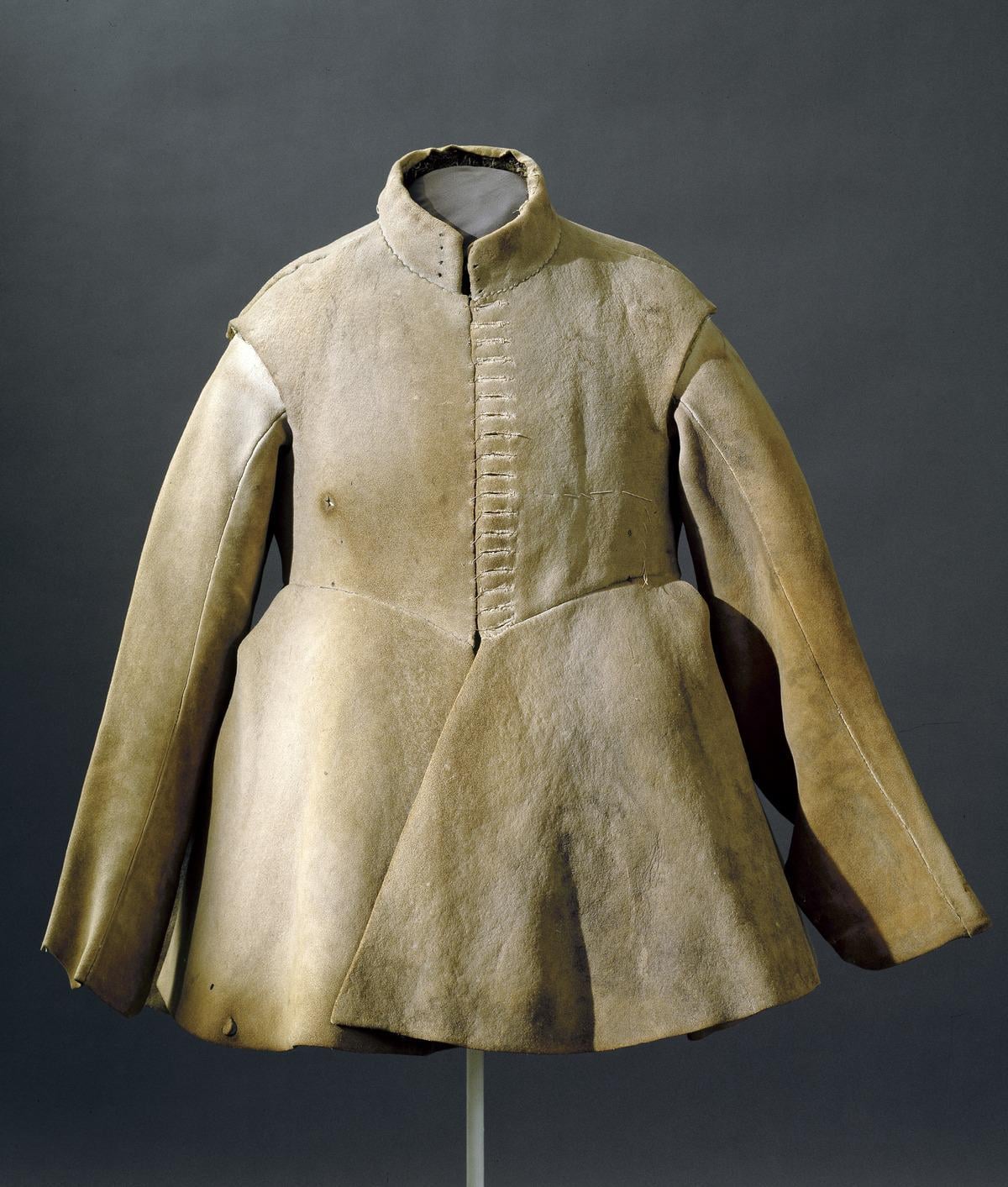
This is the moose leather buff coat worn by Gustavus Adolphus of Sweden when he died at the Battle of Lützen (1632).[1200×1412]
by Tracypop
This is the moose leather buff coat worn by Gustavus Adolphus of Sweden when he died at the Battle of Lützen (1632).[1200×1412]
by Tracypop
7 Comments
On November 6, 1632, King Gustavus Adolphus was shot during the Battle of Lützen, and his body was stripped of his uniform by Imperial cavalry, becoming a war relic.
For nearly 300 years, the jacket was held in Vienna, Austria, as a trophy.
In 1920, Austria returned the coat to Sweden as a gesture of gratitude for services rendered by the Swedish Red Cross to wounded Austrian soldiers during WWI.
>A bullet crushed his left arm below the elbow […] he sustained yet another shot in the back, was stabbed […] a final, fatal shot to the temple.
So the damage on the right breast (left for us) is probably not related.
Maybe derailing the discussion a bit, but as a Swede, I never understood why the practice in English of calling him “Gustavus Adolphus”.
His predecessors of the same dynasty are never called “Gustavus” (Gustav I), “Ericus” (Eric XIV), “Johannes” (John/Johan III), Sigismundus” (Sigismund I), and “Carolus” (Charles/Karl IX), respectively, EVEN THOUGH that’s consistently how their names appear on coins, official inscriptions and declarations.
In fact, most Swedish monarchs used their Latin monikers heavily well into the 18th century. British kings did too. The Jameses of the Stuart family were *Jacobus* in formal Latin, and the Charleses were *Carolus*. But no one would dream of talking about “king *Carolus Secundus* who was executed by parliament”.
Yet English speakers persist in the single case of Gustav II Adolf. My current pet theory is that English speakers are less used to the name “Adolf” and only associate it with a certain Austrian corporal, and thus want to use any kind of alternative there is.
Endless drip. I need this so I can flex on the plebs.
I read “mouse leather” at first and was intensely curious.
Wasn’t there a post that showed a completely different outfit that was blue with the same caption?
Oh moose leather. Rare and valuable back in the day till now.