
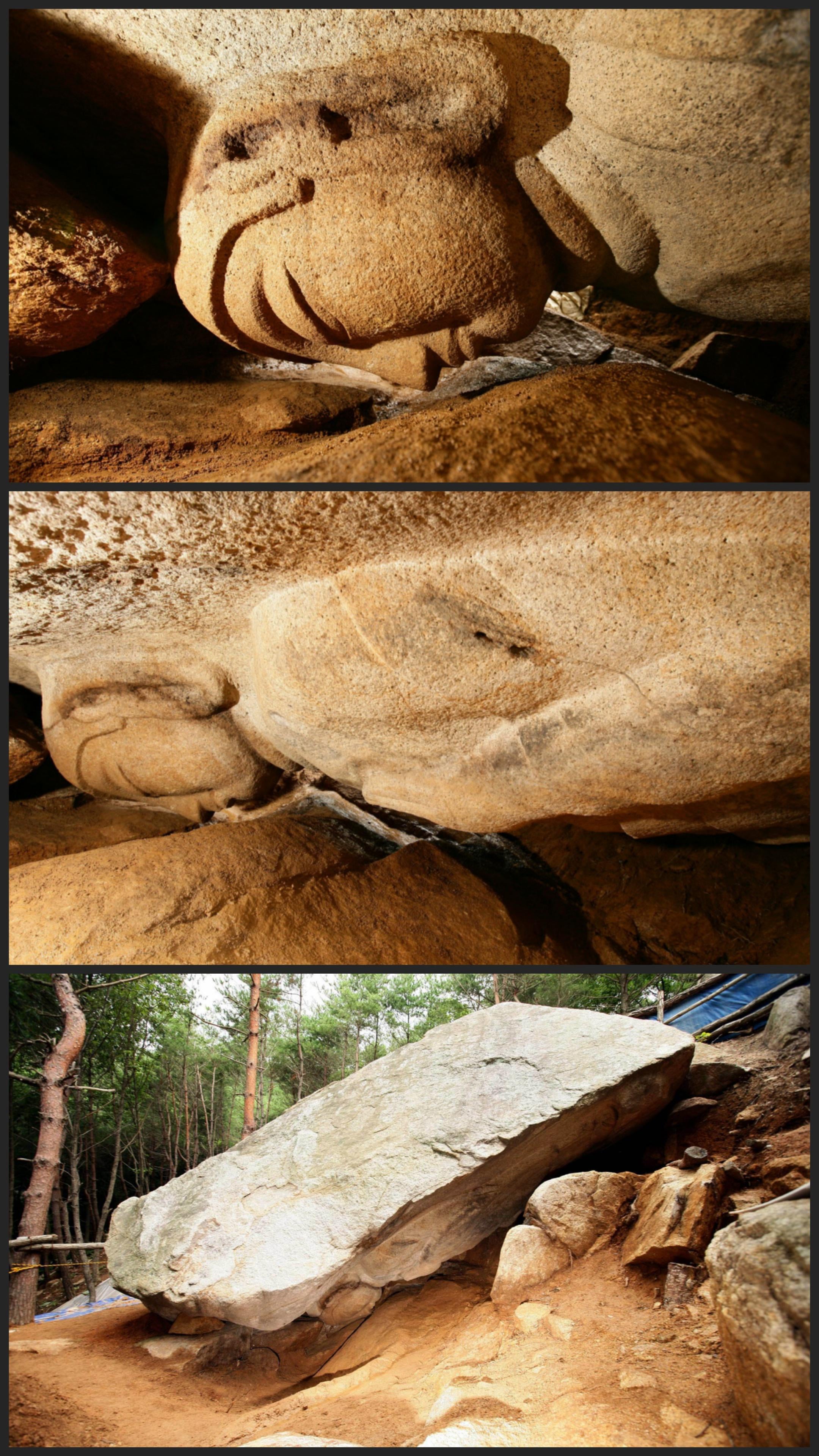
1,300-year-old Silla-era rock-carved Buddha in Yeolamgok Valley, Gyeongju, Korea. The cliff broke off in an earthquake (between 8th–16th c.), but the Buddha was left miraculously intact just 5 cm above ground. Found in 2007, experts are debating on how to raise the 80-ton rock safely. [2160×3840]
by ManiaforBeatles
5 Comments
I feel like it’s cool enough in the position it’s in to keep if, but idk if it will damage it over time
Wow, hadn’t even been discovered yet when I was in Daegu, I definitely would have checked it out
Dude looks pretty chill, given the circumstances.
Leading by example, obviously
Here’s a google translated version of this [Korean newspaper article](https://www.khan.co.kr/article/202211290500001) from 2022;
**A miraculous 5cm-tall Silla Buddha statue found collapsed… Should it be raised?**
Last updated on November 29, 2022, at 6:44 PM
Expand/Collapse
Lee Ki-hwan, historical storyteller
> “The space between the ground and the Buddha statue is only 5cm apart (lls’en est fallu de cinq centimetres)… (Buddhist figures) said it was ‘a miracle.’”
> On September 13, 2007, the French newspaper Le Monde ran an article titled, “Gyeongju’s rock-carved Buddha, which fell over 1,300 years ago, is preserved in its original form…” along with a photo of a large Buddha statue the size of a door on the front page. This Buddha statue is a “large rock-carved Buddha discovered upside down” in Yeolamgok Valley, Namsan Mountain, Gyeongju.
> The scale of the rock-carved Buddha is enormous. The rock on which the Buddha statue is carved measures 4.0 meters wide, 6.8 meters high, and 2.9 meters thick, and weighs a staggering 80 tons.
> It’s a wonder that such a rock could be lodged upside down on a nearly 40-degree slope, and that the Buddha statue’s nose fell just 5 centimeters from the ground. The fact that such a massive body fell so helplessly, yet the tip of its nose remained unscathed, made it a truly sensational topic of international discussion.
■Let’s expose the soil under the huge rock…
> The discovery story was also dramatic. Namsan Mountain in Gyeongju, where the rock-carved Buddha was discovered, has long been known as a “spiritual mountain” where the Buddha Sakyamuni resides.
> Scattered along the 40 or so valleys and mountain ranges flowing from the two peaks of Geumobong (468m) and Gowibong (494m) are some 150 temple sites, 120 stone Buddhas, and 100 stone pagodas. The site where the rock-carved Buddha was discovered is located in Yeolamgok Valley, one of Namsan’s many valleys. Temple sites have existed nearby since ancient times, and at that temple site stands the so-called Yeolamgok Seated Stone Buddha (estimated to be late 8th century, early 9th century), whose head (Buddha head) is severed.
> However, in October 2005, a Namsan Research Institute member (Ms. Lim Hee-sook) surveying the area discovered the head of a seated stone Buddha in a valley about 40 meters below the hill on which it rested. When the head was aligned with the seated stone Buddha, it was a perfect fit. It was the moment when the “separate body, separate head” Buddha statues were united.
> The National Research Institute of Cultural Heritage in Gyeongju began excavating the stone seated Buddha statue and the temple site surrounding it.
> On May 22, 2007, researchers Park So-hee and Chae Mu-gi of the National Research Institute of Cultural Heritage discovered a suspicious rock.
> “I was looking for traces of the old access road leading to the temple site. I found a long rock lying on the southeastern slope, next to a path between piles of rocks of various sizes.” (Park So-hee)
> Sensing an unusual aura, the two men examined the rock’s upper and lower parts. Researcher Park So-hee, half-lying and crawling along the slope between the rocks, caught sight of a jagged, artificial mark.
> “Feeling strange, I cleared away some of the fallen leaves and branches that covered the rock. Then, I put my hand through the crevice and felt the rock’s surface. I could distinctly feel the tactile sensation of the sculpture at my fingertips.”
> The huge stone Buddha statue created during the Unified Silla period miraculously appeared face down.
> As a result of the emergency investigation, the pedestal, both legs, chest, and shoulders of the rock-carved Buddha were properly identified, as well as the ‘Buddha’s face (相好·Sangho).’
> I’ve finally figured out why the tip of the nose barely survived. When the rock-carved Buddha fell, the railings in front of it caused the statue’s body to hit the ground first, avoiding the catastrophe of its face being shattered.
> The oval face of the Buddha statue, which reveals its form, is well expressed with a high nose, sharp eyes, and plump, soft lips.
> The four-headed, standing statue of Buddha carved into the rock has the characteristic of a large head.
> This visual effect was created by considering the sense of proportion when a worshiper looks up at the rock-carved Buddha. The solemnity felt in the voluminous face and sharp eyes is a typical characteristic of Unified Silla Buddhist statues. The Buddha’s clothing is a “pyeondan-u-gyeon” (偏袒右肩), meaning that it exposes the right shoulder. Unlike other Buddhist statues, the feet are fully spread apart.
■Buddha slipped up to 2.5cm in 10 years
> How could such a huge Buddha statue fall forward so easily?
> The surrounding terrain of the Yeol-am Valley Rock Buddha statue offers clues. The statue was discovered on a steep slope of up to 40 degrees. Behind the statue, large and small boulders, broken from an outcrop (where rock is directly exposed to the ground), are piled up like a mountainside littered with rocks. Furthermore, the rock supporting it resembles a rice cake or a radish. It is composed of joints (cracks created by weathering), tors (rock protruding from the ground due to differential weathering), and core stones (rounded, weathered rocks).
> It can be said that these rocks overturned the standing rock-carved Buddha statue, which stood at the very front, by “some force” that pushed it or struck it. That “some force” was most likely an earthquake.
> As we experienced in 2016, the Gyeongju area is home to active faults with a high potential for earthquakes.
> According to the Samguk Sagi (History of the Three Kingdoms), there were 13 earthquakes recorded in Gyeongju between the late 8th and early 9th centuries, when the Yeolamgok Rock Buddhas were created. Among these, the record that “the Gyeongju earthquake in March 779 (the 15th year of King Hyegong’s reign) caused the collapse of people’s houses and the death toll of over 100 people” stands out.
> If this earthquake was the cause, it means that the Yeol-am Valley rock-carved Buddha would have collapsed only a few years after it was created.
> However, there are also studies that estimate it to be from the early Goryeo period or the mid-Joseon period.
> A wad of paper discovered during the dismantling and repair of the Seokgatap Pagoda in 1966 records that “the Seokgatap Pagoda collapsed twice due to the Gyeongju earthquakes in 1024 (the 15th year of King Hyeonjong’s reign) and 1038 (the 4th year of King Jeongjong’s reign).” The powerful earthquakes at those times may have also caused the collapse of the Yeol-am Valley Rock Buddha.
> Furthermore, a 2018 report by the Korea Institute of Construction Technology (KICT) dated the collapse around 1550, based on mineral particles (quartz) exposed to sunlight after earthquakes and other events. According to the Annals of the Joseon Dynasty, eight earthquakes struck Gyeongju between 1521 (the 15th year of King Jungjong’s reign) and 1564 (the 19th year of King Myeongjong’s reign). Landslides triggered by torrential rains or floods could also have contributed to the collapse.
No way did Earth make our Buddha do a Tom Cruise like stunt