When Hernán Cortés entered central Mexico in 1519, he commanded roughly 500 to 600 Spanish soldiers, fewer than 20 horses, and a handful of artillery pieces.
This force alone was militarily incapable of defeating the Aztec (Mexica) Empire, which ruled over 5-6 million people through a tributary system centered on Tenochtitlan.
The decisive shift occurred with the alliance between Cortés and Tlaxcala, a confederation of city-states led by nobles such as Xicotencatl the Elder. Tlaxcala had resisted Mexica expansion for decades and had fought the Spaniards initially, inflicting heavy casualties before choosing alliance over annihilation. This decision was strategic, not submissive.
During the final campaign, from 1520 to 1521, Spanish forces were accompanied by 30,000 to 80,000 Indigenous warriors, primarily Tlaxcalans, with additional support from Texcoco, whose ruler Ixtlilxochitl II defected from the Aztec alliance after internal succession disputes.
By contrast, Spanish troops never exceeded 1,300 men, even after reinforcements arrived.
Leadership of the Mexica also destabilized resistance. Emperor Moctezuma II was captured early in the conflict and died in 1520 under unclear circumstances. His successor Cuitláhuac successfully expelled the Spaniards during La Noche Triste, but died of smallpox only months later.
The final emperor, Cuauhtémoc, led the defense during the siege of Tenochtitlan but faced catastrophic demographic collapse due to epidemic disease.
Smallpox, introduced in 1520, killed an estimated 30-50% of the population in the Valley of Mexico, including experienced warriors and political elites, severely weakening coordination and resistance.
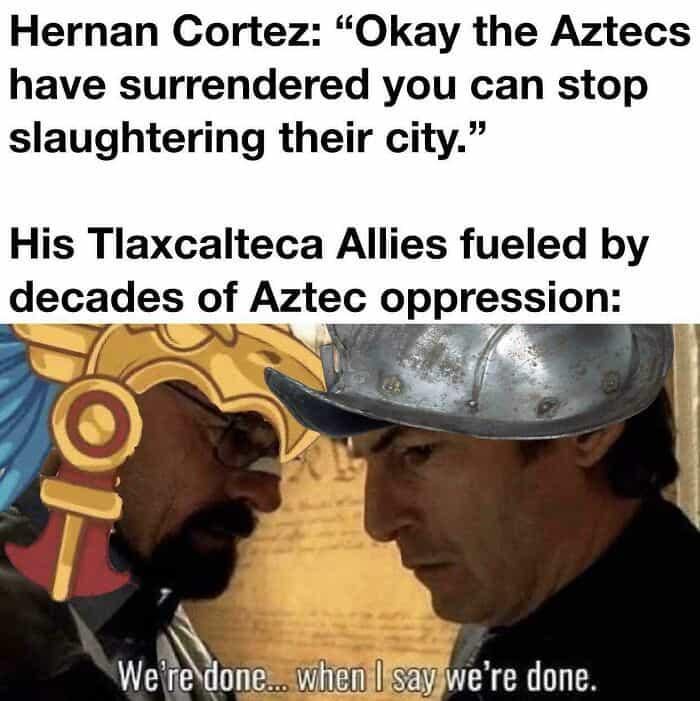
During the siege of Tenochtitlan (May-August 1521), Indigenous allies conducted most of the street fighting, destruction, and killing. Cortés himself repeatedly complained about his inability to restrain Tlaxcalan troops, whose motivations included revenge for decades of tribute extraction, ritual warfare, and captive-taking by the Mexica.
The fall of Tenochtitlan was therefore not a simple case of European technological superiority. It was the result of inter-Indigenous warfare, political fragmentation, strategic alliances, and epidemic disease, with the Spaniards acting as catalysts rather than sole conquerors.
irradihate on
Making conquistadors the most overrated
Adrian_Alucard on
but, but… Reddit says the Aztecs were not oppressors, everybody happily contributed to the human sacrifices
Successful_Gas_5122 on
Local feelings should not be rebuffed
MrWonderz on
I know who you watch on youtube.
National-Frame8712 on
Who could have imagined that keeping other city states “alive” as blood banks to fuel their blood-sacrificing culture would create such a ***bad blood*** between them?
Antique_Historian_74 on
Well that’s the last time I’ll trust Neil Young as an authority on Mesoamerican history.
bmerino120 on
Not to downplay the immorality of the conquistadors but they wanted gold not blood, now the oppressed tribes they did wanted blood
BosmangLoq on
Under Spanish rule the Tlaxcalteca were largely allowed to continue practicing their own religion. Following the defeat of the Aztecs, the four leaders of Tlaxcala’s four cities accepted Christianity and were baptized in July of 1520, through it swearing fealty to the Spanish Crown. They enjoyed privileges which other natives did not- while various other indigenous peoples slaved away in mining riches for the Spanish, the Tlaxcalteca were recognized for the role they had in toppling the Aztec Empire.
The Tlaxcalteca would hold a privileged role in New Spain, which allowed their chief men (principals) to carry guns and ride horses, hold noble titles, maintain Tlaxcalan names and traditions, and also autonomously govern their own barrios. Other Capitulations that the Spanish conceded to the Tlaxcalteca included two years of necessary provisions for Tlaxcaltecans settling northward, and Tlaxcalan settlers and their descendants were declared Hidalgos/noblemen in perpetuity, free from tributes, taxes and personal service for all time.
newnilkneel on
Always fun to hear about Hernan Cortez and Franciso Pissaro
Beautiful-Hair6925 on
“So. You see all that blood they used for sacrifices. Our people”
GCN_09 on
One of the most dangerous weapon in history is someone else’s grievance, btw.
Since the times of the Romans with their auxilia, through the Spanish with the Tlaxcala, the British with their sepoys and princely states in India, polities fall the fastest when the invaders know who already wants the throne burned.
Interesting-Dream863 on
The spanish walked so the english could run… and the americans fly.

13 Comments
When Hernán Cortés entered central Mexico in 1519, he commanded roughly 500 to 600 Spanish soldiers, fewer than 20 horses, and a handful of artillery pieces.
This force alone was militarily incapable of defeating the Aztec (Mexica) Empire, which ruled over 5-6 million people through a tributary system centered on Tenochtitlan.
The decisive shift occurred with the alliance between Cortés and Tlaxcala, a confederation of city-states led by nobles such as Xicotencatl the Elder. Tlaxcala had resisted Mexica expansion for decades and had fought the Spaniards initially, inflicting heavy casualties before choosing alliance over annihilation. This decision was strategic, not submissive.
During the final campaign, from 1520 to 1521, Spanish forces were accompanied by 30,000 to 80,000 Indigenous warriors, primarily Tlaxcalans, with additional support from Texcoco, whose ruler Ixtlilxochitl II defected from the Aztec alliance after internal succession disputes.
By contrast, Spanish troops never exceeded 1,300 men, even after reinforcements arrived.
Leadership of the Mexica also destabilized resistance. Emperor Moctezuma II was captured early in the conflict and died in 1520 under unclear circumstances. His successor Cuitláhuac successfully expelled the Spaniards during La Noche Triste, but died of smallpox only months later.
The final emperor, Cuauhtémoc, led the defense during the siege of Tenochtitlan but faced catastrophic demographic collapse due to epidemic disease.
Smallpox, introduced in 1520, killed an estimated 30-50% of the population in the Valley of Mexico, including experienced warriors and political elites, severely weakening coordination and resistance.
During the siege of Tenochtitlan (May-August 1521), Indigenous allies conducted most of the street fighting, destruction, and killing. Cortés himself repeatedly complained about his inability to restrain Tlaxcalan troops, whose motivations included revenge for decades of tribute extraction, ritual warfare, and captive-taking by the Mexica.
The fall of Tenochtitlan was therefore not a simple case of European technological superiority. It was the result of inter-Indigenous warfare, political fragmentation, strategic alliances, and epidemic disease, with the Spaniards acting as catalysts rather than sole conquerors.
Making conquistadors the most overrated
but, but… Reddit says the Aztecs were not oppressors, everybody happily contributed to the human sacrifices
Local feelings should not be rebuffed
I know who you watch on youtube.
Who could have imagined that keeping other city states “alive” as blood banks to fuel their blood-sacrificing culture would create such a ***bad blood*** between them?
Well that’s the last time I’ll trust Neil Young as an authority on Mesoamerican history.
Not to downplay the immorality of the conquistadors but they wanted gold not blood, now the oppressed tribes they did wanted blood
Under Spanish rule the Tlaxcalteca were largely allowed to continue practicing their own religion. Following the defeat of the Aztecs, the four leaders of Tlaxcala’s four cities accepted Christianity and were baptized in July of 1520, through it swearing fealty to the Spanish Crown. They enjoyed privileges which other natives did not- while various other indigenous peoples slaved away in mining riches for the Spanish, the Tlaxcalteca were recognized for the role they had in toppling the Aztec Empire.
The Tlaxcalteca would hold a privileged role in New Spain, which allowed their chief men (principals) to carry guns and ride horses, hold noble titles, maintain Tlaxcalan names and traditions, and also autonomously govern their own barrios. Other Capitulations that the Spanish conceded to the Tlaxcalteca included two years of necessary provisions for Tlaxcaltecans settling northward, and Tlaxcalan settlers and their descendants were declared Hidalgos/noblemen in perpetuity, free from tributes, taxes and personal service for all time.
Always fun to hear about Hernan Cortez and Franciso Pissaro
“So. You see all that blood they used for sacrifices. Our people”
One of the most dangerous weapon in history is someone else’s grievance, btw.
Since the times of the Romans with their auxilia, through the Spanish with the Tlaxcala, the British with their sepoys and princely states in India, polities fall the fastest when the invaders know who already wants the throne burned.
The spanish walked so the english could run… and the americans fly.