
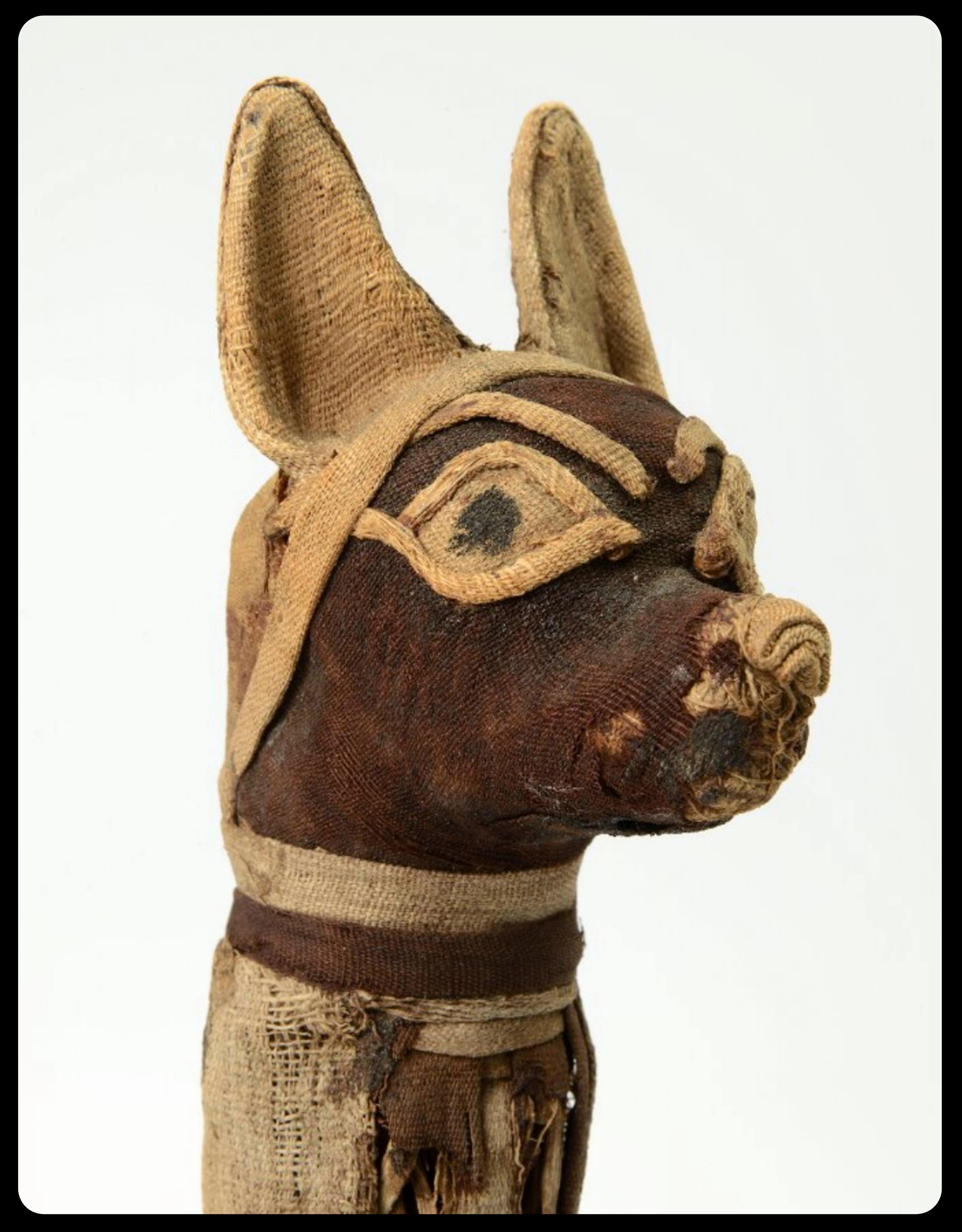
Mummified Jackal or Dog from Egypt, c.100 CE: this mummified canine is wrapped in beige and dark brown bandages that mimic the pattern of the animal’s fur, and it measures 340mm (about 13 inches) tall [4010×5134]
by SixteenSeveredHands
Mummified Jackal or Dog from Egypt, c.100 CE: this mummified canine is wrapped in beige and dark brown bandages that mimic the pattern of the animal’s fur, and it measures 340mm (about 13 inches) tall [4010×5134]
by SixteenSeveredHands
1 Comment
According to [the Oriental Museum at Durham University:](https://discover.durham.ac.uk/permalink/44DUR_INST/k3s6qp/alma991010503876907366)
> From the 26th Dynasty (664-525 BCE) onwards it became increasingly common for Egyptians to use mummified animals as a form of temple offering. This mummified dog is wrapped in bandages of light and dark brown linen to imitate the pattern of dog’s fur. The eyes and brows are modelled in linen and painted black. Dogs were associated with gods who protected the mummification process and the necropolis.
[This article](https://www.bigissuenorth.com/centre-stage/2016/11/preview-animal-mummies-revealed/) also describes the religious context:
> Specific animals were associated with specific gods in ancient Egypt, where citizens regularly visited temples and made a donation that paid for the wrapping and burial of an animal on their behalf. The deceased creature would then act as an offering, a way of communicating between the living and the gods whilst also providing oracular powers. Visitors would sleep overnight in a dormitory at the temple and the next day the priests would analyse their dreams.
This particular mummy measures 340mm tall (about 13 inches). You can see more photos of it [here.](https://iiif.durham.ac.uk/index.html?manifest=a725&canvas=35441)
#Sources & More Info:
– The Oriental Museum: [Jackal Mummy](https://discover.durham.ac.uk/permalink/44DUR_INST/k3s6qp/alma991010503876907366)
– Big Issue North: [Preview: Animal Mummies Revealed](https://www.bigissuenorth.com/centre-stage/2016/11/preview-animal-mummies-revealed/)
– The Ancient Egyptians and the Animal World: [To Be or Not to Be a Dog Mummy](https://www.researchgate.net/publication/356345314_To_Be_or_Not_to_Be_a_Dog_Mummy_How_a_Metric_Study_of_the_Skull_Can_Inform_on_Selection_Practices_Pertaining_to_Canid_Mummification_in_Ancient_Egypt)