
Hello again, everyone!
A while ago, someone asked about our Seleucid coins. Indeed, we have a fine collection of those, especially in terms of quality, as de Hirsch and du Chastel, our two 19th-century aesthetics, had a penchant for beautiful portraits. Seleucid coins are, of course, renowned for their ruler portraits and the immense variety they offer in terms of iconography and mints (especially when the bronze coinage is included, of which we also have a good collection, thanks to the acquisition of the collection of Marc Bar).
For those unfamiliar with the Seleucids, their history in a nutshell. Through clever political manoeuvring, Seleukos I, one of the companions of Alexander the Great, managed to claim the largest part of Alexander’s former empire, at least in terms of territory. By and large, the Seleucid Empire coincided with the former Achaemenid Empire, including wealthy regions such as Mesopotamia and Bactria. Holding this empire together, stretching as it did from western Asia Minor to Central Asia, was a tremendous challenge, however, and little by little, the Seleucids lost ground, especially as the Parthians encroached from the East and the Romans from the West. While the Seleucid dynasty produced plenty of weak and villainous rulers, some were cut from different cloth. One such man was Antiochos III (223-187 BCE), also known as ‘the Great’.
Antiochos III inherited a weakened empire, but he was, as they say, a man with a plan. After some obligatory warring with the Ptolemies and dynastic strife in Asia Minor, he turned his attention to the eastern part of the Seleucid realm (212-205 BCE). Parthia and Bactria had broken away from royal authority during the previous decades, and Antiochos now quickly subdued both. Like Alexander before him, he reached India, where he successfully managed to obtain war elephants from the local ruler, Sophagasenus. In 2014, Paul Kosmin published a book about the Seleucid Empire titled ‘The Land of the Elephant Kings’, in which he investigated the shaping of Seleucid royal ideology and how they forged a more or less coherent political entity out of very disparate regions.
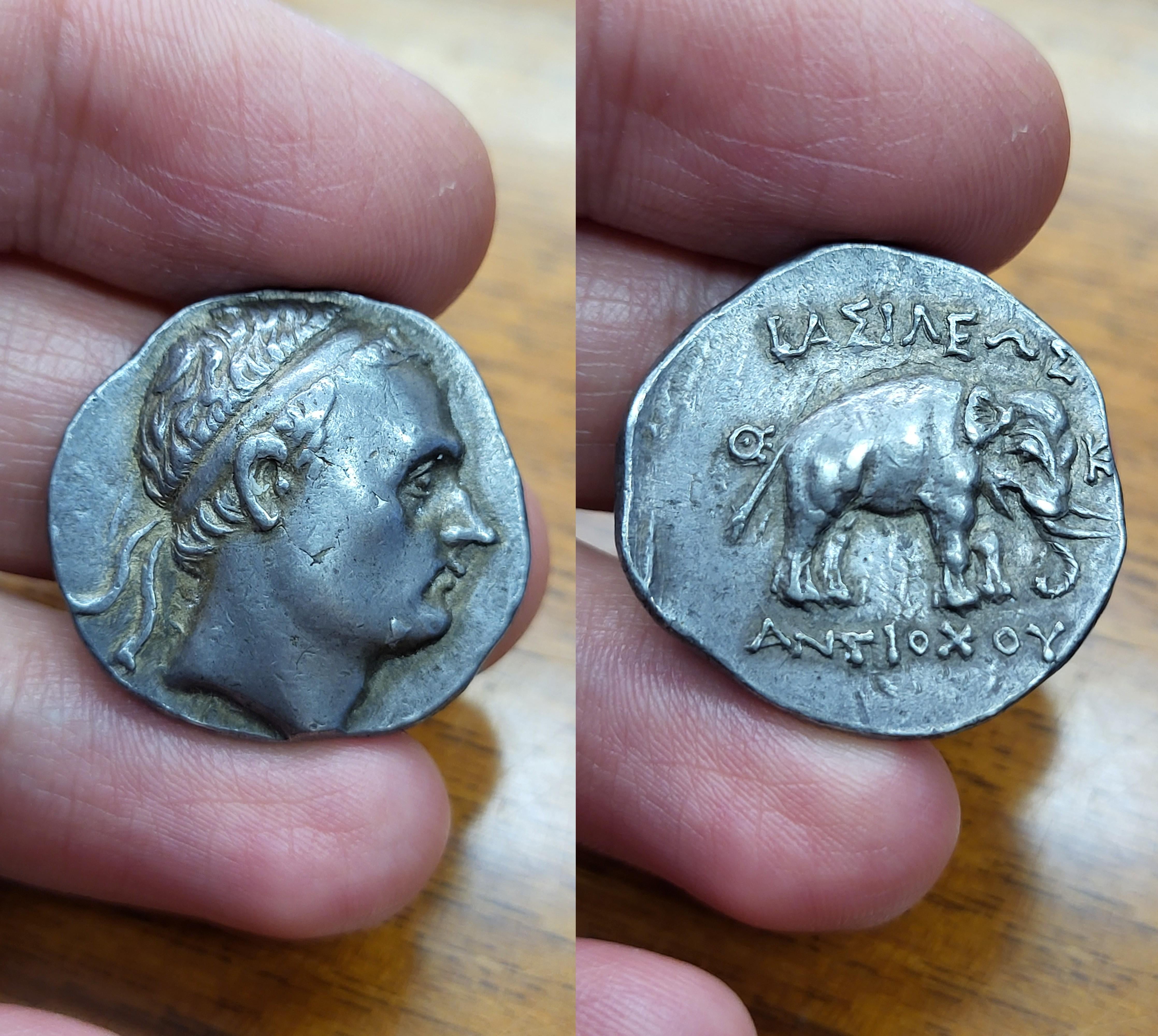
As the title of Kosmin’s book implies, elephants were an important symbol of royal authority. Elephants are sometimes considered the “battle tanks” of Hellenistic warfare – hyperbole notwithstanding, Hellenistic kings such as the Seleucids and the Ptolemies spared no expense to acquire them for their armies. Under Seleukos I, Strabo tells us (16.2.10), an elephant corps of no less than 500 animals was stationed at Apameia on the Orontes. The importance of elephants is also seen in the Seleucid coinage. A fine example are tetradrachms such as this one, which feature the portrait of Antiochos III (admittedly, not the best portrait) on the obverse and a fearsome elephant on the reverse. The exact mint isn’t known, but, perhaps, it was minted at Apameia – it would certainly be most apt! It comes from the collection of Lucien de Hirsch, who acquired it from Lambros in 1879, a very old pedigree for a Seleucid coin!
Alas, Antiochos’ successes in the East and Coile-Syria could not be replicated in Asia Minor. After invading Greece, the king was repelled by the Roman Republic, who dealt a decisive blow to the Seleucids at the Battle of Magnesia (190 BCE), effectively signalling the collapse of Seleucid power in Asia Minor. By the 1st century BCE, being hemmed in between Rome and Parthia, the Seleucid realm was reduced to a petty state in Syria. The dynasty may have started with a bang but it surely ended with a whimper.
by KBRCoinCabinet