
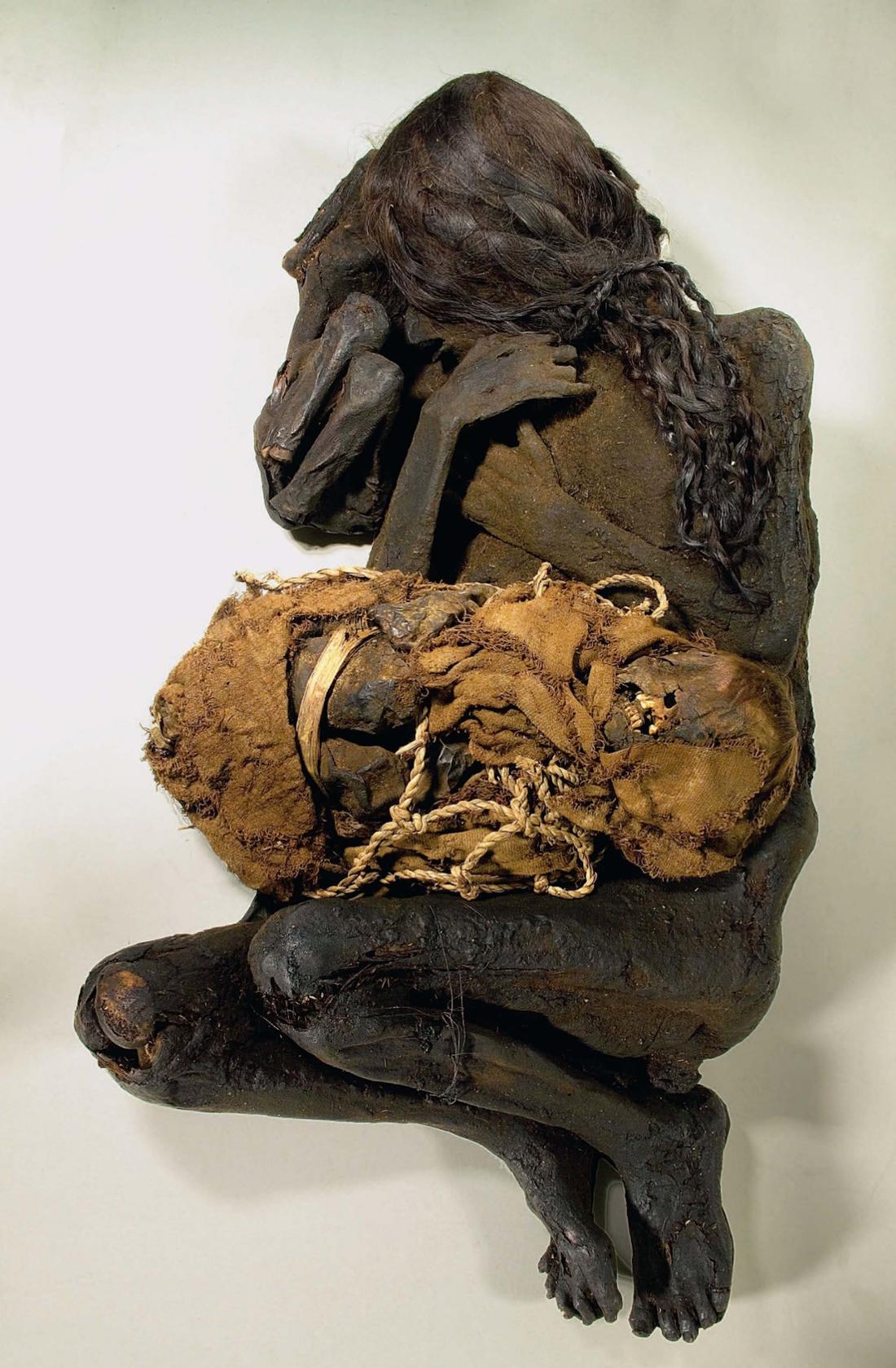
A female mummy with children, from northern Chile. Her head is resting on a child mummy, while another one lies in the woman’s lap. 11th-14th century CE [1100×1679]
by Fuckoff555
A female mummy with children, from northern Chile. Her head is resting on a child mummy, while another one lies in the woman’s lap. 11th-14th century CE [1100×1679]
by Fuckoff555
11 Comments
11th-14th century? This is organic matter and the best dating has a 300yr spread?
Any info on this and a hypothesis as to why they were buried like this or what circumstances it was that all three died with?
This is heartbreaking I don’t wanna even imagine why they were mummified like this🥺
Chile has natural mummies dried out by desert air.
The Chinchorro mummies are mummified remains of individuals from the South American Chinchorro culture, found in what is now northern Chile.
Is that a ligature around her left knee or was that put there recently to hold her leg together?
This particular woman and children is so poignant. Most of the mummies I’ve read about are children or women, buried alone.
this type of mummies make me so sad… like the Llullaillaco mummies…
Heartbreakingly beautiful, and her hair is gorgeous.
A reverse image search suggests this trio may be held in a German museum and form part of a long-term research study called the German Mummy Project. Here is an excerpt from an article in Nature (Sept 2018):
“Among the most extensively studied of the rediscoveries are the remains of a woman with two small children, one laid on her stomach. Anthropologists had assumed that the child had been placed there relatively recently, because its binding cloth seemed much fresher in colour than those of the other bodies. But carbon dating and computerized tomography (CT) scans showed that all three dated to the medieval period, before Europeans entered South America; that the woman probably died in her early thirties; and that the children were toddlers. A sample from the woman’s intestine showed traces of the bacterium Helicobacter pylori, which causes gastric diseases, and arracacha, an Andean root vegetable.
In July, the team found that the younger child had an over-expanded chest and a blockage in her windpipe, indicating that she probably choked to death. A sample of the foreign material is now undergoing histological and molecular analysis at the Institute for Mummy Studies in Bolzano, Italy (the city in which Ötzi rests). Institute director Albert Zink says that identification should be completed in time to update the exhibition before it ends.”
Andean mummies (with some exceptions) are naturally preserved by the dry desert climate on the coast. These individuals would have been wrapped when buried, but were probably unwrapped when they were brought into the museum collection. It could also be that the textiles do not provide clues to the culture or time to which they belonged, hence the brought dates.
It’s the braid in her hair, the cloths her children were wrapped in. The story of her last day where she got up fixed her hair, ate something, woke her children up, fed them wrapped them in the cloth. At the same time she was feeling sick as a dog and had two babies with her she was watching over. I can’t imagine what she was thinking… why god was punishing her? her worry about her poor children that were so young. Who would take care of them if she passed ahhhh
Thinking about her and her babies in their last day or moments chokes me up. So much pain and emotion…
It’s incredible how intact she is. I’m in my thirties and can only dream of my knees being as intact as this centuries-old thirty-something.