
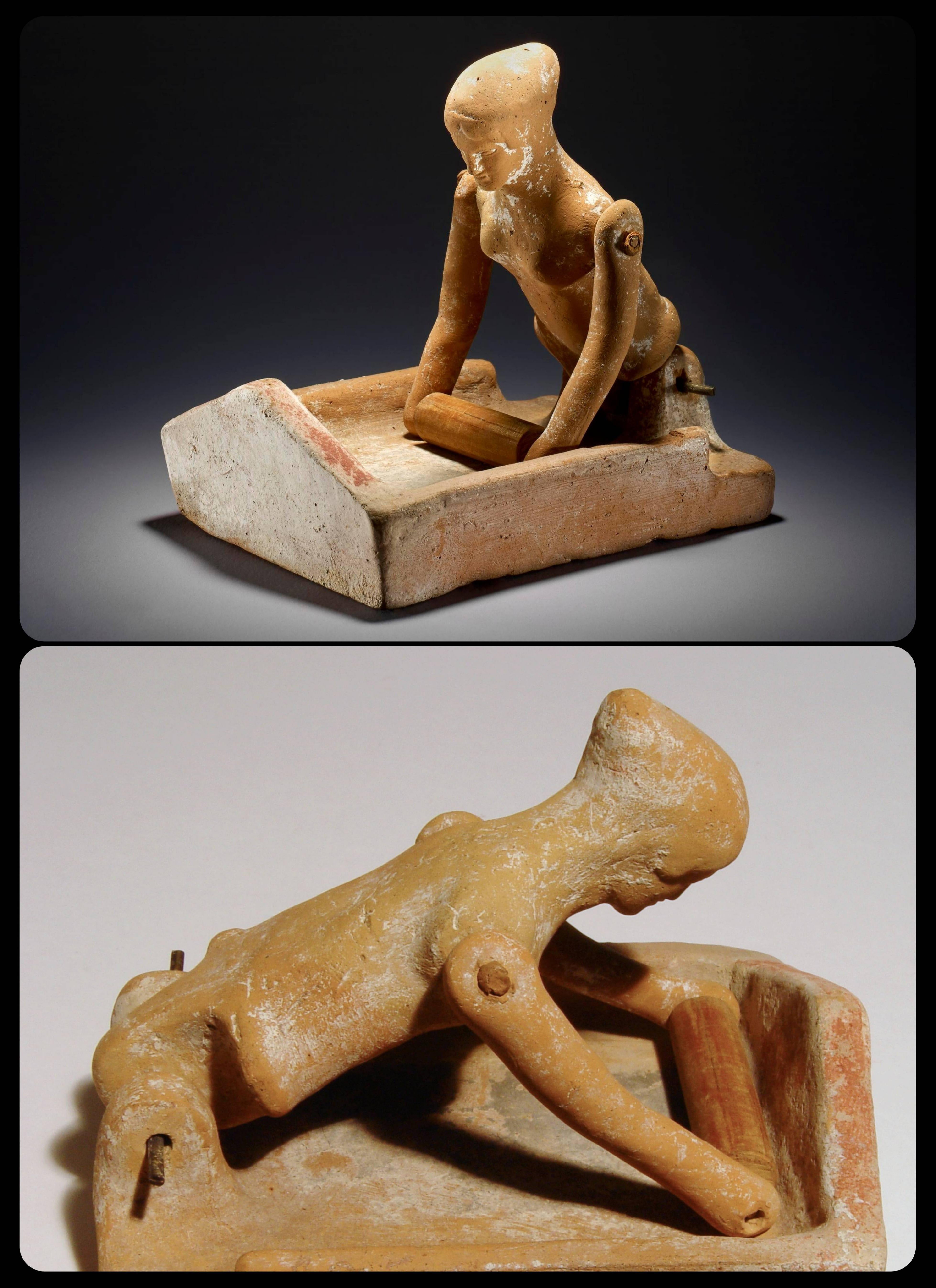
Toy from Ancient Greece, c.450 BCE: this doll was crafted in the form of a woman with a rolling pin, and it has articulated joints that allow the rolling pin to be pushed back and forth [3914×5387]
by SixteenSeveredHands
Toy from Ancient Greece, c.450 BCE: this doll was crafted in the form of a woman with a rolling pin, and it has articulated joints that allow the rolling pin to be pushed back and forth [3914×5387]
by SixteenSeveredHands
4 Comments
This terracotta figurine was created nearly 2,500 years ago, and it was likely designed as a toy. The doll is positioned above a small tray, and its torso is equipped with a set of pins (located in the waist and shoulders) that allow the figure to lean up and down, gently pushing the rolling pin back and forth across the tray as if preparing food.
This is not the only known example of an articulated doll from ancient Greece. Many so-called “dancing dolls” (also known as *plangones*) were created throughout the Greco-Roman world.
As [this book](https://archive.org/details/comingofageinanc0000neil/page/267/mode/1up?q=%22Jointed+dolls%22) explains:
> Female dolls with attached limbs known as *plangones, korai,* or *nymphai* were made in numerous areas in Greece over a considerable span of time from the Geometric to the Hellenistic periods. Male dolls also exist but were far less popular. Although made out of a wide range of materials, including wood, bone, ivory, marble, wax, cloth, and alabaster, dolls of terracotta are by far the most common.
The same book goes on to describe [some of the other toys](https://archive.org/details/comingofageinanc0000neil/page/264/mode/1up?q=%22In+antiquity+play+was%22) that were created and used by the ancient Greeks:
> In antiquity, play was as much an integral part of growing up as it is today, and the ancient Greeks possessed a wide variety of toys and games. Both the archaeological record and ancient literature provide information about these, only some of which overlaps. The most common toys preserved include rattles, dolls, knucklebones, figurines, miniature vessels, miniature furniture, and miniature animals, some of which are wheeled and some of which have riders. Less common are balls and wheeled carts.
> Depictions on vases and sculpture expand the repertoire for these objects, showing children playing with tops, yo-yos, hoops, see-saws, swings, and miniature chariots — mostly toys made of wood, a perishable material, which is why they are no longer preserved. Literature tells us of others, such as kites, rocking horses, and boats, and makes clear that many toys were homemade rather than bought.
#Sources & More Info:
– The British Museum: [Toy](https://www.britishmuseum.org/collection/object/G_1864-1007-136)
– Coming of Age in Ancient Greece: Images of Childhood from the Classical Past: [Jointed Dolls](https://archive.org/details/comingofageinanc0000neil/page/267/mode/1up?q=%22Jointed+dolls%22) and [Play](https://archive.org/details/comingofageinanc0000neil/page/264/mode/1up?q=%22In+antiquity+play+was%22)
– American Journal of Archaeology: [Jointed Dolls in Antiquity](https://www.jstor.org/stable/498710?seq=1)
– Metropolitan Museum of Art: [Bone Figurine with Articulated Limbs](https://www.metmuseum.org/art/collection/search/248624)
– University of Friboug: [From Greece to Rome: Toys for Growing Up?](https://folia.unifr.ch/documents/305158/files/De_la_Grece_a_Rome_Des_jouets_pour_gran.pdf) (PDF in French)
– Cambridge University Press: [Ritual, Play, and Belief in Evolution and Early Human Societies](https://www.researchgate.net/publication/321648777_Ritual_Play_and_Belief_in_Evolution_and_Early_Human_Societies)
That’s very interesting. Thanks for posting that.
Proof that even 2,500 years ago, kids were out here role playing chores before actually doing them.
Wild to think some kid in 450 BCE was probably annoyed their doll’s rolling pin jammed mid‑pretend bread session.