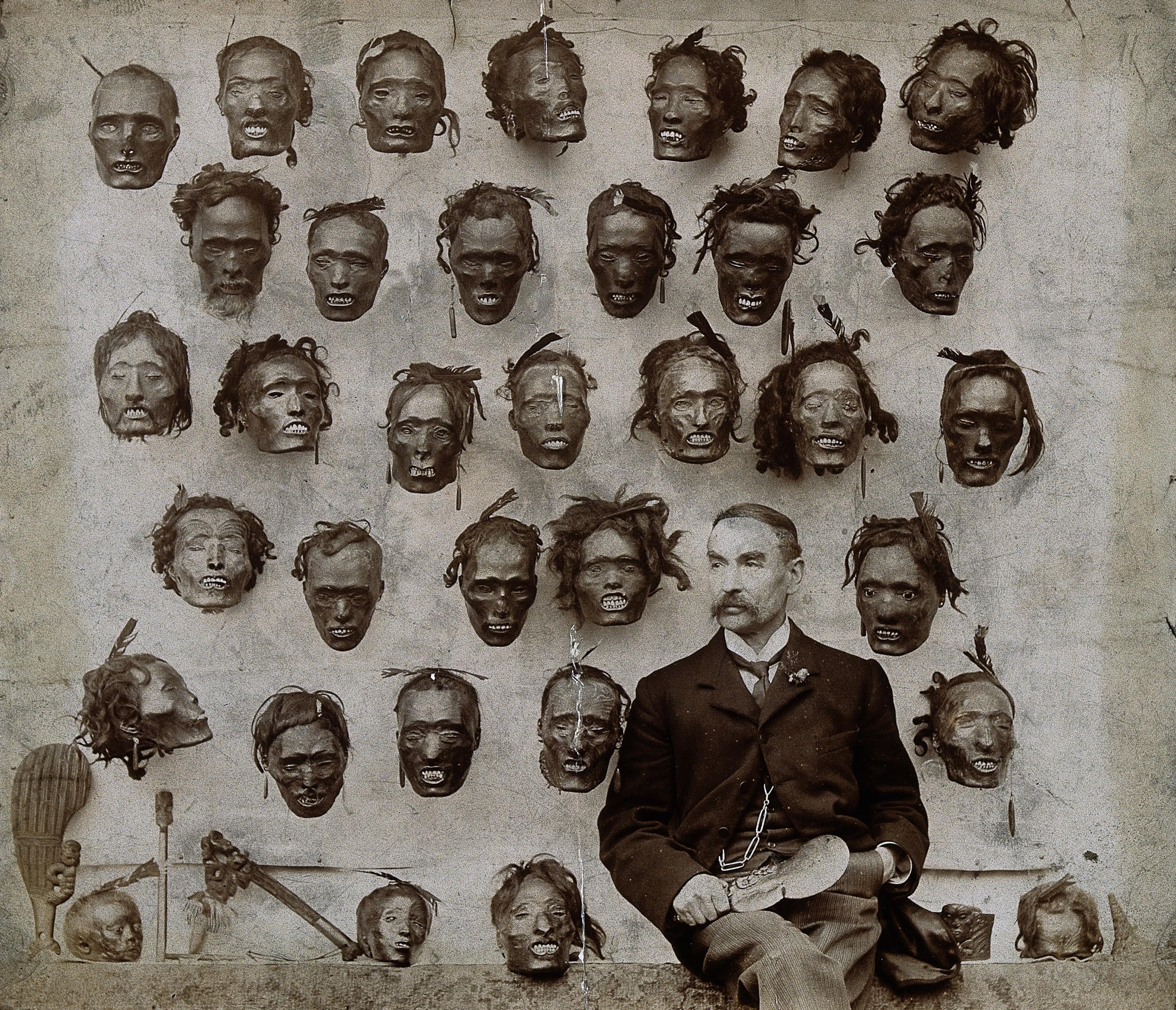
Imagine you didn’t know about his collection and you walked into this room. What would you say?
gmred91 on
I would personally choose other hobbies.
DanishWhoreHens on
OMG, at least two are children. I don’t care what his personal reason for collecting severed heads was I hope he’s currently enjoying a case of bleeding piles in Hell and has to wipe with gravel.
crystalline1299 on
What a psycho
PoopthInPanth on
The original funko pops.
SugarTurkey on
Erm… what the fuck?
ApolloShuttlesworth on
Peculiar hobby
BroBroMate on
Pokémon Go, 1800s style.
Youasking on
He gave the worst Christmas gifts!
TheDreamteller on
What a piece of shit.
Quirky-Cap3319 on
Horrific. They also all seem to be of the same ethnicity.
JustSomeRandomGuy36 on
based
ineedtopeebutnocando on
Toi moko, or mokomokai, are the preserved heads of Māori, the indigenous people of New Zealand, where the faces have been decorated by tā moko tattooing. They became valuable trade items during the Musket Wars of the early 19th century. Many toi moko were taken from their family and homeland as trophies. Repatriation efforts are underway by Te Papa and Te Herekiekie Haerehuka Herewini to return toi moko to their descendants.
There are local rumors that both British and Maori headhunted during this time to make ‘imitation’ heads to be sold overseas
LateralEntry on
I just read about him, it looks like he may have collected these heads by trading with Māori people in New Zealand, and didn’t actually kill any of these people himself. Still super weird.
He also collected sketches of Māori tattoos.
Hopeful-Function4522 on
From Wikipedia:
Robley was a British army officer and artist who served in New Zealand during the New Zealand Wars in the 1860s. He was interested in ethnology and fascinated by the art of tattooing. He wrote Moko; or Maori Tattooing, which was published in 1896. After he returned to England he built up a collection of 35 to 40 mokomokai which he later offered to sell to the New Zealand Government. When the offer was declined, most of the collection was sold to the American Museum of Natural History.[9] The collection was repatriated to Te Papa Tongarewa in 2014.[10]
Mokomokai
When someone with moko died, often the head would be preserved. The brain and eyes were removed, with all orifices sealed with flax fibre and gum. The head was then boiled or steamed in an oven before being smoked over an open fire and dried in the sun for several days. It was then treated with shark oil. Such preserved heads, toi moko, would be kept by their families in ornately carved boxes and brought out only for sacred ceremonies.[3]
The heads of enemy chiefs killed in battle were also preserved; these toi moko, being considered trophies of war, would be displayed on the marae and mocked. They were important in diplomatic negotiations between warring tribes, with the return and exchange of mokomokai being a bargaining chip as well as an essential precondition for peace.[1]: 3–4
These are Maori toi moko and must be understood in the context of Maori culture and beliefs. The severed heads of ancestors were preserved and honored; the severed heads of enemies were preserved so as to retain power over their spirits. The significance of severing heads was due to the profound importance of moko (facial tattoos) which recorded and displayed ancestral lineage; the tattoos indicated mana (prestige, spiritual power).
This was an ancient practice in traditional (pre-European contact) Maori culture, later revived and commercialized to meet demand from European collectors, museums et al.
ThrowawayWlmrtWorker on
> Continuing with writing after his retirement, he returned to his interest in tattoos and wrote two books relating to his time in New Zealand, Moko or Maori Tattooing in 1896 and Pounamu: Notes on New Zealand Greenstone. In the first book, as well as demonstrating and explaining the art of Māori tattooing, he also wrote chapters on the dried tattooed heads known as Mokomokai. Robley decided to acquire as many examples of Mokomokai as possible, and at length built up a unique collection of 35 heads. In 1908 he offered them to the New Zealand Government for £1,000; his offer, however, was refused. Later, with the exception of the five best examples which Robley retained, the collection was purchased by the American Museum of Natural History, New York, for the equivalent of £1,250.[15]
Direct source [15] on Wikipedia (not sure how the sub handles archival links)
Just search up his name, he collected them but he didn’t kill people the people to get these, weird to collect either way though.

24 Comments
Imagine you didn’t know about his collection and you walked into this room. What would you say?
I would personally choose other hobbies.
OMG, at least two are children. I don’t care what his personal reason for collecting severed heads was I hope he’s currently enjoying a case of bleeding piles in Hell and has to wipe with gravel.
What a psycho
The original funko pops.
Erm… what the fuck?
Peculiar hobby
Pokémon Go, 1800s style.
He gave the worst Christmas gifts!
What a piece of shit.
Horrific. They also all seem to be of the same ethnicity.
based
Toi moko, or mokomokai, are the preserved heads of Māori, the indigenous people of New Zealand, where the faces have been decorated by tā moko tattooing. They became valuable trade items during the Musket Wars of the early 19th century. Many toi moko were taken from their family and homeland as trophies. Repatriation efforts are underway by Te Papa and Te Herekiekie Haerehuka Herewini to return toi moko to their descendants.
There are local rumors that both British and Maori headhunted during this time to make ‘imitation’ heads to be sold overseas
I just read about him, it looks like he may have collected these heads by trading with Māori people in New Zealand, and didn’t actually kill any of these people himself. Still super weird.
He also collected sketches of Māori tattoos.
From Wikipedia:
Robley was a British army officer and artist who served in New Zealand during the New Zealand Wars in the 1860s. He was interested in ethnology and fascinated by the art of tattooing. He wrote Moko; or Maori Tattooing, which was published in 1896. After he returned to England he built up a collection of 35 to 40 mokomokai which he later offered to sell to the New Zealand Government. When the offer was declined, most of the collection was sold to the American Museum of Natural History.[9] The collection was repatriated to Te Papa Tongarewa in 2014.[10]
Mokomokai
When someone with moko died, often the head would be preserved. The brain and eyes were removed, with all orifices sealed with flax fibre and gum. The head was then boiled or steamed in an oven before being smoked over an open fire and dried in the sun for several days. It was then treated with shark oil. Such preserved heads, toi moko, would be kept by their families in ornately carved boxes and brought out only for sacred ceremonies.[3]
The heads of enemy chiefs killed in battle were also preserved; these toi moko, being considered trophies of war, would be displayed on the marae and mocked. They were important in diplomatic negotiations between warring tribes, with the return and exchange of mokomokai being a bargaining chip as well as an essential precondition for peace.[1]: 3–4
https://en.wikipedia.org/wiki/Toi_moko
u/bot-sleuth-bot
Autism isn’t a new thing
These are Maori toi moko and must be understood in the context of Maori culture and beliefs. The severed heads of ancestors were preserved and honored; the severed heads of enemies were preserved so as to retain power over their spirits. The significance of severing heads was due to the profound importance of moko (facial tattoos) which recorded and displayed ancestral lineage; the tattoos indicated mana (prestige, spiritual power).
This was an ancient practice in traditional (pre-European contact) Maori culture, later revived and commercialized to meet demand from European collectors, museums et al.
> Continuing with writing after his retirement, he returned to his interest in tattoos and wrote two books relating to his time in New Zealand, Moko or Maori Tattooing in 1896 and Pounamu: Notes on New Zealand Greenstone. In the first book, as well as demonstrating and explaining the art of Māori tattooing, he also wrote chapters on the dried tattooed heads known as Mokomokai. Robley decided to acquire as many examples of Mokomokai as possible, and at length built up a unique collection of 35 heads. In 1908 he offered them to the New Zealand Government for £1,000; his offer, however, was refused. Later, with the exception of the five best examples which Robley retained, the collection was purchased by the American Museum of Natural History, New York, for the equivalent of £1,250.[15]
Direct source [15] on Wikipedia (not sure how the sub handles archival links)
Just search up his name, he collected them but he didn’t kill people the people to get these, weird to collect either way though.
God forbid a man has hobbies
Maybe a spoiler blur?
So uhhh not gonna mark that one NSFW, huh?
What the fuck?