> On the day the Nazis came to Copenhagen, a Hungarian chemist named Georgy de Hevesy (he would one day win a Nobel of his own) was working in Bohr’s lab. He wrote later, “I suggested that we should bury the medal(s),” but Bohr thought no, the Germans would dig up the grounds, the garden, search everywhere in the building. Too dangerous.
> > I decided to dissolve it.
> > Georgy de Hevesy
> So Hevesy’s thoughts turned to chemistry. Maybe he could make the medals disappear. He took the first one, he says, and “I decided to dissolve it. While the invading forces marched in the streets of Copenhagen, I was busy dissolving Laue’s and also James Franck’s medals.”
> This was not an obvious solution, since gold is a very stable element, doesn’t tarnish, doesn’t mix, and doesn’t dissolve in anything — except for one particular chemical emulsifier, called “aqua regia,” a mixture of three parts hydrochloric acid and one part nitric acid.
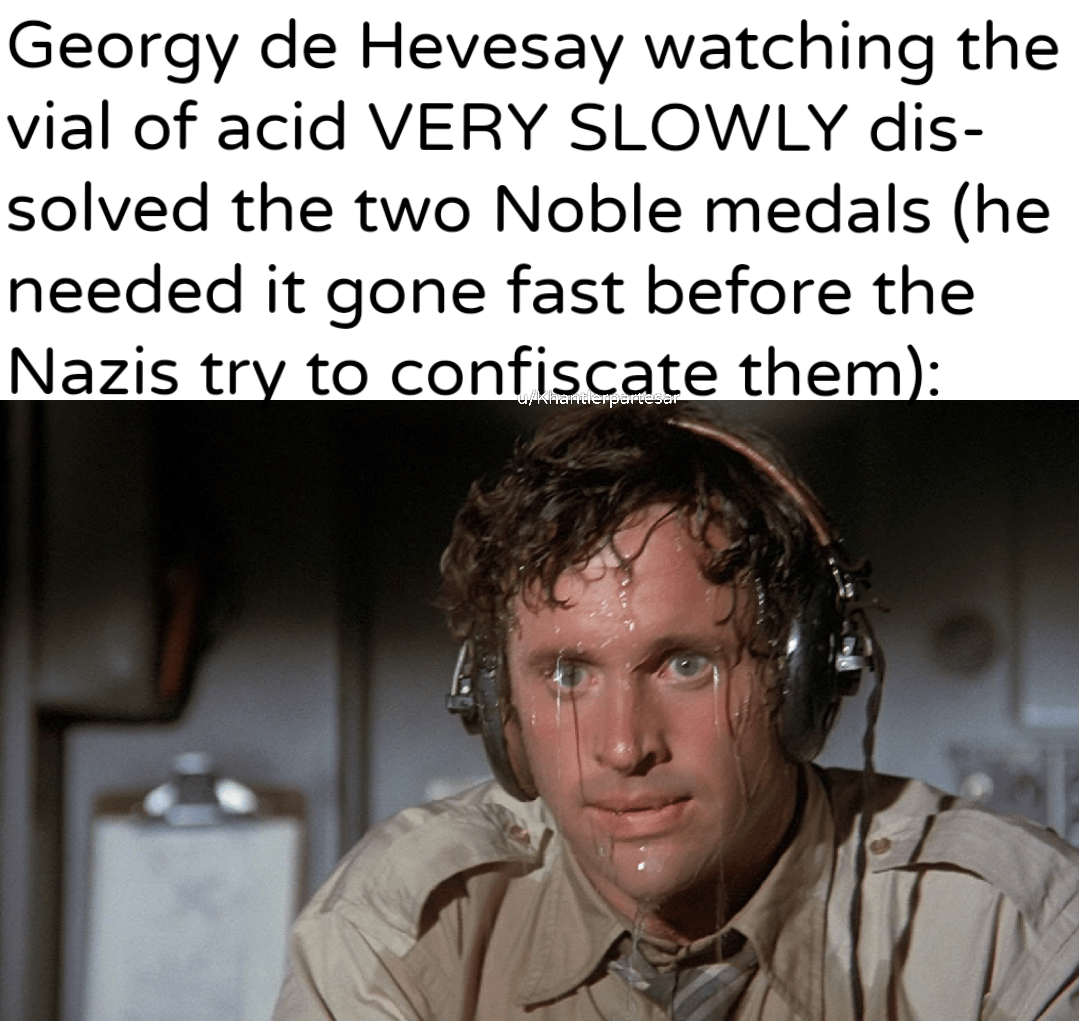
> It must have been an excruciating afternoon. De Hevesy, in his autobiography, says because gold is “exceedingly unreactive and difficult to dissolve,” it was slow going, but as the minutes ticked down, both medals were reduced to a colorless solution that turned faintly peach and then bright orange. By the time the Nazis arrived, both awards had liquefied inside a flask that was then stashed on a high laboratory shelf. Then, says science writer (and Radiolab contributor) Sam Kean, in his book The Disappearing Spoon:
> > …When the Nazis ransacked Bohr’s institute, they scoured the building for loot or evidence of wrongdoing but left the beaker of orange aqua regia untouched. Hevesy was forced to flee to Stockholm in 1943, but when he returned to his battered laboratory after V-E Day, he found the innocuous beaker undisturbed on a shelf.
> Back in Denmark, de Hevesy did a remarkable thing. He reversed the chemistry, precipitated out the gold and then, around January, 1950, sent the raw metal back to the Swedish Academy in Stockholm. The Nobel Foundation then recast the prizes using the original gold and re-presented them to Mr. Laue and Mr. Franck in 1952. Professor Frank, we know, got his re-coined medal at a ceremony at the University of Chicago, on January 31, 1952.
https://ahf.nuclearmuseum.org/ahf/profile/george-de-hevesy/
> When Germany invaded Denmark in 1940, de Hevesy dissolved the gold Nobel Prizes of Max von Laue and James Franck in aqua regia to prevent the Nazis from taking them. After the war, he precipitated the gold out of the acid, and the Nobel Society recast Franck and von Laue’s awards from the original gold.

4 Comments
https://www.npr.org/sections/krulwich/2011/10/03/140815154/dissolve-my-nobel-prize-fast-a-true-story
> Author: Krulwich (2011)
> On the day the Nazis came to Copenhagen, a Hungarian chemist named Georgy de Hevesy (he would one day win a Nobel of his own) was working in Bohr’s lab. He wrote later, “I suggested that we should bury the medal(s),” but Bohr thought no, the Germans would dig up the grounds, the garden, search everywhere in the building. Too dangerous.
> > I decided to dissolve it.
> > Georgy de Hevesy
> So Hevesy’s thoughts turned to chemistry. Maybe he could make the medals disappear. He took the first one, he says, and “I decided to dissolve it. While the invading forces marched in the streets of Copenhagen, I was busy dissolving Laue’s and also James Franck’s medals.”
> This was not an obvious solution, since gold is a very stable element, doesn’t tarnish, doesn’t mix, and doesn’t dissolve in anything — except for one particular chemical emulsifier, called “aqua regia,” a mixture of three parts hydrochloric acid and one part nitric acid.
> It must have been an excruciating afternoon. De Hevesy, in his autobiography, says because gold is “exceedingly unreactive and difficult to dissolve,” it was slow going, but as the minutes ticked down, both medals were reduced to a colorless solution that turned faintly peach and then bright orange. By the time the Nazis arrived, both awards had liquefied inside a flask that was then stashed on a high laboratory shelf. Then, says science writer (and Radiolab contributor) Sam Kean, in his book The Disappearing Spoon:
> > …When the Nazis ransacked Bohr’s institute, they scoured the building for loot or evidence of wrongdoing but left the beaker of orange aqua regia untouched. Hevesy was forced to flee to Stockholm in 1943, but when he returned to his battered laboratory after V-E Day, he found the innocuous beaker undisturbed on a shelf.
> Back in Denmark, de Hevesy did a remarkable thing. He reversed the chemistry, precipitated out the gold and then, around January, 1950, sent the raw metal back to the Swedish Academy in Stockholm. The Nobel Foundation then recast the prizes using the original gold and re-presented them to Mr. Laue and Mr. Franck in 1952. Professor Frank, we know, got his re-coined medal at a ceremony at the University of Chicago, on January 31, 1952.
https://ahf.nuclearmuseum.org/ahf/profile/george-de-hevesy/
> When Germany invaded Denmark in 1940, de Hevesy dissolved the gold Nobel Prizes of Max von Laue and James Franck in aqua regia to prevent the Nazis from taking them. After the war, he precipitated the gold out of the acid, and the Nobel Society recast Franck and von Laue’s awards from the original gold.
[Obligatory SMBC](https://www.smbc-comics.com/?id=2260)
Proven alchemist trick.
You always keep a viol of dissolved gold so if your patron becomes impatient you undissolve (?) It again to show them that you can make gold.
The you tell them you need more time to produce it in larger quantities.
And that’s when you scadaddle.
An amazing historic anecdote