
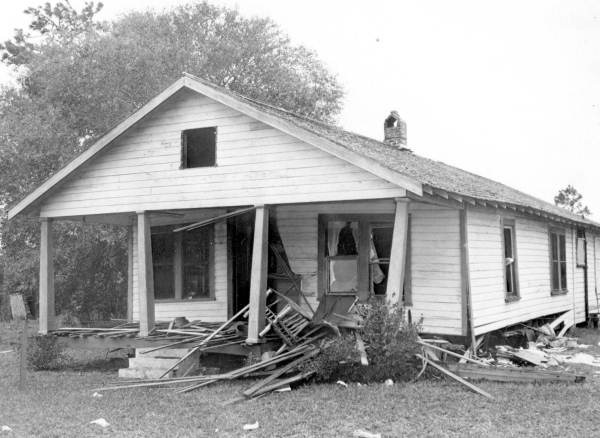
The home of civil rights pioneer Harry T. Moore and his wife Harriette Moore after being bombed by the Ku Klux Klan on Christmas Day. Both were killed in the bombing. They were the first civil rights activists to be assassinated during the post-war civil rights movement (Florida, 1951) [600 x 438].
by lightiggy
4 Comments
In 1978, Brevard County Sheriff Roland Zimmerman reopened the investigation after attending a memorial service for Harry Moore. A detective from the Brevard County Sheriff’s Office retraced the steps of an initial FBI investigation that had not resulted in federal charges. During the investigation, a man named Edward L. Spivey called on several occasions to complain about it, calling it a waste of money. The police discovered that Spivey was a former high ranking member of the Ku Klux Klan in central Florida. Spivey had several meetings with the detective. He revealed the details of the assassinations.
Four Klan members were implicated in the bombing, Joseph N. Cox, Earl J. Brooklyn, Tillman H. Belvin, and Edward L. Spivey. Months before the bombing, a witness saw Brooklyn and Belvin in a local store, asking for directions to the Moore’s home. When interviewed by the FBI, Brooklyn gave conflicting accounts of his whereabouts on Christmas Day, 1951. Spivey said Cox, a close friend, was responsible for detonating the dynamite under the Moore’s home. He also said this was a deathbed confession, as he was currently dying from cancer.
Spivey told the detective that on March 30, 1952, Cox had went to his home and privately confessed that he had been paid $5,000 by the Klan to kill the Moores. Cox, who had been questioned by the FBI just a day earlier, said he used the money to pay off his mortgage. However, he was afraid that the FBI would find out about his mortgage payment. After confessing, Cox, 61, borrowed a shotgun and killed himself. The two other suspects had died within a years of the bombing. Tillman Belvin died on August 25, 1952, at the age of 58. Earl Brooklyn died on Christmas Day 1952, at the age of 41.
Spivey denied any personal involvement in the bombing, but provided such detailed accounts of it that the police thought he had to have been present when Cox planted the bomb. Prosecutors from the Brevard County State Attorney’s Office attended several of the Spivey interviews. The State Attorney’s Office was preparing to take the case against Spivey to the grand jury when the State Attorney lost his reelection bid. Spivey was never prosecuted and the case was closed. Spivey died of cancer two years later.
The worst part was not that the KKK routinely committed acts of radical Christian terrorism, but that the rest of society let them get away with it.
It felt like we’d come a long way until recently. Now it feels uncomfortably close.
Right-wing conservative terrorism.