
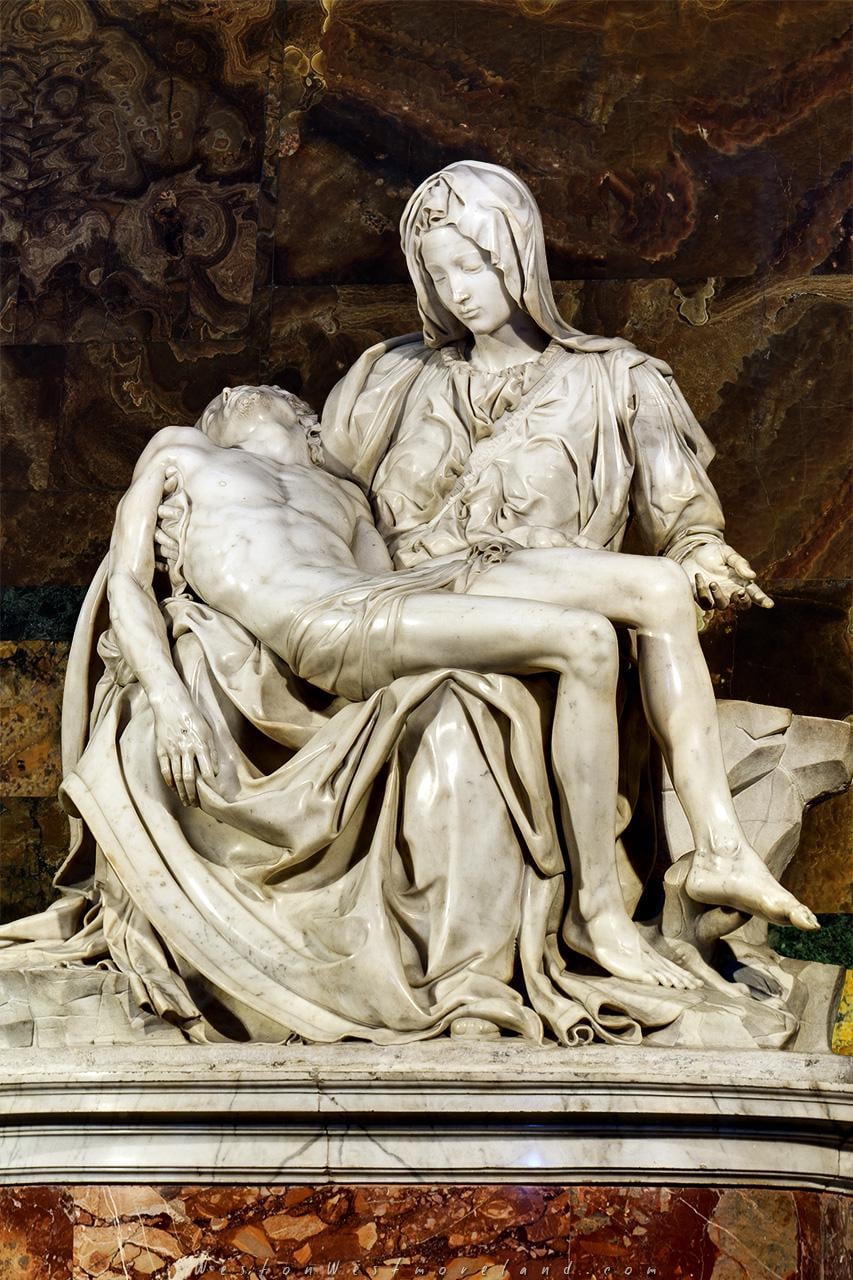
La Pieta, one of Michelangelo’s most revered sculptures, probably the most moving. He was 24 when he carved it. Mary suffers in silence. While her face remains serene, her hand betrays her emotions by saying at the same time there you have him and how could this possibly happen?…[1280×853] [OC]
by WestonWestmoreland
5 Comments
…Michelangelo was was nobody before it, and a genius after. Everything that came later was because he was given the chance to carve this piece. It is the only sculpture Michelangelo ever signed (you can see it in Mary’s band), which he did the very same night he learned of the rumor that the sculpture was not his own work. The theme is of Northern origin, popular by that time in France but not yet in Italy. Michelangelo’s interpretation of the Pieta was unprecedented in Italian sculpture…
It is 1498 in Rome, Rome, at the height of the Renaissance. Cardinal Saint Denis commissioned the Florentine sculptor Michelangelo to create a Pietà.
The sculptor astonished everyone in two ways. First, his brilliant mastery of sculptural technique at such a young age. He demonstrated this mastery in his handling of marble through the size and composition of the piece, all when he was barely 24 years old. Second, Michelangelo defied artistic tradition by depicting Mary younger than Jesus and without any visible signs of suffering.
The Pietà represents the Virgin Mary’s grief as she cradles the body of her son Jesus as he is taken down from the cross, just before the Lamentation over the Dead Christ, or Planctus.
The Pietà was carved life-size from a single block of white marble quarried in the Carrara mountains of Tuscany. It is said that Michelangelo personally traveled to Carrara to select his marble blocks. Of all the quarries available at the time, there was one vein that yielded the palest marble, from which the sculptor had the block for the Pietà extracted. This explains why the work has an almost uniform appearance, in which the marble veins barely interfere with the representation.
The sculptural group forms an equilateral triangle on an elliptical base, which lends balance and stability to the image. The Neoplatonic influence on the sculptor is notable, resulting in the Renaissance idealism that prioritizes beauty over suffering.
Thus, despite the harsh moment depicted, the Virgin Mary appears with a youthful, beautiful, and immaculate face, while Jesus has a more mature appearance than his mother, representing a face common to human nature.
A less obvious characteristic is Mary’s imposing size. If she were to stand upright, she would appear to be a woman of enormous proportions. Michelangelo used this oversizing to correct the perspective of the sculpture from the ground, and at the same time place the body of Jesus on a greater point of support.
I always end up looking at that hand, saying so much with so little…
My apologies for inaccuracies and mistakes.
Merry Christmas to all.
Mary is also like 7 feet tall so she can be large enough to hold Jesus on her lap.
*La pietà
Michelangelo came to regret carving his name into the statue. I like that he did it though – there’s something very 24 about that. Looking at Michelangelo, it can be tough to keep in mind that he was a real person, with impulses and flaws and all.
One of the most incredible sculptures ever made.