
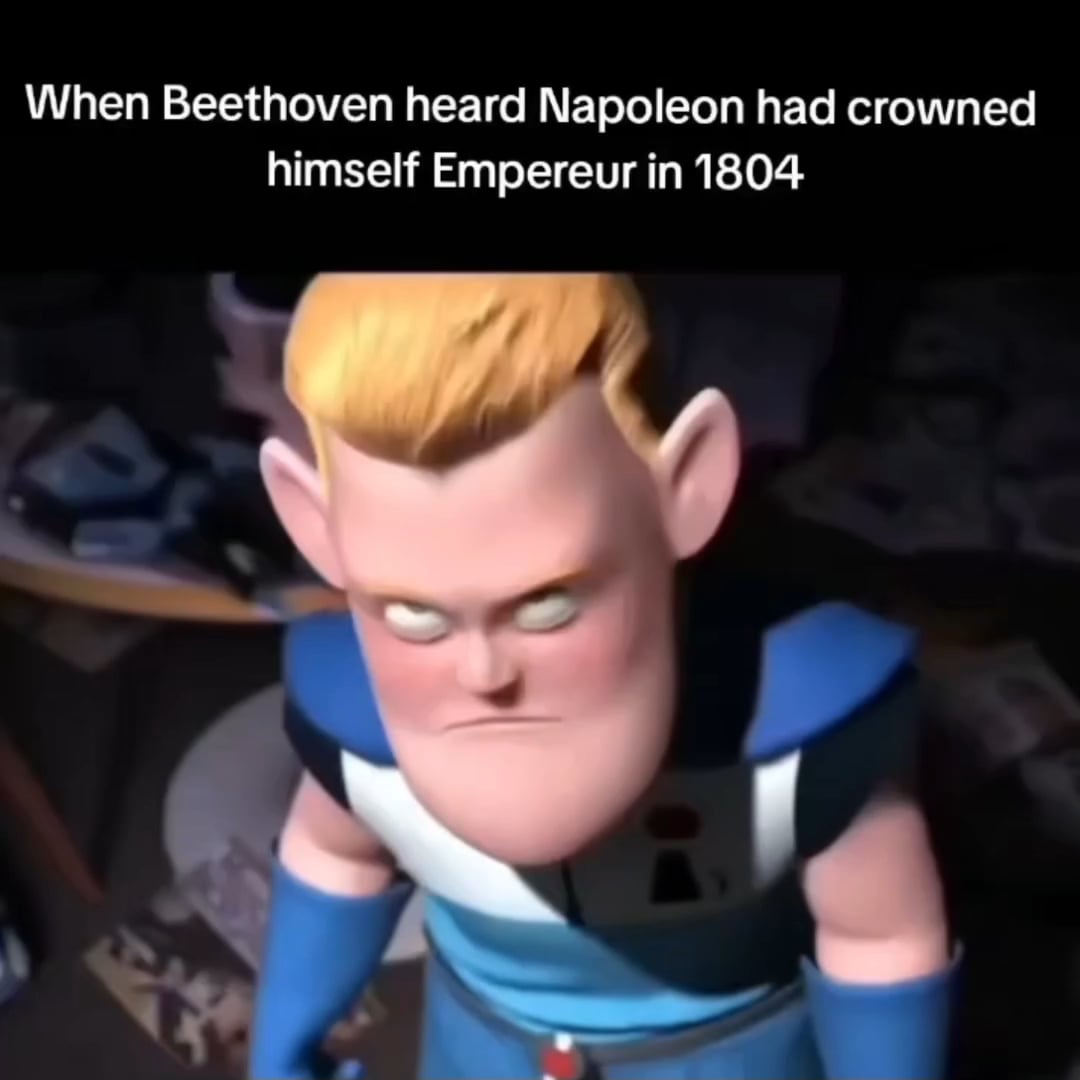
Context: Beethoven admired Napoleon long before 1804 because, to him, Napoleon represented the ideals of the Enlightenment. He saw in the young French general a hero who stood against old monarchies, feudal privilege, and tyranny. Beethoven believed Napoleon was fighting for liberty, equality, and the rights of ordinary people—values the composer deeply cherished. This admiration was so strong that Beethoven even planned to dedicate his Eroica Symphony to Napoleon, imagining him as a champion of a new, freer Europe. But everything changed the moment Beethoven learned that Napoleon had crowned himself Emperor. For Beethoven, this act was a complete betrayal of everything Napoleon had claimed to stand for. Instead of being the liberator of Europe, he had become just another tyrant—another ruler hungry for power and personal glory. According to his student Ferdinand Ries, Beethoven became furious, shouting that Napoleon was no different from the kings he had condemned. In his anger, he tore the dedication page of the symphony so violently that it ripped through the manuscript. From that point on, Beethoven’s admiration turned into disappointment and even disgust. What had once inspired him now felt like a false promise. To Beethoven, Napoleon’s coronation was the moment the hero died and the dictator was born.
by Im_yor_boi
8 Comments
I learned about this from Classics Explained.
[Ludwig Van Beethoven’s Symphony No.9 :A message to humanity](https://youtu.be/iY2lPuWrhkU?si=StU46sR9GF22CGep)
Basedtoven
betrayal only comes from French
Simon Bolivar can relate to this too.
Ironically this also applied to Simon Bolivar upon hearing the news
Best use of this format I think I’ve ever seen
Fake, he couldn’t have heard it, he was deaf
It’s easy to be a hero until the time comes to set one’s ego aside for the greater good