
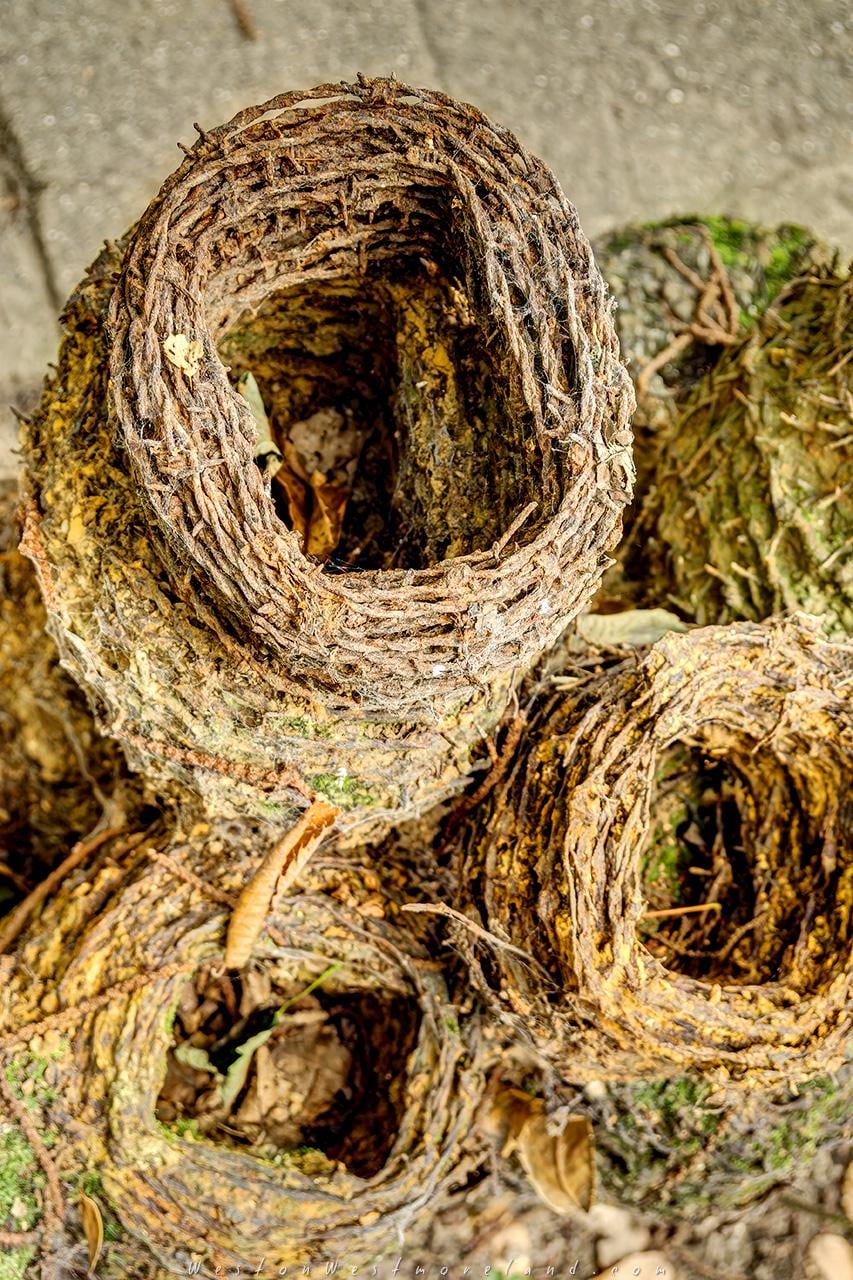
Remnants of barb wire coils for the WWI trenches, Hill 62, “Sanctuary Wood”, Ypres, Belgium, 1914-1918. The wooden poles have rotted. Sanctuary Wood earned its name in October 1914 when it was used during the First Battle of Ypres as a ‘sanctuary’ to tend to casualties and regroup… [1280×853] [OC]
by WestonWestmoreland
1 Comment
…At that time the wood was to the west of and behind the British fighting line. It is believed to have been given its name on the 1914-1918 British Army battlefield maps, called Trench Maps, for that very reason; it was providing a place of sanctuary to the wounded.
This was to be short-lived and its name deemed most inappropriate from November 1914 onwards. In 1918 the German Army pushed the Allied Armies back towards Ypres again and the two front lines were located to the west of Sanctuary Wood close to Ypres. This meant that the Sanctuary Wood area was now east of and behind the German front line. The movement of front lines backwards and forwards over the same ground is typical of the WWI fighting during the four years of war in the Ypres Salient. This accounts for the absolute destruction of parts of the landscape over and over, and the reason why the bodies of so many thousands of soldiers from all sides have never been found.
After the war, the wood was turned into a private museum by the landowners, the trench lines and dugouts were enclosed, and the shattered trees fenced in. Today Sanctuary Wood is considered by many to offer the finest preserved trenches on the Western Front. The area was known as Hill 62 because it was literally 62 meters above sea-level.
Much of the material used during the war was left there afterwards and has also been preserved, as those barb wire coils.
My apologies for inaccuracies and mistakes.