
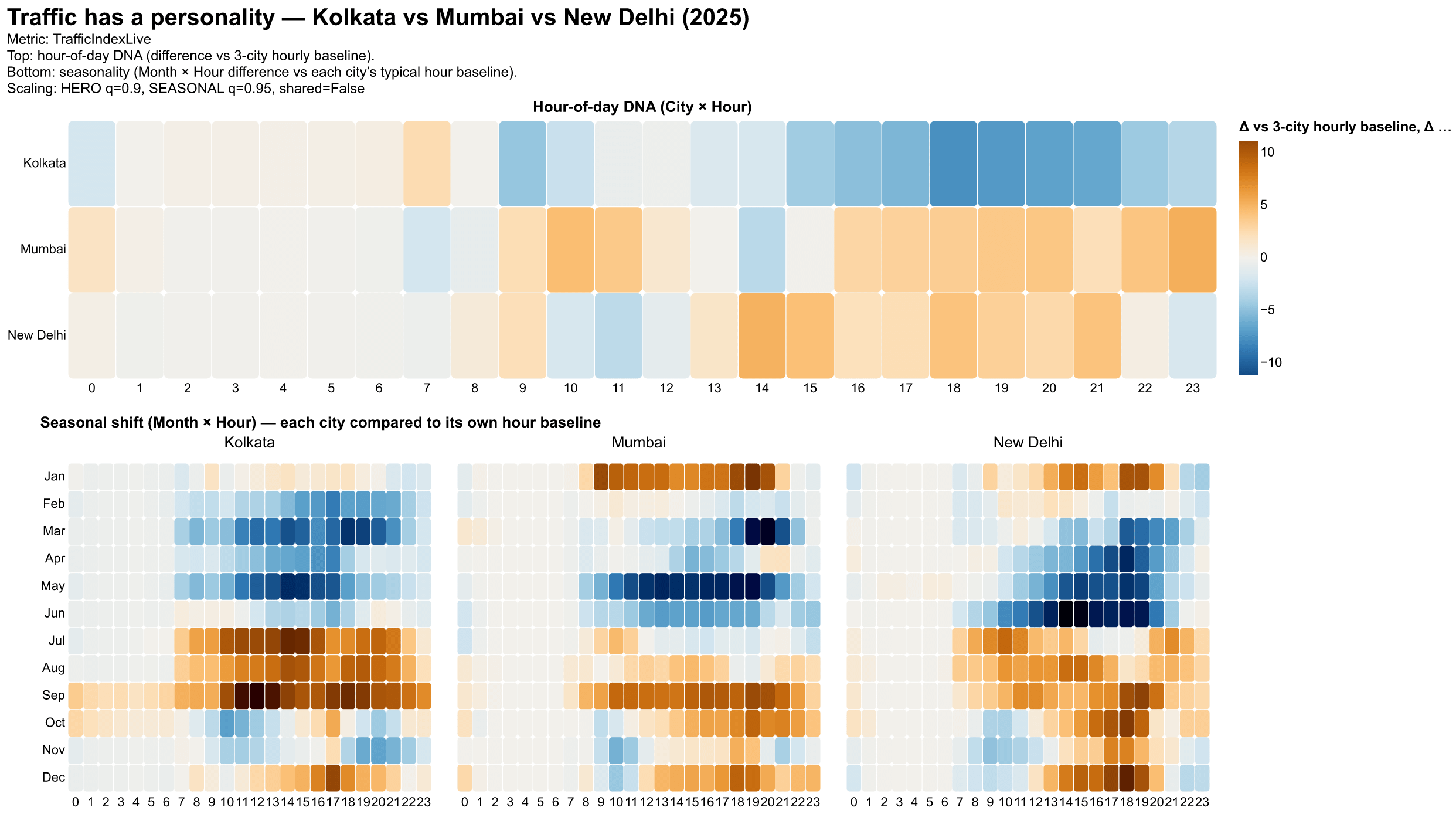
After going through so many beautiful posts on this subreddit, here is my attempt at creating one. I analysed hourly traffic data for Kolkata, Mumbai, and New Delhi across 2025 (updated till the early hours of December 22, 2025) to see whether congestion behaves the same way everywhere — or whether cities have distinct “rhythms.”
The charts focus on patterns, not rankings. Following is a brief explanation of the panels.
Top panel — Hour-of-day “DNA”
Each cell shows how a city behaves at a given hour relative to the combined average of all three cities at that same hour.
- Blue = calmer than the shared baseline
- Orange/Red = more congested than the shared baseline
This normalisation lets the cities be compared fairly without turning it into a “who’s worst” contest.
Bottom panels — Seasonal shifts (Month × Hour)
Here, each city is compared to its own typical hour-of-day baseline.
This reveals how monsoon months, winter, and late-year periods reshape daily traffic rhythms within each city.
The data itself does not reveal any major surprises regarding the traffic flow in each city.
- Mumbai is the steady grinder, consistently above the shared baseline from late morning through late night.
- New Delhi is the volatile city, with more conspicuous contrasts between the calm and chaos hours
- Kolkata is the breather, with the usual evening congestion, but overall the traffic comes in bursts, not as a constant state.
About the metric
The metric used is TrafficIndexLive, which is commonly associated with TomTom’s Traffic Index methodology.
In simple terms, TrafficIndex reflects how much longer a trip takes compared to free-flow conditions, based on aggregated probe data from navigation devices and apps.
It’s not a direct count of vehicles, and it’s not a single sensor — it’s a modeled index derived from many moving sources.
Tools used: Python and Altair
Data: https://www.kaggle.com/datasets/bwandowando/tomtom-traffic-data-55-countries-387-cities
by VegetableSense