Srinivasa Ramanujan (1887-1920) is perhaps one of the most original mathematicians of all time. In a career that only lasted around ten years, he produced hundreds of highly innovative results in several areas of pure mathematics, particularly number theory and analysis. After his death, his notebooks and unpublished results inspired decades of research by succeeding mathematicians, the impact of which is still being felt in mathematics today. What’s more remarkable, Ramanujan was a self-taught mathematician who derived his amazing results without a formal university-level education in mathematics and totally unaware of results that were already known in the body of mathematical knowledge.
Ramanujan was born to a modest Brahmin family on 22 December 1887 in the town of Erode in Tamil Nadu, southern India. Performing well at primary school, he passed exams in all subjects at the age of 10 with the best scores in his school district. After beginning secondary level mathematics, by his early teens he was investigating and discovering his own independent results. Of course, having no contact with any active mathematical researchers and being essentially self-taught, he had no knowledge of contemporary research topics. So he largely pursued his own ideas, often inspired by formulae and techniques he read from compendiums such as A Synopsis of Elementary Results in Pure and Applied Mathematics by a certain G.S. Carr. Although the book was dry and contained little to motivate the results listed in it, Ramanujan was hooked, particularly by formulas concerning infinite series.
As early as 1904 when he was only 17, Ramanujan began to produce mathematical research of substantial sophistication.
Ironically, his child-like fascination with infinite series led him to spend so much time thinking about math his own way that he actually flunked out of the college, not once but twice. Fortunately in January 1913 Ramanujan wrote a letter (certainly one of the most famous letters in the history of mathematics), to G.H. Hardy, a lecturer at Trinity College, Cambridge, who was one of Britain’s foremost pure mathematicians. On reading the multi-page letter crammed with dozens of intricate formulae and theorems from Ramanujan’s notebooks, Hardy could hardly believe his eyes. A close examination of its content by Hardy and his Cambridge colleague J.E. Littlewood revealed a host of amazing results, which Hardy divided into three categories. Firstly, there were theorems that, unbeknown to Ramanujan, were already known. Secondly, there were results that, while new, were interesting rather than important. Finally, there were entirely original results that were simply astonishing.
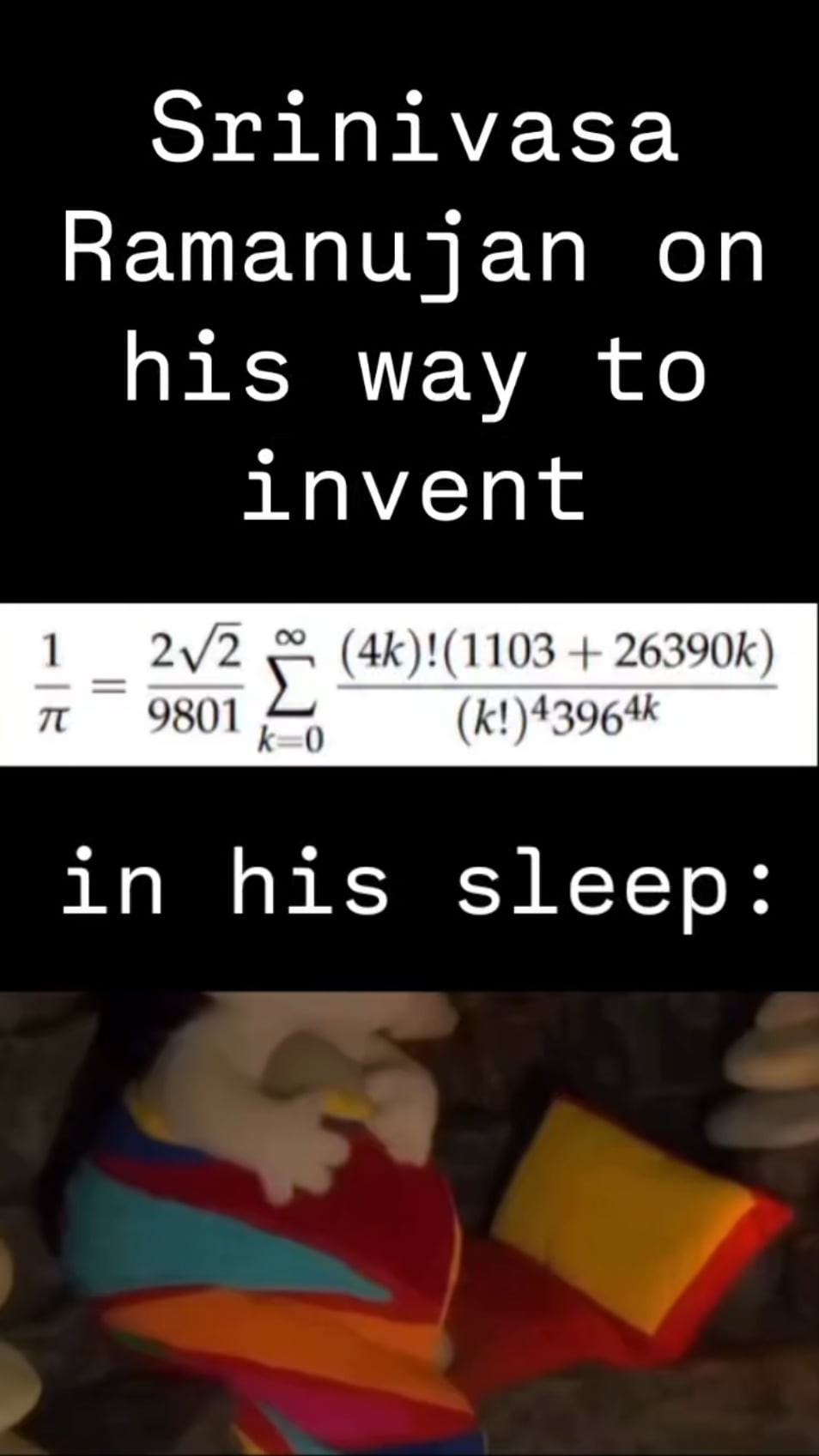
So impressed was Hardy that he took Ramanujan under his wings and helped fill the gaps in Ramanujan’s mathematical knowledge. The two men soon became research collaborators, although their style could not be more different: Hardy and Littlewood, being strict analysts, were insistent on absolute rigour and formal proofs, while Ramanujan was content to rely on intuition and inductive experimentation. When asked where he got his intuition from, Ramanujan cryptically remarked that they mostly came to him through dreams given by the Hindu Goddess Shree Maa Namagi.

5 Comments
Lore?
Dear god what is that?
Srinivasa Ramanujan (1887-1920) is perhaps one of the most original mathematicians of all time. In a career that only lasted around ten years, he produced hundreds of highly innovative results in several areas of pure mathematics, particularly number theory and analysis. After his death, his notebooks and unpublished results inspired decades of research by succeeding mathematicians, the impact of which is still being felt in mathematics today. What’s more remarkable, Ramanujan was a self-taught mathematician who derived his amazing results without a formal university-level education in mathematics and totally unaware of results that were already known in the body of mathematical knowledge.
Ramanujan was born to a modest Brahmin family on 22 December 1887 in the town of Erode in Tamil Nadu, southern India. Performing well at primary school, he passed exams in all subjects at the age of 10 with the best scores in his school district. After beginning secondary level mathematics, by his early teens he was investigating and discovering his own independent results. Of course, having no contact with any active mathematical researchers and being essentially self-taught, he had no knowledge of contemporary research topics. So he largely pursued his own ideas, often inspired by formulae and techniques he read from compendiums such as A Synopsis of Elementary Results in Pure and Applied Mathematics by a certain G.S. Carr. Although the book was dry and contained little to motivate the results listed in it, Ramanujan was hooked, particularly by formulas concerning infinite series.
As early as 1904 when he was only 17, Ramanujan began to produce mathematical research of substantial sophistication.
Ironically, his child-like fascination with infinite series led him to spend so much time thinking about math his own way that he actually flunked out of the college, not once but twice. Fortunately in January 1913 Ramanujan wrote a letter (certainly one of the most famous letters in the history of mathematics), to G.H. Hardy, a lecturer at Trinity College, Cambridge, who was one of Britain’s foremost pure mathematicians. On reading the multi-page letter crammed with dozens of intricate formulae and theorems from Ramanujan’s notebooks, Hardy could hardly believe his eyes. A close examination of its content by Hardy and his Cambridge colleague J.E. Littlewood revealed a host of amazing results, which Hardy divided into three categories. Firstly, there were theorems that, unbeknown to Ramanujan, were already known. Secondly, there were results that, while new, were interesting rather than important. Finally, there were entirely original results that were simply astonishing.
So impressed was Hardy that he took Ramanujan under his wings and helped fill the gaps in Ramanujan’s mathematical knowledge. The two men soon became research collaborators, although their style could not be more different: Hardy and Littlewood, being strict analysts, were insistent on absolute rigour and formal proofs, while Ramanujan was content to rely on intuition and inductive experimentation. When asked where he got his intuition from, Ramanujan cryptically remarked that they mostly came to him through dreams given by the Hindu Goddess Shree Maa Namagi.
-It Came to Me in A Dream: the Intuitive Mathematician, Srinivasa Ramanujan – Sublime https://thesublimeblog.org/2022/08/09/it-came-to-me-in-a-dream-the-intuitive-mathematician-srinivasa-ramanujan/
Invent ❌
Blessed with✅
Isn’t that out of context for this sub. This is about history memes