Perfectly fair. Organ donors give their organs when they DIE. You don’t NEED that if you’re already dead. And if you’re gonna be selfish and hoarde that which you DON’T NEED because you’re DEAD then yes you don’t deserve to reap the rewards of other people’s generosity.
Best part of all of this is even though it’s automatically applied for you, you can still opt out but you don’t get precedence for doing so. That’s the best.
Batmanswrath on
This makes complete sense. You shouldn’t benefit from a scheme you aren’t willing to opt in to.
DegreeUnusual2928 on
UK has an opt out system too
Icy-Swordfish7784 on
Are you sure they can’t just be rich and pay money?
Acceptable_Foot3370 on
Then you better take care of yourself if you opt out
PGGABC on
In Brazil, it is a single list controlled by the SUS (unified health system, state-run).
Mixeygoat on
I mean if you are morally against donating your own organs then you should not feel owed the right for priority to transplants
captain-lowrider on
same in here AUSTRIA. you can opt out but regulary you are a donor by law.
paint_thetown_red on
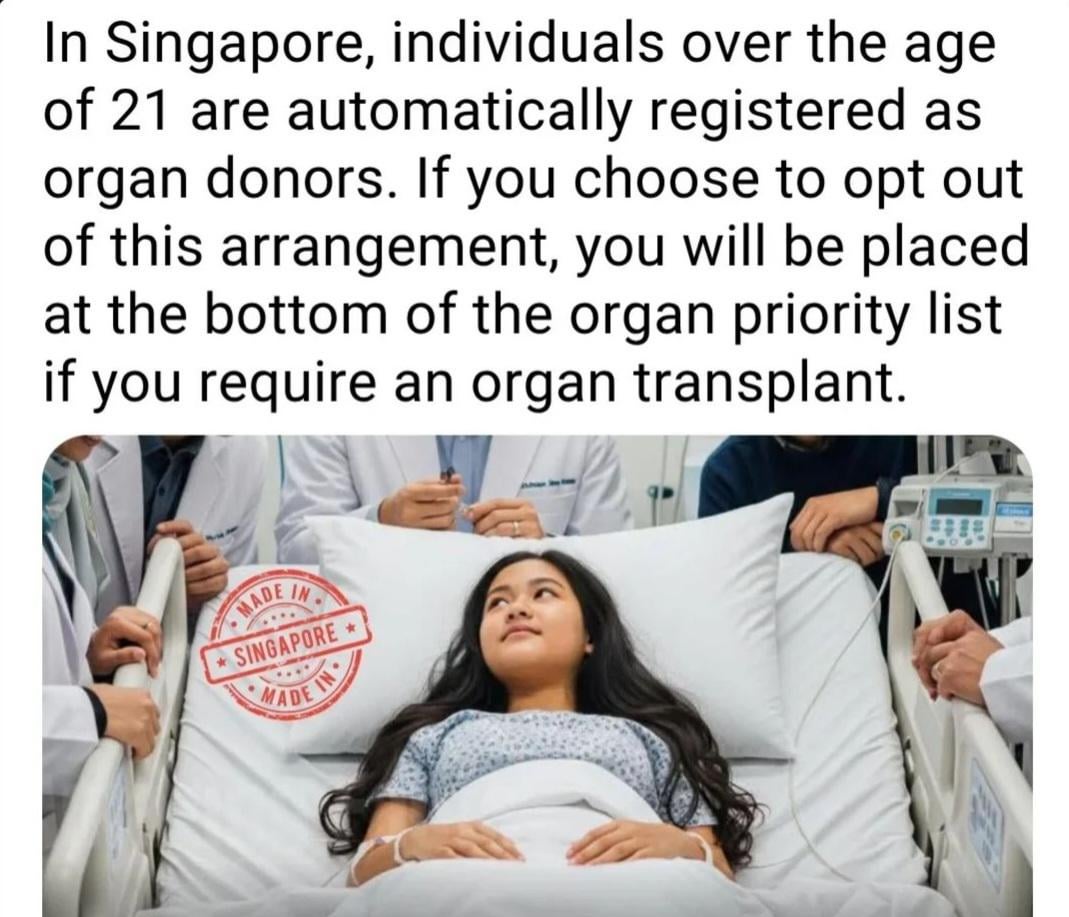
Was the creepy ai looking image necessary to convey this info
SmokinSweety on
I wonder what percentage of recipients and donors and male vs female.
In the USA, women donate more organs than they receive.
Agiantpubicmess on
Damn. Some of us can’t donate blood, tissue or organs because of medications and other levels of things in the blood
Kexxa420 on
In the U.K. everyone is also opted in by default. I don’t think there’s any penalty for opting out, though.
MaybeOnFire2025 on
Guessing 99.99% of the opposition to such laws being enacted everywhere else is attributed to (powerful) religious zealots.
Renbarre on
In France you are automatically an organ donor too. You need to make it known that you refuse it. It was the other way around before but many people did not bother to get or carry an organ donor card. So now the onus is on not wanting to be one.
butterflycole on
What happens when your organs aren’t safe to donate? I can’t donate blood or bone marrow because I’m on immunosuppressants. I’m a registered organ donor but I wonder if they would even accept them because of the medication 🤷🏼♀️
seggnog on
Based
Snoo_67993 on
Same in UK
DaStampede on
Seems fair to me
Dolphin_sucker69 on
I think that’s the same in alot of EU countries
Arschgeige42 on
A good way to darwinize religious fanatics.
Severe_snake6600 on
I’m gonna go against the hivemind and ask some questions.
Bottom of queue compared to what? If everyone is opted in by default then the list could be endless anyway so what difference does it make?
gymgal19 on
What if youre not eligible to be a donor? I assume there must be exceptions if you have medical documentation.
LaughableIKR on
I think this is a great law. The selfish people will probably never get a transplant, and it’s their own fault.
PsycheDiver on
I wish we’d adopt this in Canada.
Warm-Review156 on
US they let you die if you have organ donor status, or so I’ve heard
Aggressive_Step_290 on
Good idea.
Primordial104 on
I’m an organ donor because even if I die a part of me will still get to live on in another person. I find that kind of beautiful in a way.
nodesign89 on
What a well thought out and fair system
lostinadream66 on
Can you still sell your kidney to a rich white person?
Conscious_String_195 on
It seems like a perfectly reasonable system, as long as you can trust the country and medical association to not let you die to save multiple people or someone younger.
Mariana Van Zeller has a really good show called TRAFFICKED, where they show what goes on and how black market body parts get mixed in in places like the U.S., etc.
Seems perfectly reasonable to me, as does the inverse, ie I am not an organ donor in the US because I will not be able to get an organ if I need one based on a lack of financial resources to cover it myself and the perfidy of my health insurance company.
If I am not going to benefit whether I participate or not then I won’t participate.
Lachimanus on
In Germany we tried to implement also an opt out version.
There are people going like “they force us to get slaughtered”…. Idiots.
charing-cross on
Seems fair. I feel like that about rich people who don’t pay taxes, you shouldn’t get services paid for by taxes.
remnant_phoenix on
This makes so much sense.
Connect-Initiative64 on
More than fair to be honest.
If you need an organ you’ll get one, if possible, but if you refuse to contribute to the organ donation system on your death you’re immediately given lower priority while alive.
Only issue I can see of this are people who don’t donate due to religious reasons, but that’s just unlucky for them IMO.
bboyneko on
One thing that often gets misunderstood about organ donation is what “dead” actually means. Organs can’t be harvested from a body that has no circulation or oxygen at all. For organs to be usable, the body must be maintained in a physiologically living state so those organs remain alive.
That means donors are maintained on ventilators and life support. Some donors retain residual brain activity, spinal reflexes, hormonal stress responses There is legitimate debate among bioethicists and patient advocates and doctors about whether this could include the capacity for suffering. The public is often not informed of these ambiguities, especially the donor’s family.
Families often imagine cold, lifeless bodies, blue skin, pale skin, no circulation, no response etc.
In reality, donors may be warm, natural living skin color, breathing via ventilator, maintaining blood pressure, and exhibiting reflexes during the harvesting.
This disconnect isn’t accidental.. on it’s surface it’s about minimizing distress, but it is also about maintaining consent rates.
Ethically, that’s shaky ground.
>Neil Lazar, Director of the Medical-Surgical ICU at Toronto General Hospital, along with Maxwell J. Smith and David Rodríguez-Arias, argued in the American Journal of Bioethics that the “dead donor rule” may be ethically misleading. **They note that donors may retain physiological capacities at the time of organ retrieval and argue that donor welfare should be explicitly addressed, including the possible use of anesthesia**.
I used to be registered as an organ donor until I found out what happens to most of the corpses. Then I opted out and will never opt back in unless some massive changes are made
JubijubCH on
I’m an organ donor, and I think this rule is more than fair
coyote_of_the_month on
Seems perfectly reasonable tbh.
Elskyflyio on
In the Czech republic, everyone is automatically also an organ donor and can choose to opt out.
NinjaTabby on
Golden Rule: “Do unto others as you would have them do unto you”

44 Comments
Seems fair 🤷♀️
Is it the same with blood donation?
I’m happily an organ donor.
I mean, wtf I’mma do with them when I’m dead
Perfectly fair. Organ donors give their organs when they DIE. You don’t NEED that if you’re already dead. And if you’re gonna be selfish and hoarde that which you DON’T NEED because you’re DEAD then yes you don’t deserve to reap the rewards of other people’s generosity.
Best part of all of this is even though it’s automatically applied for you, you can still opt out but you don’t get precedence for doing so. That’s the best.
This makes complete sense. You shouldn’t benefit from a scheme you aren’t willing to opt in to.
UK has an opt out system too
Are you sure they can’t just be rich and pay money?
Then you better take care of yourself if you opt out
In Brazil, it is a single list controlled by the SUS (unified health system, state-run).
I mean if you are morally against donating your own organs then you should not feel owed the right for priority to transplants
same in here AUSTRIA. you can opt out but regulary you are a donor by law.
Was the creepy ai looking image necessary to convey this info
I wonder what percentage of recipients and donors and male vs female.
In the USA, women donate more organs than they receive.
Damn. Some of us can’t donate blood, tissue or organs because of medications and other levels of things in the blood
In the U.K. everyone is also opted in by default. I don’t think there’s any penalty for opting out, though.
Guessing 99.99% of the opposition to such laws being enacted everywhere else is attributed to (powerful) religious zealots.
In France you are automatically an organ donor too. You need to make it known that you refuse it. It was the other way around before but many people did not bother to get or carry an organ donor card. So now the onus is on not wanting to be one.
What happens when your organs aren’t safe to donate? I can’t donate blood or bone marrow because I’m on immunosuppressants. I’m a registered organ donor but I wonder if they would even accept them because of the medication 🤷🏼♀️
Based
Same in UK
Seems fair to me
I think that’s the same in alot of EU countries
A good way to darwinize religious fanatics.
I’m gonna go against the hivemind and ask some questions.
Bottom of queue compared to what? If everyone is opted in by default then the list could be endless anyway so what difference does it make?
What if youre not eligible to be a donor? I assume there must be exceptions if you have medical documentation.
I think this is a great law. The selfish people will probably never get a transplant, and it’s their own fault.
I wish we’d adopt this in Canada.
US they let you die if you have organ donor status, or so I’ve heard
Good idea.
I’m an organ donor because even if I die a part of me will still get to live on in another person. I find that kind of beautiful in a way.
What a well thought out and fair system
Can you still sell your kidney to a rich white person?
It seems like a perfectly reasonable system, as long as you can trust the country and medical association to not let you die to save multiple people or someone younger.
Mariana Van Zeller has a really good show called TRAFFICKED, where they show what goes on and how black market body parts get mixed in in places like the U.S., etc.
https://www.nationalgeographic.com/tv/episode/ad4b0123-4a55-40a1-afa0-1aa0f4f8784d/playlist/pl554408064
Seems perfectly reasonable to me, as does the inverse, ie I am not an organ donor in the US because I will not be able to get an organ if I need one based on a lack of financial resources to cover it myself and the perfidy of my health insurance company.
If I am not going to benefit whether I participate or not then I won’t participate.
In Germany we tried to implement also an opt out version.
There are people going like “they force us to get slaughtered”…. Idiots.
Seems fair. I feel like that about rich people who don’t pay taxes, you shouldn’t get services paid for by taxes.
This makes so much sense.
More than fair to be honest.
If you need an organ you’ll get one, if possible, but if you refuse to contribute to the organ donation system on your death you’re immediately given lower priority while alive.
Only issue I can see of this are people who don’t donate due to religious reasons, but that’s just unlucky for them IMO.
One thing that often gets misunderstood about organ donation is what “dead” actually means. Organs can’t be harvested from a body that has no circulation or oxygen at all. For organs to be usable, the body must be maintained in a physiologically living state so those organs remain alive.
That means donors are maintained on ventilators and life support. Some donors retain residual brain activity, spinal reflexes, hormonal stress responses There is legitimate debate among bioethicists and patient advocates and doctors about whether this could include the capacity for suffering. The public is often not informed of these ambiguities, especially the donor’s family.
Families often imagine cold, lifeless bodies, blue skin, pale skin, no circulation, no response etc.
In reality, donors may be warm, natural living skin color, breathing via ventilator, maintaining blood pressure, and exhibiting reflexes during the harvesting.
This disconnect isn’t accidental.. on it’s surface it’s about minimizing distress, but it is also about maintaining consent rates.
Ethically, that’s shaky ground.
>Neil Lazar, Director of the Medical-Surgical ICU at Toronto General Hospital, along with Maxwell J. Smith and David Rodríguez-Arias, argued in the American Journal of Bioethics that the “dead donor rule” may be ethically misleading. **They note that donors may retain physiological capacities at the time of organ retrieval and argue that donor welfare should be explicitly addressed, including the possible use of anesthesia**.
>[https://www.tandfonline.com/doi/full/10.1080/15265161.2011.591213](https://www.tandfonline.com/doi/full/10.1080/15265161.2011.591213)
I used to be registered as an organ donor until I found out what happens to most of the corpses. Then I opted out and will never opt back in unless some massive changes are made
I’m an organ donor, and I think this rule is more than fair
Seems perfectly reasonable tbh.
In the Czech republic, everyone is automatically also an organ donor and can choose to opt out.
Golden Rule: “Do unto others as you would have them do unto you”
I like it.