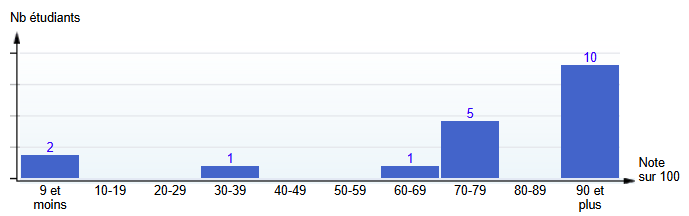
The two on the left are just students who stopped coming to the class after a few weeks.
Loki-L on
Was there one big task or similar set of tasks worth a quarter of the points?
raptorman556 on
I’ve seen some wacky grade distributions in my classes. One midterm I had 27.5% of the class score an A (90% or better) while another 27.5% failed the exam (below 50%—some of them *way* below 50).
Most commonly, I get an approximately normal distribution centered around 70-75% with another clump of students that absolutely bombed (20-40%).
kevinmorice on
So you discard the 2 non-attendees.
Then you have one that didn’t understand the assignment, one who did but didn’t care or made an early process mistake that compounds to give a fundamentally wrong answer.
Then 5 who were basically right but made a small error that you didn’t like.
And 10/17 are getting the top grade, so your exam is too easy or your assessment is flawed.
melodyze on
Are you curving a class where the distribution could be significantly affected by using chatgpt/ai tools?
That would explain a new extreme bimodality around yes/no this student used chatgpt, as the chatgpt content would pile in one high quality level and then the curve would push normal content down.
The sample size is small, but the probability of pulling zero scores from 80-90 in 20 samples when the mean of the underlying distribution was 85 would still be very low, so that implies that the underlying distribution is not likely to be that.
Like, if this went through the kinds of bayesian anomaly detection systems I’ve written for big companies, it would definitely trigger on this.
itijara on
I’d guess it is caused by two factors, one binomial (whether a student does the assignment) and one normal (score when they do the assignment). What happens when you just look at scores of submitted assignments?
esw123 on
Free Gemini, free ChatGPT, actual knowledge and paid subs? Joking 😀
hotairballonfreak on
I would call it a binomial
NLwino on
In the past I had an teacher that often did tiny tests for French. Just write a couple of sentences. A lot of students could do that without mistakes. Every mistake cost 1 point (grade between 1 and 10). I generally had 20+ with my dyslexia. I remember getting 14 mistakes once and the teacher got mad at me for being happy about it.
Thank god I was allowed to drop French and German eventually. I don’t know what the school where thinking, giving 4 mandatory languages to students they knew were dyslectic. After that I could focus efforts on only my mother language and English and manage to get an passing grade on both. Languages were the only classes I had real trouble with.

9 Comments
Usually I see a bell curve peaking at 80-89.
The two on the left are just students who stopped coming to the class after a few weeks.
Was there one big task or similar set of tasks worth a quarter of the points?
I’ve seen some wacky grade distributions in my classes. One midterm I had 27.5% of the class score an A (90% or better) while another 27.5% failed the exam (below 50%—some of them *way* below 50).
Most commonly, I get an approximately normal distribution centered around 70-75% with another clump of students that absolutely bombed (20-40%).
So you discard the 2 non-attendees.
Then you have one that didn’t understand the assignment, one who did but didn’t care or made an early process mistake that compounds to give a fundamentally wrong answer.
Then 5 who were basically right but made a small error that you didn’t like.
And 10/17 are getting the top grade, so your exam is too easy or your assessment is flawed.
Are you curving a class where the distribution could be significantly affected by using chatgpt/ai tools?
That would explain a new extreme bimodality around yes/no this student used chatgpt, as the chatgpt content would pile in one high quality level and then the curve would push normal content down.
The sample size is small, but the probability of pulling zero scores from 80-90 in 20 samples when the mean of the underlying distribution was 85 would still be very low, so that implies that the underlying distribution is not likely to be that.
Like, if this went through the kinds of bayesian anomaly detection systems I’ve written for big companies, it would definitely trigger on this.
I’d guess it is caused by two factors, one binomial (whether a student does the assignment) and one normal (score when they do the assignment). What happens when you just look at scores of submitted assignments?
Free Gemini, free ChatGPT, actual knowledge and paid subs? Joking 😀
I would call it a binomial
In the past I had an teacher that often did tiny tests for French. Just write a couple of sentences. A lot of students could do that without mistakes. Every mistake cost 1 point (grade between 1 and 10). I generally had 20+ with my dyslexia. I remember getting 14 mistakes once and the teacher got mad at me for being happy about it.
Thank god I was allowed to drop French and German eventually. I don’t know what the school where thinking, giving 4 mandatory languages to students they knew were dyslectic. After that I could focus efforts on only my mother language and English and manage to get an passing grade on both. Languages were the only classes I had real trouble with.