Teacher’s interpretation: The man was full of anger and hatred (and this somehow devolves into talking about the power of nature or the power of God).
Author: The door is red because it’s my favourite colour.
9447044 on
“I think this is a good representation of the authors life” was my go to.
TheArcanist_1 on
A Polish poet Wisława Szymborska once took a test on her own poems, the teacher gave her a low grade saying ‘this is not what the author meant’ or something like that.
Senkosoda on
Dear god I hated that shit in literature classes. Stop. Making. Shit. Up. DONT GRADE IT EITHER.
WalkwiththeWolf on
In the movie “Back To School” Rodney Dangerfield’s character hires Kurt Vonnegut to write the book report on Slaughterhouse Five. The professor gives Dangerfield a low grade and says “did you even read the book”.
Wrong_Season1104 on
My school once invited a local poet, whose poems had actually made it into some school books. The guy was legit flabbergasted reading through the analyses of his work. “I wasn’t thinking any of that. Y’all are making children hate literature”.
Fattens on
This was one of the worst things about public school, and perfectly illustrates why I hated it so much.
Peen_Round_4371 on
“The dog ran fast”
My stupid high school teachers for some reason: “The dog’s frantic sprint symbolizes humanity’s perpetual struggle against the inexorable march of time, illustrating how instinctual drives often collide with societal expectations.”
BurnieTheBrony on
“I don’t understand subtext so I’m going to blame my teachers and think Fight Club is just a fun movie about punching dudes”
Human-Assumption-524 on
I had a history teacher that insisted INSISTED that the Wizard of Oz was a metaphor for world war 2…somehow despite predating it.
Like she actually forced us to do a report on how it was a metaphor for ww2 which we needed for a passing grade.
Penseun on
Creativity is such a blessing!
a_rabid_anti_dentite on
Doesn’t matter what the original author’s intentions were. That’s the nature of art.
BrennanBetelgeuse on
Okay this is a common high schooler complaint. Let me explain why that’s wrong:
Think of a meme, something with little intent like 67. The ‘authors’ obviously didn’t try to say a lot by populatizing it but there is a fuckton to interpret about it. The history of HipHop influencing the original lyrics, online pop culture spreading the meme, modern absurdist humor and brainrot evolving from the deep fried meme era, nihilism in society etc.
When analyzing a piece of art you’re trying to understand why it does what it does. You could for example wonder why a meme got popular.
It’s the same for books, movies, etc.
The authors intent is an interesting piece of the puzzle but is Star Wars truly popular because it’s a Vietnam war allegory? Or do we have to dig deeper to understand why it’s been a fan favorite for decades?
I’m by no means an expert on media analysis but this complaint has been around since I’ve been in school myself and it misses the point.
junker359 on
I seem to recall a story where a teacher friend of John Lennon told him that they were analyzing Beatles songs for hidden meaning. Lennon, either annoyed or amused by this, wrote “I am the Walrus” to give them something they really could analyze.
artofterm on
Ray Bradberry saw the effects of this when he went to present what he meant in Fahrenheit 451 (i.e., that tv was dangerous and new technology was making people mindless). UC students told him he was wrong because their teachers told them to interpret the book as anti-censorship.
Bruz_the_milkman on
That’s all literature analysis was for me at school, just bullshit your way through until you run out of time. You extract every single word and details into meanings and metaphors.
OkCar7264 on
So many people have this didactic idea about art like it’s always trying to teach you a lesson. A poem should be an experience, not a lesson. The meaning that you derive from the experience is yours alone. If has a single meaning it’s probably bad.
NebularViscosity on
This is before, of course, students learn that there are different lenses one can use to interpret literature. Sure, most students tend to roll their eyes when there might be more to the color that’s used in a story, but it’s how that interpretation is presented in an argument backed with evidence that’s pertinent. If a teacher is indicating that a red door means the protagonist is angry, but there isn’t evidence to prove this, one can see why students become frustrated with these types of interpretation. As a teacher I have students play devil’s advocate. What other reasons can there be for the door to be red?
Further, by implying that an author chooses a color without purpose can also be a slippery slope. Whether the reason is to have a color have meaning or to set an ambient tone, or to have a realistic depiction of the scene so a reader can visualize what’s happening using imagery, the reader must provide evidence to the claim.
Deliriousious on
I hated English class for this reason.
I look at it, and whilst I can see how some bits are metaphors and have some meanings, when my teacher would write a ton of different perspective on a single line… I just bluescreened.
Are you certain you aren’t looking into it a bit too deeply?
Thatonegaywarhammere on
I forget the bame of the book by i remember my highschool English teacher talking about how the author put in so many references to how god is always with us and references to the authors devout faith. When googleing some info for the essay we had to wright I discovers the author was actually an atheist, and publicly stated that this book was anti religion. I got a D- for my “anti Christian interpretation” this was a public school BTW.
Lobster_fest on
Y’all act like this then complain about movies being too confusing or not “getting” them.
Media literacy is a skill. Making connections between events, descriptions, and thematic elements is a skill. I’m sorry it annoys you, but if you don’t practice, you won’t learn.
roowco1 on
that’s the point of media literacy though
finding all of the potential meanings and messages you can derive from a piece of work, even if that interpretation isn’t likely. Counter evidence is important too, and interpreting a poem or any story can be like a fun puzzle where you find some sort of meaning. Or maybe the point of a story is that there is no meaning and that’s also valid. Sometimes a story is just a story or a poem is just a poem.
The problems only occur when you enforce a certain interpretation and baselessly dismiss any others without much thought.

22 Comments
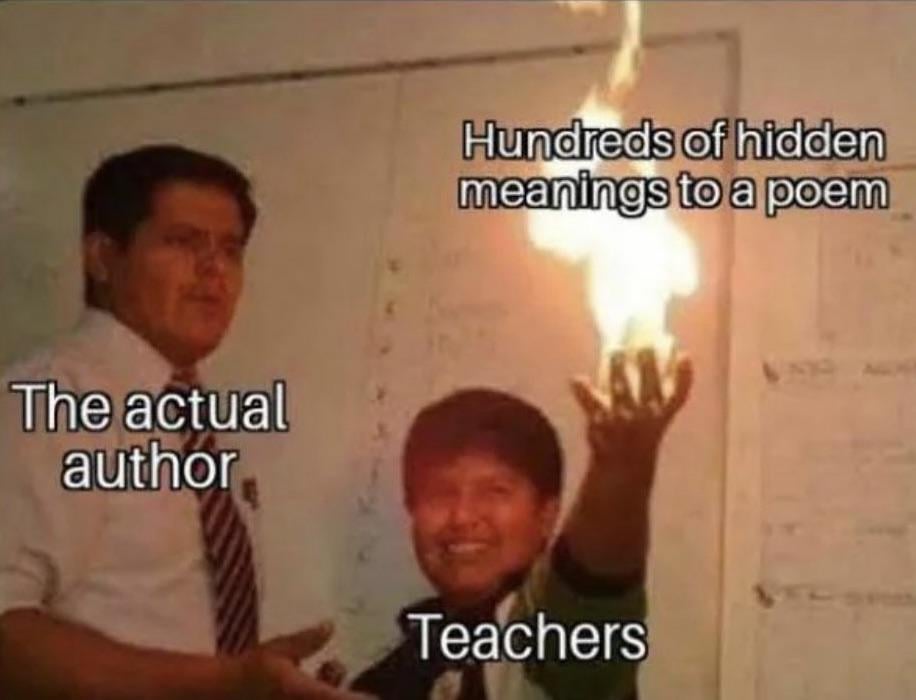
“The door was red”
Teacher’s interpretation: The man was full of anger and hatred (and this somehow devolves into talking about the power of nature or the power of God).
Author: The door is red because it’s my favourite colour.
“I think this is a good representation of the authors life” was my go to.
A Polish poet Wisława Szymborska once took a test on her own poems, the teacher gave her a low grade saying ‘this is not what the author meant’ or something like that.
Dear god I hated that shit in literature classes. Stop. Making. Shit. Up. DONT GRADE IT EITHER.
In the movie “Back To School” Rodney Dangerfield’s character hires Kurt Vonnegut to write the book report on Slaughterhouse Five. The professor gives Dangerfield a low grade and says “did you even read the book”.
My school once invited a local poet, whose poems had actually made it into some school books. The guy was legit flabbergasted reading through the analyses of his work. “I wasn’t thinking any of that. Y’all are making children hate literature”.
This was one of the worst things about public school, and perfectly illustrates why I hated it so much.
“The dog ran fast”
My stupid high school teachers for some reason: “The dog’s frantic sprint symbolizes humanity’s perpetual struggle against the inexorable march of time, illustrating how instinctual drives often collide with societal expectations.”
“I don’t understand subtext so I’m going to blame my teachers and think Fight Club is just a fun movie about punching dudes”
I had a history teacher that insisted INSISTED that the Wizard of Oz was a metaphor for world war 2…somehow despite predating it.
Like she actually forced us to do a report on how it was a metaphor for ww2 which we needed for a passing grade.
Creativity is such a blessing!
Doesn’t matter what the original author’s intentions were. That’s the nature of art.
Okay this is a common high schooler complaint. Let me explain why that’s wrong:
Think of a meme, something with little intent like 67. The ‘authors’ obviously didn’t try to say a lot by populatizing it but there is a fuckton to interpret about it. The history of HipHop influencing the original lyrics, online pop culture spreading the meme, modern absurdist humor and brainrot evolving from the deep fried meme era, nihilism in society etc.
When analyzing a piece of art you’re trying to understand why it does what it does. You could for example wonder why a meme got popular.
It’s the same for books, movies, etc.
The authors intent is an interesting piece of the puzzle but is Star Wars truly popular because it’s a Vietnam war allegory? Or do we have to dig deeper to understand why it’s been a fan favorite for decades?
I’m by no means an expert on media analysis but this complaint has been around since I’ve been in school myself and it misses the point.
I seem to recall a story where a teacher friend of John Lennon told him that they were analyzing Beatles songs for hidden meaning. Lennon, either annoyed or amused by this, wrote “I am the Walrus” to give them something they really could analyze.
Ray Bradberry saw the effects of this when he went to present what he meant in Fahrenheit 451 (i.e., that tv was dangerous and new technology was making people mindless). UC students told him he was wrong because their teachers told them to interpret the book as anti-censorship.
That’s all literature analysis was for me at school, just bullshit your way through until you run out of time. You extract every single word and details into meanings and metaphors.
So many people have this didactic idea about art like it’s always trying to teach you a lesson. A poem should be an experience, not a lesson. The meaning that you derive from the experience is yours alone. If has a single meaning it’s probably bad.
This is before, of course, students learn that there are different lenses one can use to interpret literature. Sure, most students tend to roll their eyes when there might be more to the color that’s used in a story, but it’s how that interpretation is presented in an argument backed with evidence that’s pertinent. If a teacher is indicating that a red door means the protagonist is angry, but there isn’t evidence to prove this, one can see why students become frustrated with these types of interpretation. As a teacher I have students play devil’s advocate. What other reasons can there be for the door to be red?
Further, by implying that an author chooses a color without purpose can also be a slippery slope. Whether the reason is to have a color have meaning or to set an ambient tone, or to have a realistic depiction of the scene so a reader can visualize what’s happening using imagery, the reader must provide evidence to the claim.
I hated English class for this reason.
I look at it, and whilst I can see how some bits are metaphors and have some meanings, when my teacher would write a ton of different perspective on a single line… I just bluescreened.
Are you certain you aren’t looking into it a bit too deeply?
I forget the bame of the book by i remember my highschool English teacher talking about how the author put in so many references to how god is always with us and references to the authors devout faith. When googleing some info for the essay we had to wright I discovers the author was actually an atheist, and publicly stated that this book was anti religion. I got a D- for my “anti Christian interpretation” this was a public school BTW.
Y’all act like this then complain about movies being too confusing or not “getting” them.
Media literacy is a skill. Making connections between events, descriptions, and thematic elements is a skill. I’m sorry it annoys you, but if you don’t practice, you won’t learn.
that’s the point of media literacy though
finding all of the potential meanings and messages you can derive from a piece of work, even if that interpretation isn’t likely. Counter evidence is important too, and interpreting a poem or any story can be like a fun puzzle where you find some sort of meaning. Or maybe the point of a story is that there is no meaning and that’s also valid. Sometimes a story is just a story or a poem is just a poem.
The problems only occur when you enforce a certain interpretation and baselessly dismiss any others without much thought.