
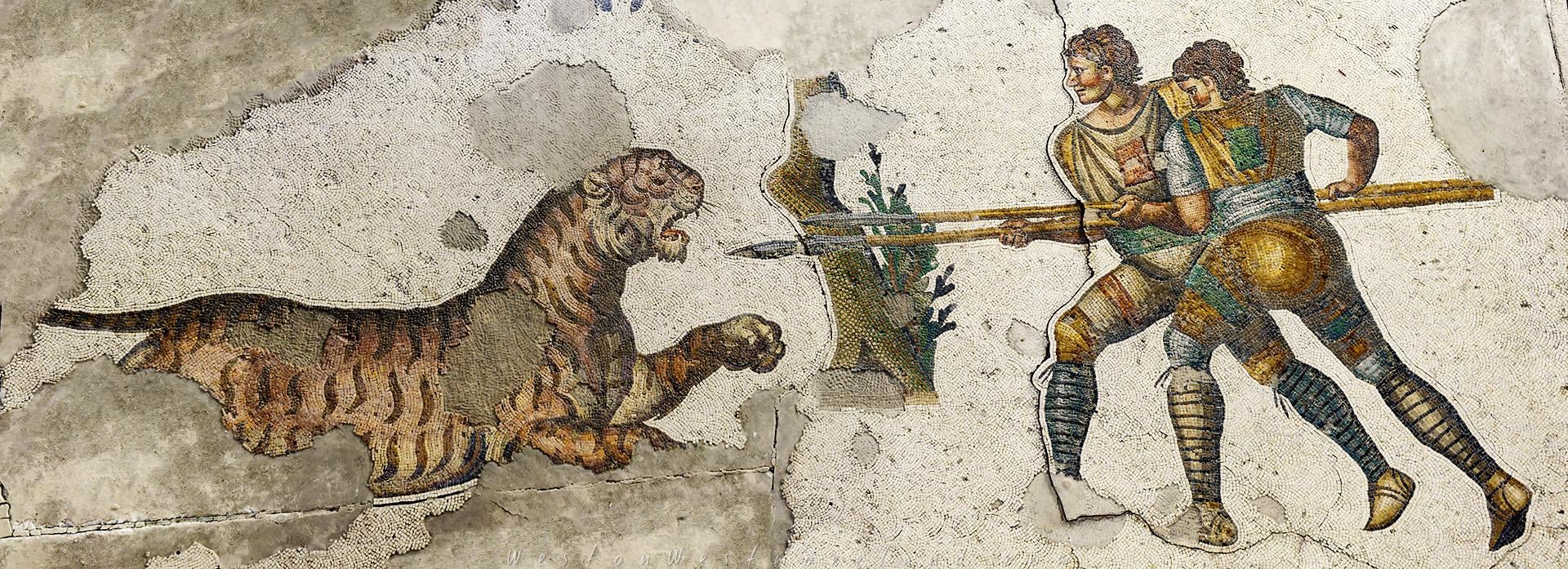
Mosaic of two Venatores facing a tiger. Peristyle court, Palatium Magnum, Constantinople, 531-602 AD, Roman Empire. Possibly from the times of Justinian I builder of Hagia Sophia, this mosaic can be admired at its original location on the court that Justinian himself might have trod… [1920×1080][OC]
by WestonWestmoreland
1 Comment
…right by the hippodrome that now forms the Sultanahmet square in Istanbul.
Venatores (hunters) were a type of performer in ancient Rome who specialized in hunting and fighting wild animals in Roman amphitheaters, like the Colosseum. In staged hunts or combat scenarios, they would face off against dangerous animals such as lions, bears, wild boars, tigers…
The tesserae, these small cubes made of glass, colored lime, or terracotta, were about 5 mm long. There were about 40,000 tesserae per m2. The size of the complete mosaic floor, which surrounded a large court at the Great Palace of Constantinople, was about 2,000 m2, so the grand total summed up to 80,000,000 tesserae.
Unfortunately, only some 250 m2 have reached our times – still sufficient for no less than 150 figures. With only one eighth of the mosaic, however, we get an idea of the themes in general. There were hunting scenes, representations of animals, playing children, and bucolic landscapes (including a rare picture of a watermill). There are fantastic animals like a griffin devouring a lizard or a [chimaera ](https://www.reddit.com/r/ArtefactPorn/comments/15g68gh/roman_mosaic_of_a_chimera_usually_seen_as_a_lion/#lightbox)(usually seen as a lion with a goat head on its back and a snake’s head tail) about to be attacked by the hero Bellerophon.
None of these figures could be identified as specifically Christian. Some of them may indeed be pagan. Written texts were not found, nor are there boundaries to separate the various scenes, as can be seen in contemporary mosaics.
The combination of the various elements may strike us as odd: what are playing children doing between hunting scenes? The fact that there are no inscriptions suggests that, to most visitors in the sixth century, the meaning was self-evident or could be discovered without too much study.
My apologies for inaccuracies and mistakes.