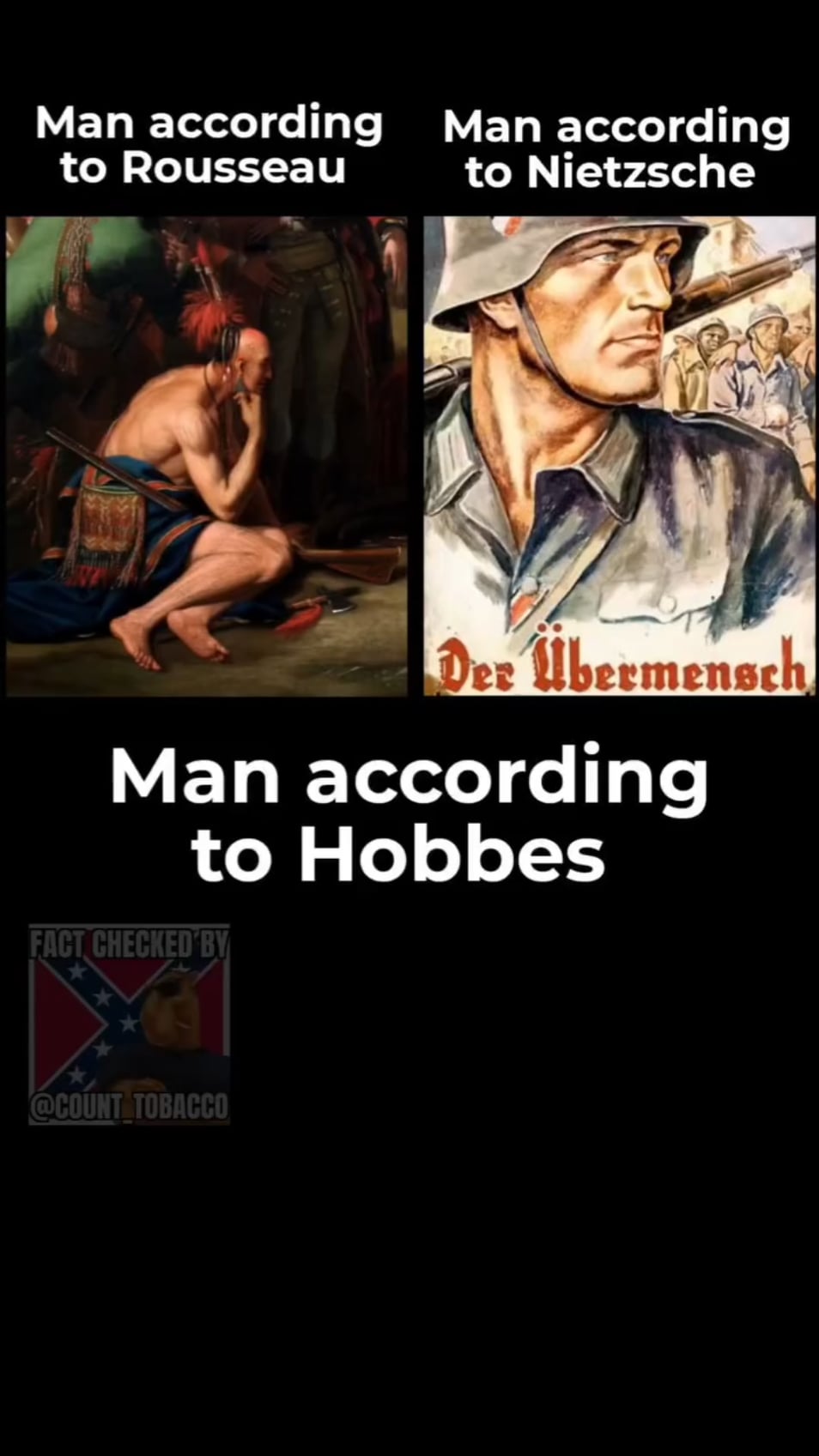
Jean-Jacques Rousseau, writing in the mid-18th century, argued in his Discourse on Inequality that humanity in its original condition was peaceful, self-sufficient, and compassionate—a solitary but gentle “noble savage” whose needs were simple and whose pity for others was natural. Only the emergence of private property, society, and comparison with others corrupted this innocence and introduced conflict, vanity, and oppression.
Friedrich Nietzsche, a century later, rejected any notion of a gentle primordial state. He saw the earliest humans as blond, predatory “beasts of prey” whose vitality, strength, and will to power were magnificent precisely because they were unrestrained by pity or equality. Civilization, especially Christian morality with its emphasis on meekness and compassion, was for him a taming and weakening process that bred resentment and produced the mediocre “last man.”
Thomas Hobbes described the natural condition of mankind with the famous line that without government, life would be “solitary, poor, nasty, brutish, and short,” and he repeatedly likened unrestrained human beings to wild animals, but the specific image he returned to again and again was the wolf. In De Cive he writes that men in their natural state must either be considered “as if they were but even now sprung out of the earth, and suddenly, like mushrooms, come to full maturity, without all kind of engagement to each other,” or, more pointedly, that “man is a wolf to man” (homo homini lupus). He borrowed the Latin phrase from Plautus but made it the centerpiece of his anthropology: outside the commonwealth, every person has a right to everything, trusts no one, and lives in continual fear and danger of violent death. The wolf, for Hobbes, was not noble or majestic; it was a lean, suspicious, predatory creature that prowled alone or in small packs, ready to tear apart anything weaker the moment opportunity arose. Only the overwhelming power of an absolute sovereign—the Leviathan—could force these human wolves into peaceful coexistence by making the cost of aggression higher than any possible gain.
-Minne on
Gotta be honest here; that post is way too long for me to read at my speed, and just looking at that clip immediately gave me a “what the fuck? face.
Someone explain the joke, I am in 4th grade and can’t comprehend this level of jerking.

2 Comments
Jean-Jacques Rousseau, writing in the mid-18th century, argued in his Discourse on Inequality that humanity in its original condition was peaceful, self-sufficient, and compassionate—a solitary but gentle “noble savage” whose needs were simple and whose pity for others was natural. Only the emergence of private property, society, and comparison with others corrupted this innocence and introduced conflict, vanity, and oppression.
Friedrich Nietzsche, a century later, rejected any notion of a gentle primordial state. He saw the earliest humans as blond, predatory “beasts of prey” whose vitality, strength, and will to power were magnificent precisely because they were unrestrained by pity or equality. Civilization, especially Christian morality with its emphasis on meekness and compassion, was for him a taming and weakening process that bred resentment and produced the mediocre “last man.”
Thomas Hobbes described the natural condition of mankind with the famous line that without government, life would be “solitary, poor, nasty, brutish, and short,” and he repeatedly likened unrestrained human beings to wild animals, but the specific image he returned to again and again was the wolf. In De Cive he writes that men in their natural state must either be considered “as if they were but even now sprung out of the earth, and suddenly, like mushrooms, come to full maturity, without all kind of engagement to each other,” or, more pointedly, that “man is a wolf to man” (homo homini lupus). He borrowed the Latin phrase from Plautus but made it the centerpiece of his anthropology: outside the commonwealth, every person has a right to everything, trusts no one, and lives in continual fear and danger of violent death. The wolf, for Hobbes, was not noble or majestic; it was a lean, suspicious, predatory creature that prowled alone or in small packs, ready to tear apart anything weaker the moment opportunity arose. Only the overwhelming power of an absolute sovereign—the Leviathan—could force these human wolves into peaceful coexistence by making the cost of aggression higher than any possible gain.
Gotta be honest here; that post is way too long for me to read at my speed, and just looking at that clip immediately gave me a “what the fuck? face.
Someone explain the joke, I am in 4th grade and can’t comprehend this level of jerking.