
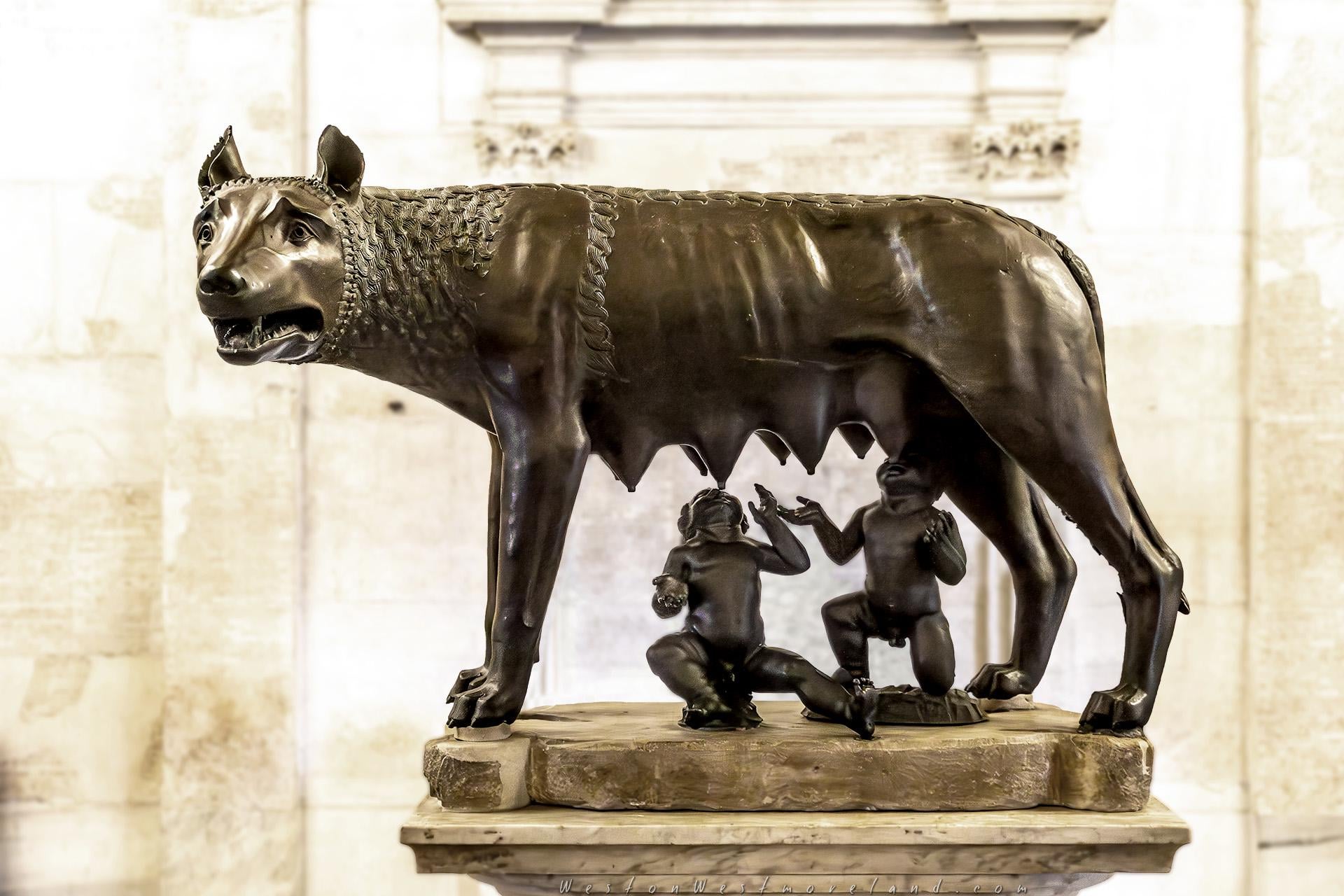
The Lupa Capitolina (Capitoline Wolf), a symbol of Rome since ancient times, is a bronze sculpture of a she-wolf suckling the twins Romulus and Remus after the legend of the foundation of the Eternal City. Thought to be an Etruscan sculpture from the 5th century BC for a long time… [1920×1280][OC]
by WestonWestmoreland
3 Comments
…with the twins added in the late 15th century AD, the matter of the origin and age of the she-wolf itself remains undetermined.
According to the legend, when King Numitor, grandfather of the twins, was overthrown by his brother Amulius in Alba Longa, the usurper ordered them to be cast into the Tiber River. They were rescued by a she-wolf that cared for them until a herdsman, Faustulus, found and raised them.
The image of the she-wolf suckling Romulus and Remus has been a symbol of Rome since ancient times, and one of the most recognizable icons of ancient mythology. Several ancient sources refer to statues depicting the wolf suckling the twins. Livi and Pliny the Elder (who died in Pompeii in the eruption of the Vesuvius) mention the presence of a statue of a she-wolf. Cicero also mentions a statue of the she-wolf — a gilt statue of a baby being given suck from the udders of a wolf — as one among some sacred objects on the Capitoline inauspiciously struck by lightning in 65 BC. The Capitoline Wolf was widely assumed to be the very sculpture described by Cicero, due to the presence of damage to the sculpture’s paw (you can see it on the left hind leg), which was believed to correspond to the lightning strike.
The wolf is depicted in a tense, watchful pose, with alert ears and glaring eyes, which are watching for danger. Scholars attribute it to an unknown Etruscan artist of around 480 or 470 BC, based on how the wolf’s fur was depicted. The twins – executed in a completely different style – are oblivious to their surroundings, absorbed by their suckling.
In 2006, Italian art historian Anna Maria Carruba and archaeologist Adriano La Regina contested the traditional dating of the wolf on the basis of an analysis of the casting technique. Carruba had been given the task of restoring the sculpture in 1997, enabling her to examine how it had been made. She observed that the statue had been cast in a single piece, using a variation of the lost-wax casting technique. This technique was not used in Classical antiquity. Ancient Greek and Roman bronzes were typically constructed from multiple pieces, a method that facilitated high-quality castings with less risk. Single-piece casting was widely used in the Middle Ages to mold bronze items that needed a high level of rigidity, such as bells and cannons. Carruba argues that the damage to the wolf’s paw resulted from an error in the molding process. In addition, La Regina, former superintendent of Rome’s archaeological heritage, argues that the sculpture’s artistic style is more akin to Carolingian and Romanesque art than that of the ancient world.
Radiocarbon and thermoluminescence dating were carried out at the University of Salento in February 2007 to resolve the question. The results revealed with an accuracy of 95.4% that the sculpture was crafted between the 11th and 12th centuries AD. A 2019 radiocarbon study based on organic residues in the casting cores recovered from the inner part of the statue claims to “firmly anchor the statue to the XI-XII centuries CE, in the Middle Ages.”
However, a recent study by John Osborne at the British School at Rome concluded that the radiocarbon and thermoluminescence dates were totally inconsistent. He pointed out that metal from which the wolf is made is of the Etruscan type, using copper from Sardinia, and that there is no sign of the adulteration common in medieval times. On the balance of probabilities, Osborne argues that the wolf should be considered Etruscan.
In other words… we don’t really know. Yet.
The sculpture has been housed since 1471 in the *Palazzo dei Conservatori* on the Campidoglio (the ancient Capitoline Hill), where it was transferred along with several other ancient sculptures to form the core of the Capitoline Museum. It’s been there ever since.
The Capitoline Wolf was used on both the emblem and the poster for the 1960 Summer Olympics in Rome. The Roman football club A.S. Roma uses it in its emblem as well.
The governments of Italy and the mayors of Rome have donated many replicas through the years. They can be found all around the world.
I cannot finish without at least mentioning the fact that the term “she-wolf”, *Lupa in Latin*, also means whore. There are other interpretations to the myth of the lupa rescuing and nursing the twins who would later found Rome, but that is another story and shall be told another time… 😜
My apologies for inaccuracies and mistakes.
That wolf looks a little dismayed.
“Awoo:)” – Shakira