
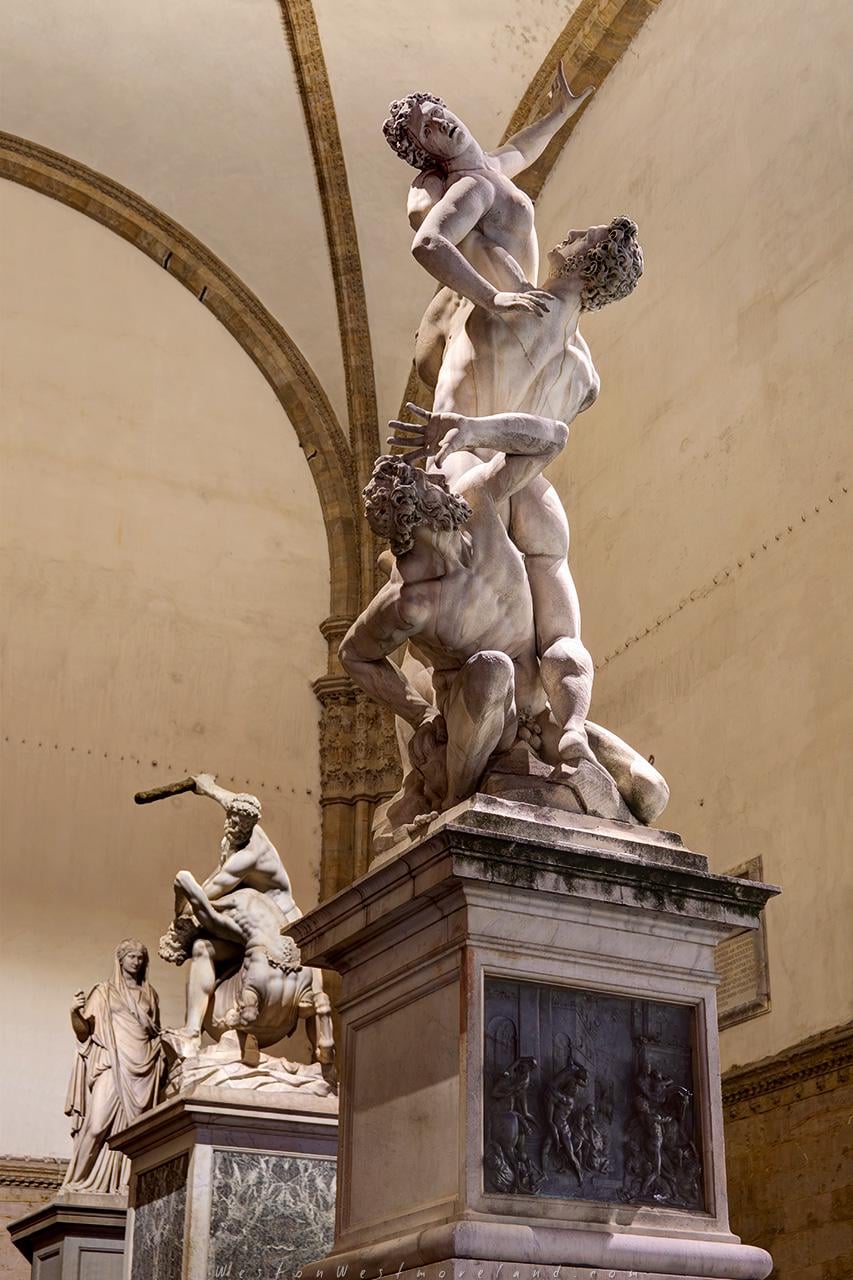
Three statues at the Loggia dei Lanzi, Florence, there since the 1500s. The Abduction of the Sabine Women and Hercules and Nessus, were both carved by Giambologna, each from a single piece of marble. The one at the bottom called Sabina, is a Roman original from the 2nd Century AD… [1280×853] [OC]
by WestonWestmoreland
1 Comment
…The Loggia dei Lanzi, also called the Loggia della Signoria, is a building on the south corner of the Piazza della Signoria in Florence, Italy, adjoining the Uffizi Gallery and the Palazzo della Signoria, the political center of the city. The loggia consists of three very high and wide arches open to the Piazza and on its east side to the Uffizi. The arches rest on cluster columns with Corinthian capitals. The wide arches appealed so much to the Florentines that Michelangelo proposed that they should be continued all around the Piazza della Signoria. It is effectively an open-air sculpture gallery of antique and Renaissance art.
The loggia was built between 1376 and 1382 to house the assemblies of the people and hold public ceremonies, such as the swearing into office of the Gonfaloniere of Justice and the Priores. The construction of the Loggia is in stark contrast with the severe architecture of the Palazzo Vecchio.
The name Loggia dei Lanzi dates back to the reign of Grand Duke Cosimo I, when it was used to house his formidable Landsknechts (In Italian: lanzichenecchi, corrupted to lanzi), or German mercenary pikemen. After the construction of the Uffizi at the rear of the Loggia, the Loggia’s roof was modified and became a terrace from which the Medici princes could watch ceremonies in the piazza.
A mostly peculiar, lovely and welcoming part of Florence. As for the sculptures in the picture…
The Abduction of the Sabine Women (1583) was carved from the largest block of white marble ever transported to Florence. Boulogne composed a “figura serpentina”, an upward snakelike spiral movement. This is the first group representing more than a single figure in European sculptural history to be conceived without a dominant viewpoint. It can be equally admired from all sides. This marble group was conceived to be displayed in this place and has been in the Loggia since 1583. The identification of the subject mattered so little to Giambologna that he called earlier versions of the same group Paris and Helen, Pluto and Proserpina, and Phineus and Andromeda. His chief interest lay in the energy of the spiral movement and the vitality of the male and female figures, and he succeeded so well in their rendition that Baroque sculptors, particularly Bernini, never forgot this group.
A redditor called *notahighpriority* corrected and enlightened me in a previous post of this sculpture: “it was the largest block of perfect (I had posted it was imperfect) marble transported to Florence at the time. An imperfect block of marble, as stated, usually had discolorations or cracks, making it less valuable. Sculptors used a mix of wax and marble dust to cover or fill the cracks. It was almost undetectable until the wax discolored the marble over time. So the term “sine cera” that translates to without wax was coined to denote the different values of marble sculpture. No wax being the best. The term also gave us the word sincere.”
The proto-Baroque tendencies of the late style of the Mannerist Giambologna are strongly apparent in his Hercules and the centaur Nessus (1600). His movement away from the grace and elegance of the mannerist style and into the realism of the Early Baroque is complete in this group.
This marble group was unveiled by Giambologna in 1600 at the Canto de’ Carnesecchi in Florence. It was moved in 1842 from its original site to the Loggia dei Lanzi.
In Greek mythology, Nessus’s father, Centauros, was killed by Hercules. In revenge for his father’s death, Nessus attempted to kidnap Hercules’s wife. He was caught in the act and killed, the scene which is depicted here. As tragedy would have it, Nessus had tainted blood, which was used to poison and kill Hercules in turn just several years later.
Giambologna was following the grand footsteps laid down by Michelangelo a century earlier. Notice the contrast in the facial expressions of Hercules with the wild centaur, who has already been struck down but is not yet defeated. This is thought to have been inspired after the famous sculpture by Baccio Bandinelli titled “Hercules and Cacus”. Giambologna tried to create a more dynamic version of the epic ending of the fight between Hercules and the Centaur, Nessus.
As for the female Roman statue, I didn’t find much. She is thought to have been found in the 16^(th) century in Rome, in the Trajan Forums, she is believed to be a relative of an emperor or other.
My apologies for inaccuracies and mistakes.