
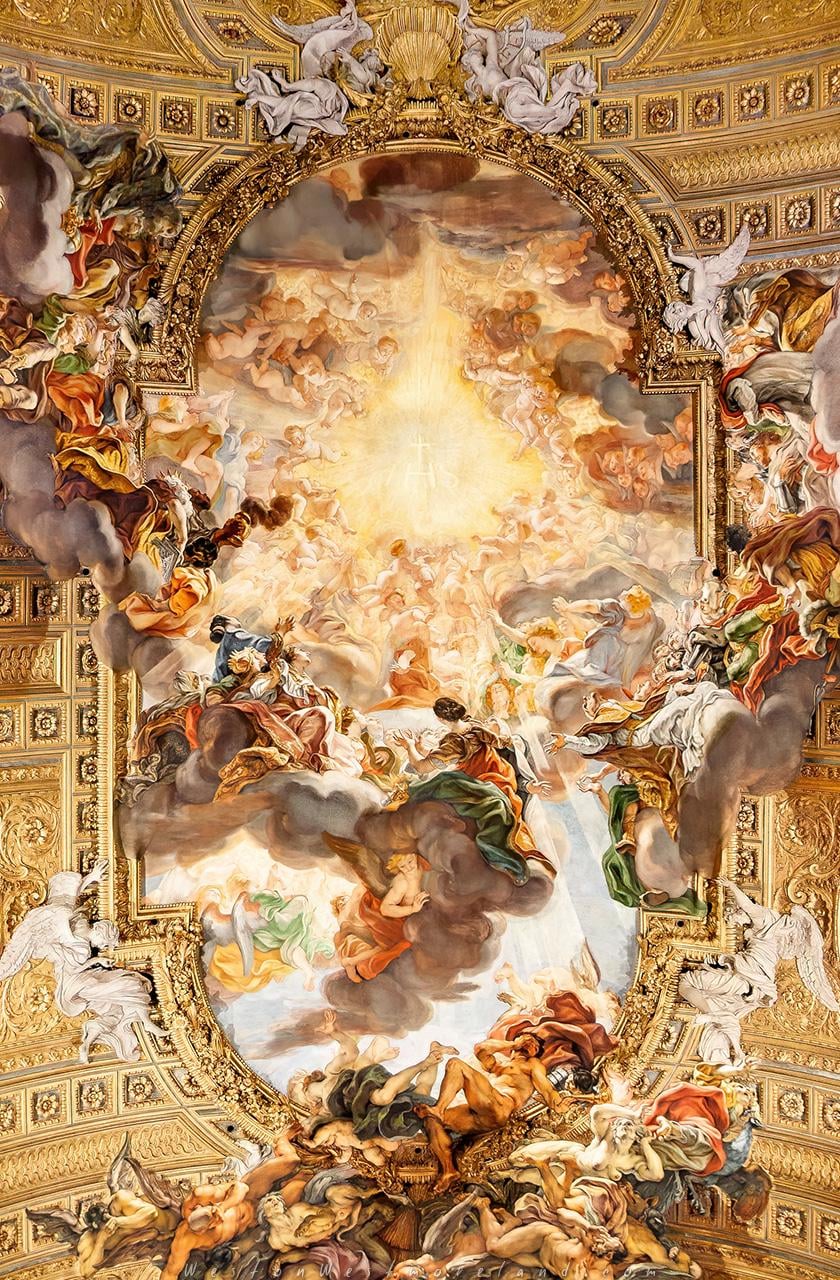
“Trompe l’oeil” is a technique to create 3D optical illusions. The fresco, statues, and frame on the ceiling of the church of Gesu in Rome, titled “Triumph of the Name of Jesus” (Gaulli, 1679) turn a part of the barrel vault into a gaping hole through which people fall or ascend…[1280×840] [OC]
by WestonWestmoreland
5 Comments
… heavenly skies. In addition to the painting, there are recognizable stucco decorations that go beyond the border outlined by the frame of the fresco.
Gaulli (1639-1709) had arrived in Rome aged eighteen after the rest of his family had been killed by the plague in Genoa in 1657. He soon came into contact with Bernini who, took him under his wing, instructed him, and acted as his master. Bernini would be the godfather of Gaulli’s first-born son.
With the teachings of Bernini, Gaulli learned to capture the spontaneity of expression so beloved in the Baroque. Gaulli owes a great deal of his success on the fresco to Bernini. Bernini obtained the commission for Gaulli and inspired some of the depictions. Without the influence of the illusion dictated by the blend of architecture and sculpture found in Bernini’s works — particularly in the [Ecstasy of Saint Teresa](https://www.reddit.com/r/ArtefactPorn/comments/vrui03/ecstasy_of_saint_teresa_by_bernini_1652_rome_one/) — Gaulli’s result would have been remarkably different.
One of Gaulli’s innovations is the dramatic breaking of the three-dimensional frame. The effect is an illusion of an authentic and material presence of the figures in Paradise, as if they were floating directly above the heads of the viewers. The depth achieved in the fresco extends beyond the physical ceiling, with the figures of the blessed being drawn towards an infinite sky. Gaulli decided to add a pronounced stucco frame around the painting, accentuating the division of the interior and “exterior” space of the vault. When the viewer looks at the fresco it is almost impossible to distinguish the paint and the stucco sculptures and decorations. This adds a further illusory effect to the scene, making it more believable that there are ascending and descending souls right before the viewer.
The fresco is characterized by meticulous attention to detail. Gaulli took into account the point of view of the faithful and painted the blessed in an extremely foreshortened manner to deceive the eye of the spectators. This stratagem attracts them and allows their eyes to linger on the various representations of the ascending angels; in addition, the size gives a sense of spiritual nature. At the apex of the celestial light is the monogram «IHS», so flooded with light that it appears almost illegible. This is the only representation of Jesus in the entire fresco, precisely because Christ is considered the light of the world; Gaulli decided to take this concept literally, choosing to represent Christ only through his initials and the divine light.
The composition can be divided into three parts. First of all, there is the celestial light and the initials of Christ in the center; then the arch of clouds that separates the blessed from the damned; finally, the figures of the damned who exit the scene. The blessed who rest on the clouds let their elbows hang over the frame, giving the impression that they have not ascended to celestial glory and that they are still in the church. They all have human features, giving hope to the faithful, who in this way see salvation as something possible and natural. The damned contrast greatly with the blessed because of their corrupt appearance: among them, there are those who are drawn with wings, claws and horns. Others are on the verge of transforming into canine creatures. Their faces are tormented and not all of them are able to bear the glare of the divine light, from which they protect themselves… (follows in replay)
fool the eye
Not comparing here. Merely offering further curios to the interested but uninitiated.
[https://commons.wikimedia.org/wiki/File:Benvenuto_Tisi_called_Il_Garofalo_-_Treasure_Room_Fresco_-_Google_Art_Project.jpg](https://commons.wikimedia.org/wiki/File:Benvenuto_Tisi_called_Il_Garofalo_-_Treasure_Room_Fresco_-_Google_Art_Project.jpg)
[https://en.wikipedia.org/wiki/Fall_of_the_Giants_(Romano)](https://en.wikipedia.org/wiki/Fall_of_the_Giants_(Romano))
baroque
All over Venezia!