
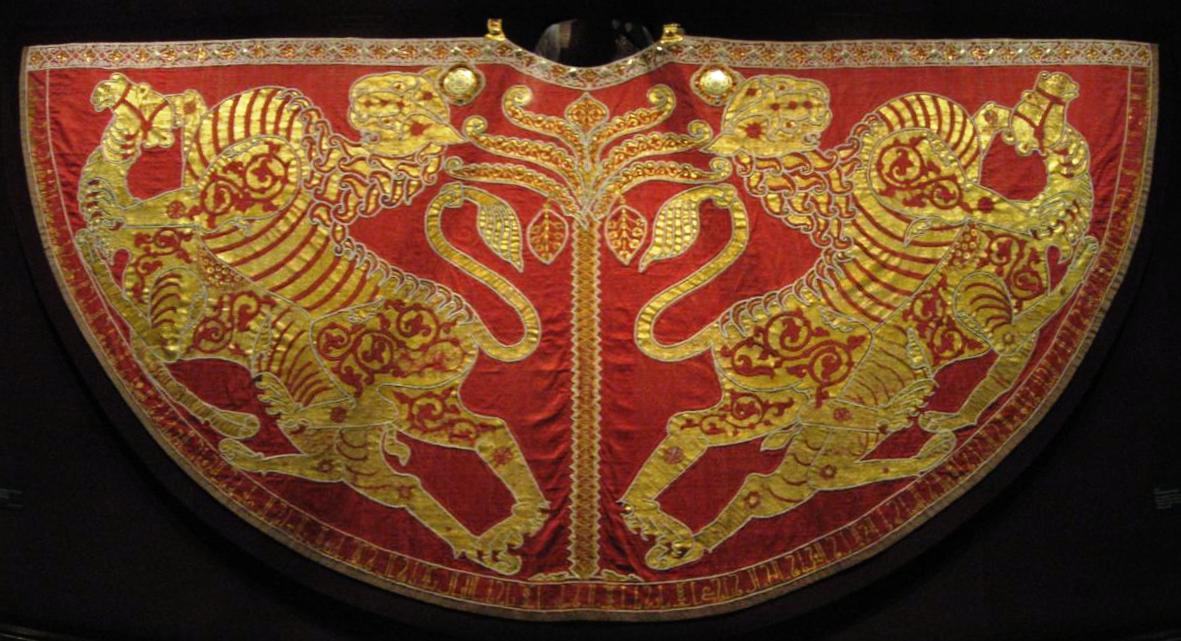
The Normans were the descendants of Vikings who had settled in North-Western France in the 10th century. In the second half of the 11th century, these Francized Vikings went on a conquering rampage, taking the British Isles and Sicily. While ruling over Britain, these Normans would trigger the development of a unique English identity, in Sicily, they oversaw the creation of unique Norman-Arab culture, a mingling of the Roman, Arabic and Byzantine-Greek traditions.
In 1194, the Dutch-born king of the German Empire, Henry VI, was crowned King of Sicily in Palermo after marrying the Sicilian Queen. Shortly after, Henry sent Sicily's crown treasure to Germany, the cloak being its most prized article. The cloak would be used in coronation ceremonies of the Christian German emperors until the late 19th century.
This cloak contains the image of a lion overtaking a camel. The outline of the cloak contains an Arabic inscription:
by Bnedem
1 Comment
>[Following the hem of the cloak is an embroidered Kufic inscription with good wishes for the wearer of the cloak. Although it is clearly legible, the translation and interpretation still raise questions that have not been fully answered. One possible translation is:](https://en.wikipedia.org/wiki/Coronation_cloak)
>>(This mantle) belongs to what has been worked in the royal workshop (ḫizāna), where happiness and honor, prosperity and perfection, merit and distinction have their seat, here in the royal workshop, which may enjoy good reception, splendid prosperity, great generosity and high splendor, fame and splendid endowment, and the fulfillment of wishes and hopes; Here, where the days and nights may pass in pleasure, without end and change; in the feeling of honor, attachment and encouraging participation in happiness and in the preservation of welfare, support and due activity; in the capital of Sicily in the year 528 of the Hejra.
>The inscription is written in a form of Arabic rhyming prose, the Saj’, which is mainly used in the Koran. The year 528 in the Islamic calendar corresponds to the year 1133 or 1134 in the Christian calendar.