**Context:**
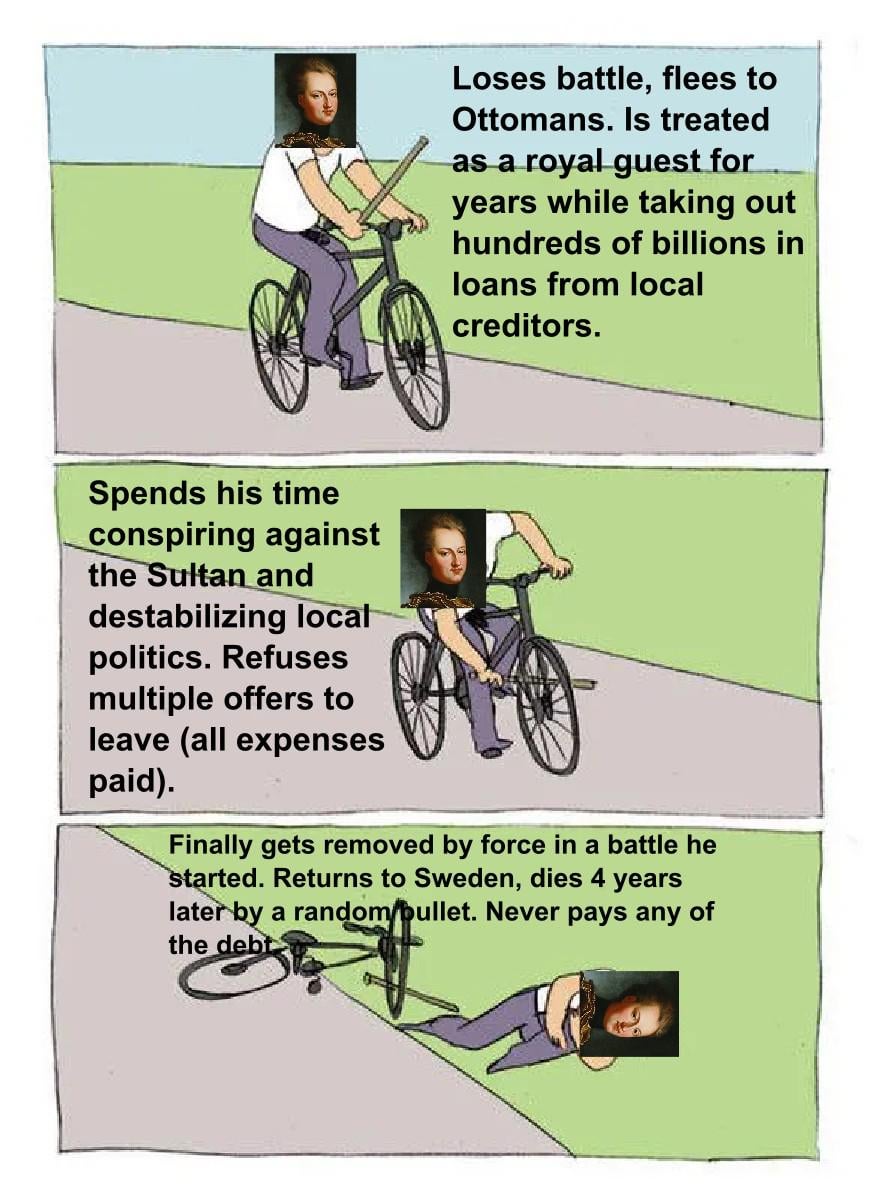
After his defeat at Poltava in 1709, Swedish King Karl XII fled to the Ottoman Empire and was granted asylum. He and his retinue settled in Bender, where he was treated as a royal guest. He would ultimately spend five years in Ottoman territory.
His entire stay was politically motivated. His goal was to convince Sultan Ahmed III to attack Russia. He successfully lobbied for the Russo-Turkish War, but the Ottomans signed a peace treaty after their victory at the Pruth River. This outcome infuriated Karl, as it secured Ottoman interests but did not help him reclaim his lost empire.
Financially, Karl’s stay was a massive burden. The Ottoman state paid him a generous daily allowance for his “court,” equivalent to over $15,000 per day. This was not enough for Karl, who was determined to maintain the appearance of a functioning royal government. He spent lavishly on his entourage, diplomatic missions, and bribes, funding it all on credit.
He financed this by borrowing enormous sums from a diverse group of local Ottoman subjects, including Armenian, Jewish, and Turkish merchants, bankers, and suppliers. This debt grew to over one million Swedish *riksdaler*. This sum was reportedly **three times the entire annual budget of the Kingdom of Sweden**, a figure comparable to $360 billion USD in relative economic value today.
His cost and stubbornness earned him the clever Turkish nickname **”Demirbaş Şarl.”** This was a pun with a double meaning: *demirbaş* literally means “iron head,” referencing his unyielding personality, but it was also the official bureaucratic term for a “fixed asset”—a non-moving, long-term item on the state’s inventory, like furniture, which Karl had become.
After the Pruth treaty, the Sultan repeatedly asked Karl to leave, even offering to pay for his journey. Karl refused, using his massive debt as a shield, believing the Sultan wouldn’t evict him and cause a financial crisis for the local creditors.
By 1713, the Sultan’s patience ended, and he ordered Karl’s forced removal in the “Skirmish at Bender” (*Kalabalik*). Karl and about 40 loyal bodyguards fought the Ottoman troops until he was captured. He was held under house arrest for another year before departing in 1714. He returned to Sweden, resumed his wars, and was killed by a bullet four years later in 1718.
The debt was never paid. Sweden, already bankrupted by the war, refused to honor the king’s personal debts. The creditors, facing financial ruin, took the extraordinary step of traveling to Sweden to petition the government. This was not a small delegation; it was a community in the low hundreds, including families and staff.
When Karl died, they became stranded. They could not afford the long journey home and could not leave without their money. They settled in Stockholm, living on a small state stipend. Their presence created a unique legal crisis, as Lutheran Sweden had no laws for non-Christians. To secure the loans, Karl had been forced to grant them the right to practice their religions, forcing Sweden to accommodate a small but permanent Jewish and Muslim community for the first time.
The original creditors grew old and died in Sweden. The Ottoman Sultan tried to intervene, sending a formal diplomatic envoy in 1727 to demand repayment. Sweden stalled. The Sultan sent another mission five years later in 1732, again without success. A final settlement decades later, meant for the creditors’ descendants, involved a payment of Swedish weapons, but the ship carrying them sank.

3 Comments
**Context:**
After his defeat at Poltava in 1709, Swedish King Karl XII fled to the Ottoman Empire and was granted asylum. He and his retinue settled in Bender, where he was treated as a royal guest. He would ultimately spend five years in Ottoman territory.
His entire stay was politically motivated. His goal was to convince Sultan Ahmed III to attack Russia. He successfully lobbied for the Russo-Turkish War, but the Ottomans signed a peace treaty after their victory at the Pruth River. This outcome infuriated Karl, as it secured Ottoman interests but did not help him reclaim his lost empire.
Financially, Karl’s stay was a massive burden. The Ottoman state paid him a generous daily allowance for his “court,” equivalent to over $15,000 per day. This was not enough for Karl, who was determined to maintain the appearance of a functioning royal government. He spent lavishly on his entourage, diplomatic missions, and bribes, funding it all on credit.
He financed this by borrowing enormous sums from a diverse group of local Ottoman subjects, including Armenian, Jewish, and Turkish merchants, bankers, and suppliers. This debt grew to over one million Swedish *riksdaler*. This sum was reportedly **three times the entire annual budget of the Kingdom of Sweden**, a figure comparable to $360 billion USD in relative economic value today.
His cost and stubbornness earned him the clever Turkish nickname **”Demirbaş Şarl.”** This was a pun with a double meaning: *demirbaş* literally means “iron head,” referencing his unyielding personality, but it was also the official bureaucratic term for a “fixed asset”—a non-moving, long-term item on the state’s inventory, like furniture, which Karl had become.
After the Pruth treaty, the Sultan repeatedly asked Karl to leave, even offering to pay for his journey. Karl refused, using his massive debt as a shield, believing the Sultan wouldn’t evict him and cause a financial crisis for the local creditors.
By 1713, the Sultan’s patience ended, and he ordered Karl’s forced removal in the “Skirmish at Bender” (*Kalabalik*). Karl and about 40 loyal bodyguards fought the Ottoman troops until he was captured. He was held under house arrest for another year before departing in 1714. He returned to Sweden, resumed his wars, and was killed by a bullet four years later in 1718.
The debt was never paid. Sweden, already bankrupted by the war, refused to honor the king’s personal debts. The creditors, facing financial ruin, took the extraordinary step of traveling to Sweden to petition the government. This was not a small delegation; it was a community in the low hundreds, including families and staff.
When Karl died, they became stranded. They could not afford the long journey home and could not leave without their money. They settled in Stockholm, living on a small state stipend. Their presence created a unique legal crisis, as Lutheran Sweden had no laws for non-Christians. To secure the loans, Karl had been forced to grant them the right to practice their religions, forcing Sweden to accommodate a small but permanent Jewish and Muslim community for the first time.
The original creditors grew old and died in Sweden. The Ottoman Sultan tried to intervene, sending a formal diplomatic envoy in 1727 to demand repayment. Sweden stalled. The Sultan sent another mission five years later in 1732, again without success. A final settlement decades later, meant for the creditors’ descendants, involved a payment of Swedish weapons, but the ship carrying them sank.
Danish propaganda
Great story op. Thanks.