we’ve all heard the stories about how native people were forced to speak english because the “colonizer” wanted them to become civil rather then the savage which they were seen as. while untrue, it was in hawai’i where dozens of westerners saw Hawaiian leaders as rather intelligent…especially for a native.
isaac davis was captured with john young during an event known as the olowalu massacre, where john young’s captain, simon metcalfe because the instigator and caused the massacre. prior to that, metcalf insulted a high ranking chief, kame’eiamoku, on the big island. all western ships were seen as kapu hewa, and the first to entire the shores of hawai’i was to be captured, and it’s crew slaughtered. the next ship was the fair american. isaac davis was a crew member and simon metcalfs son captained it. there are varying accounts about how kamehameha took this. some say he supported the capture, others say he was angry at ka me’eiamoku’s decision, but either way isaac davis was spared for his bravery. due to how he was beaten, accounts state that he remained blind for 18 months before he gained his full sight again. Isaac davis, along with a captured member of simon metcalfs crew, john young, because what I like to call “hostage advisors” of King kamehameha. eventually they became very close with the king and remained in the islands as his friend, with the two even being given the rank of ali’i. to my knowledge they gained the rank of ali’i. with the exception of kapu. (all ali’i, and all who worked or lived in their presence had both ceremonial and harsh kapu they had to follow based on their rank, genealogy or responsibility)
King Kamehameha had a wife, Queen ka’ahumanu, who was named after the old king of maui, kahekilinuiahumanu. Ka’ahumanu was kahekili’s niece; her brother was kuakini, who took the name john adams because he admired the american president and even sent various letters to the president, but to no response.
in 1809, Archibald Campbell was in the Hawaiian islands and did work for the King. “after two or three months of work, he [the king] desired me to make some canvas. having informed him that a loom was necessary, he had his principle carpenter, Boyd make one”
Boyd refused. with an idea that Campbell noted was “shared by many white people ***that the natives should be taught nothing that would render them independent of strangers***”
this is one of the earliest instances that gives us an idea about how foreigners look at hawaiians. in this case, the possibility that hawaiians could learn many “white abilities” on their own- something not liked at the time; for obvious reasons relating to racism. because of this, campbell was ordered to make a loom, which he did did.
isaac davis had a servant called jack (possibly miller keaka’ele’ele. a black mason who built for kamehameha and his family and nicknamed black jack; or naihekukui, who was a leader of hawai’is naval fleet and also known as captain jack).
this jack was anxious to observe campbell, but davis told him to not allow jack to try…”he was so quick, he’d learn to make a loom himself)
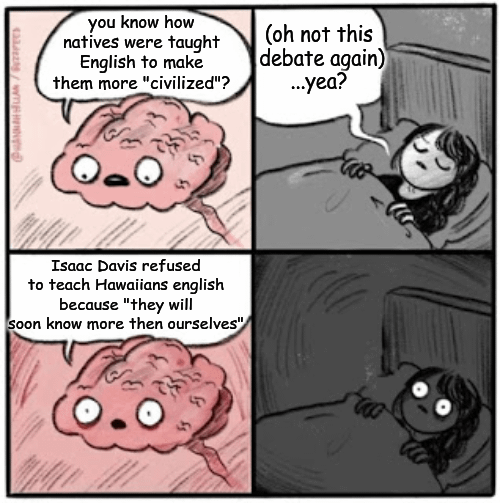
later such, queen ka’ahumanu’s brother whom the foreigners called john adams wished to learn english and to read and write….davis refused stating that “they will soon know more then themselves”….. 12 years later, the queen would learn to read and write and would push for the education of her people on reading and writing, leading to the hawaiian alphabet, and the mass production of hawaiian newspapers.
it is not known what davis thought about his hawaiian counterparts. it is not known what he understood or assumed about the hawaiians intelligence. he lived with the royal family and among the hawaiian people for over 20 years before his own death. whatever he knew, he felt that the hawaiians eventually would be on the same level as their white counter parts, something he openly opposed.

1 Comment
we’ve all heard the stories about how native people were forced to speak english because the “colonizer” wanted them to become civil rather then the savage which they were seen as. while untrue, it was in hawai’i where dozens of westerners saw Hawaiian leaders as rather intelligent…especially for a native.
isaac davis was captured with john young during an event known as the olowalu massacre, where john young’s captain, simon metcalfe because the instigator and caused the massacre. prior to that, metcalf insulted a high ranking chief, kame’eiamoku, on the big island. all western ships were seen as kapu hewa, and the first to entire the shores of hawai’i was to be captured, and it’s crew slaughtered. the next ship was the fair american. isaac davis was a crew member and simon metcalfs son captained it. there are varying accounts about how kamehameha took this. some say he supported the capture, others say he was angry at ka me’eiamoku’s decision, but either way isaac davis was spared for his bravery. due to how he was beaten, accounts state that he remained blind for 18 months before he gained his full sight again. Isaac davis, along with a captured member of simon metcalfs crew, john young, because what I like to call “hostage advisors” of King kamehameha. eventually they became very close with the king and remained in the islands as his friend, with the two even being given the rank of ali’i. to my knowledge they gained the rank of ali’i. with the exception of kapu. (all ali’i, and all who worked or lived in their presence had both ceremonial and harsh kapu they had to follow based on their rank, genealogy or responsibility)
King Kamehameha had a wife, Queen ka’ahumanu, who was named after the old king of maui, kahekilinuiahumanu. Ka’ahumanu was kahekili’s niece; her brother was kuakini, who took the name john adams because he admired the american president and even sent various letters to the president, but to no response.
in 1809, Archibald Campbell was in the Hawaiian islands and did work for the King. “after two or three months of work, he [the king] desired me to make some canvas. having informed him that a loom was necessary, he had his principle carpenter, Boyd make one”
Boyd refused. with an idea that Campbell noted was “shared by many white people ***that the natives should be taught nothing that would render them independent of strangers***”
this is one of the earliest instances that gives us an idea about how foreigners look at hawaiians. in this case, the possibility that hawaiians could learn many “white abilities” on their own- something not liked at the time; for obvious reasons relating to racism. because of this, campbell was ordered to make a loom, which he did did.
isaac davis had a servant called jack (possibly miller keaka’ele’ele. a black mason who built for kamehameha and his family and nicknamed black jack; or naihekukui, who was a leader of hawai’is naval fleet and also known as captain jack).
this jack was anxious to observe campbell, but davis told him to not allow jack to try…”he was so quick, he’d learn to make a loom himself)
later such, queen ka’ahumanu’s brother whom the foreigners called john adams wished to learn english and to read and write….davis refused stating that “they will soon know more then themselves”….. 12 years later, the queen would learn to read and write and would push for the education of her people on reading and writing, leading to the hawaiian alphabet, and the mass production of hawaiian newspapers.
it is not known what davis thought about his hawaiian counterparts. it is not known what he understood or assumed about the hawaiians intelligence. he lived with the royal family and among the hawaiian people for over 20 years before his own death. whatever he knew, he felt that the hawaiians eventually would be on the same level as their white counter parts, something he openly opposed.