
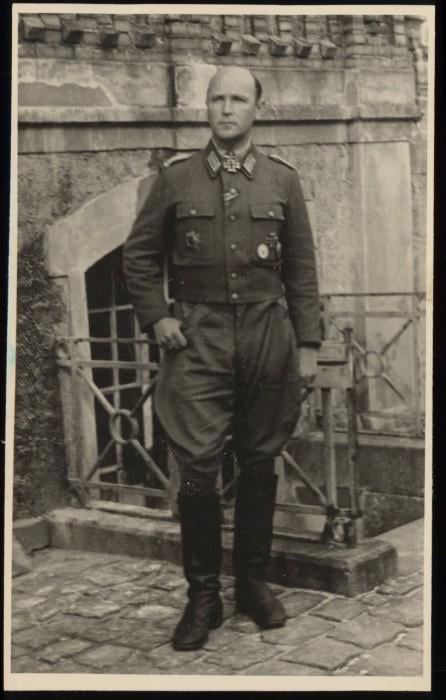
The last photo of former German Army colonel Erich Hammon, taken an hour before his execution by firing squad. A British military tribunal had convicted Hammon of murdering a recently liberated Russian slave laborer in Flensburg on V.E. Day, Allied-occupied Germany, May 30, 1945 [446 x 700].
by lightiggy
3 Comments
On May 7, 1945, [Erich Hammon](https://web.archive.org/web/20220303055409/https://itshistoria.com/military/erich-hammon/), a former German Army colonel who’d served in the entire war from start to finish and survived, noticed an argument between an elderly German woman and several liberated Soviet prisoner of wars. A Russian had evidently stolen a golden watch from the woman. When Hammon intervened, the man start running anyway. Hammond ordered ordered a sentry to shoot him. When the sentry refused, Hammon grabbed the rifle and fatally shot the Russian. He was promptly arrested by British military police and charged with murder.
On May 29, 1945, a British military court convicted Hammond of illegally using a firearm to murder an Allied national. Disregarding his plea that he had a wife and four children, the court sentenced him to death by firing squad. Hammond, 35, was shot the next day.
Hammon was arrested since the shooting was not done in self-defense.
Displaced people were not given carte blanche unless it was against those who indisputably had it coming, such as SS guards and Kapos. Far from it, [Allied occupation authorities executed dozens of displaced people](https://www.newspapers.com/article/the-oregon-daily-journal-displaced-perso/171022835/) for crimes committed in post-war Germany. Had the Russian been physically assaulting the woman or anyone else for that matter, that would’ve been different. However, that was evidently not the case here.
What really happened was that Hammon had needlessly murdered someone whom he viewed as subhuman and whose life he viewed as less valuable than a watch. The needlessness of it was emphasized by the sentry’s own refusal to comply. Hammond’s own ardent belief in the Nazi ideology is unambiguously proven by his actions and words in his final moments. He declared “Hail Germany” and gave a Nazi salute.
Guy was on the Eastern Front for 5+ years. I’m betting that wasn’t the first person he shot in the back.
I’m confused. If the sentry was British (Allied) why would Hammon think for a second that they would shoot the Russian? I can’t imagine that the sentry would have been German.