
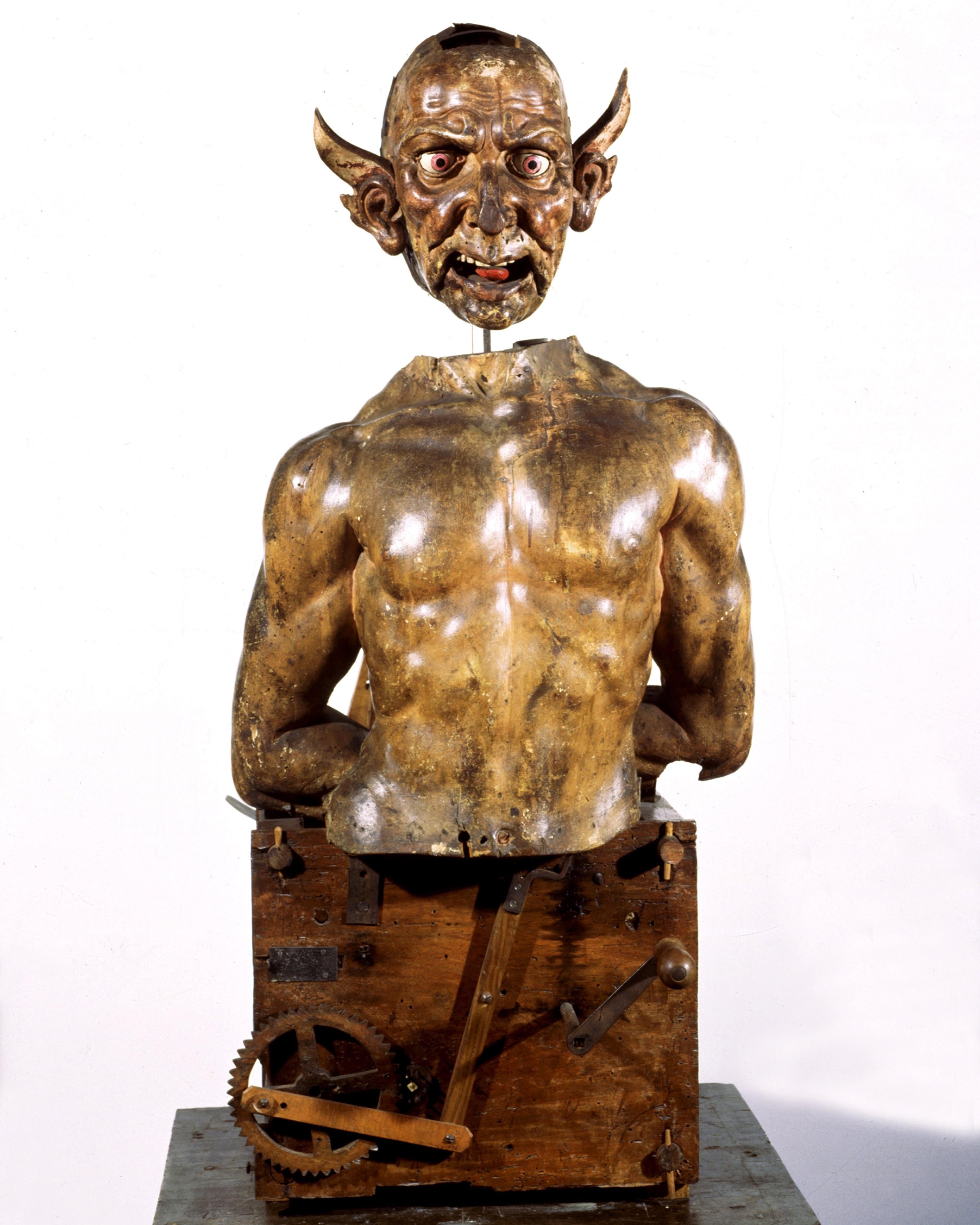
Automata of the Devil, which can move its head, eyes, mouth, tongue, and emit a strange noise to frighten visitors. Italy, 16th-17th century [4000×5000]
by MunakataSennin
Automata of the Devil, which can move its head, eyes, mouth, tongue, and emit a strange noise to frighten visitors. Italy, 16th-17th century [4000×5000]
by MunakataSennin
4 Comments
[Museum](https://artsandculture.google.com/asset/automata/ggG_1opfb9hu-A). This automata depicts a devil enchained whose internal mechanism enables him to move independently in order to frighten visitors. The mechanical function is at the back and is activated by a handle, which enables the head to turn to the right and to the left, the eyes to rotate, and the mouth to open wide, showing his tongue and emitting a strange noise. The torso, whose extreme naturalism recalls Christ at the Column by Bramante (today in the Pinacoteca di Brera, Milan), may have been created reusing a Lombard wooden statue of the early sixteenth century. The automata was one of the key pieces of the most famous Wunderkammer in Milan, created by Manfredo Settala.
Automata is pleural
Butterface Beelzebub
That bod tho 👀