
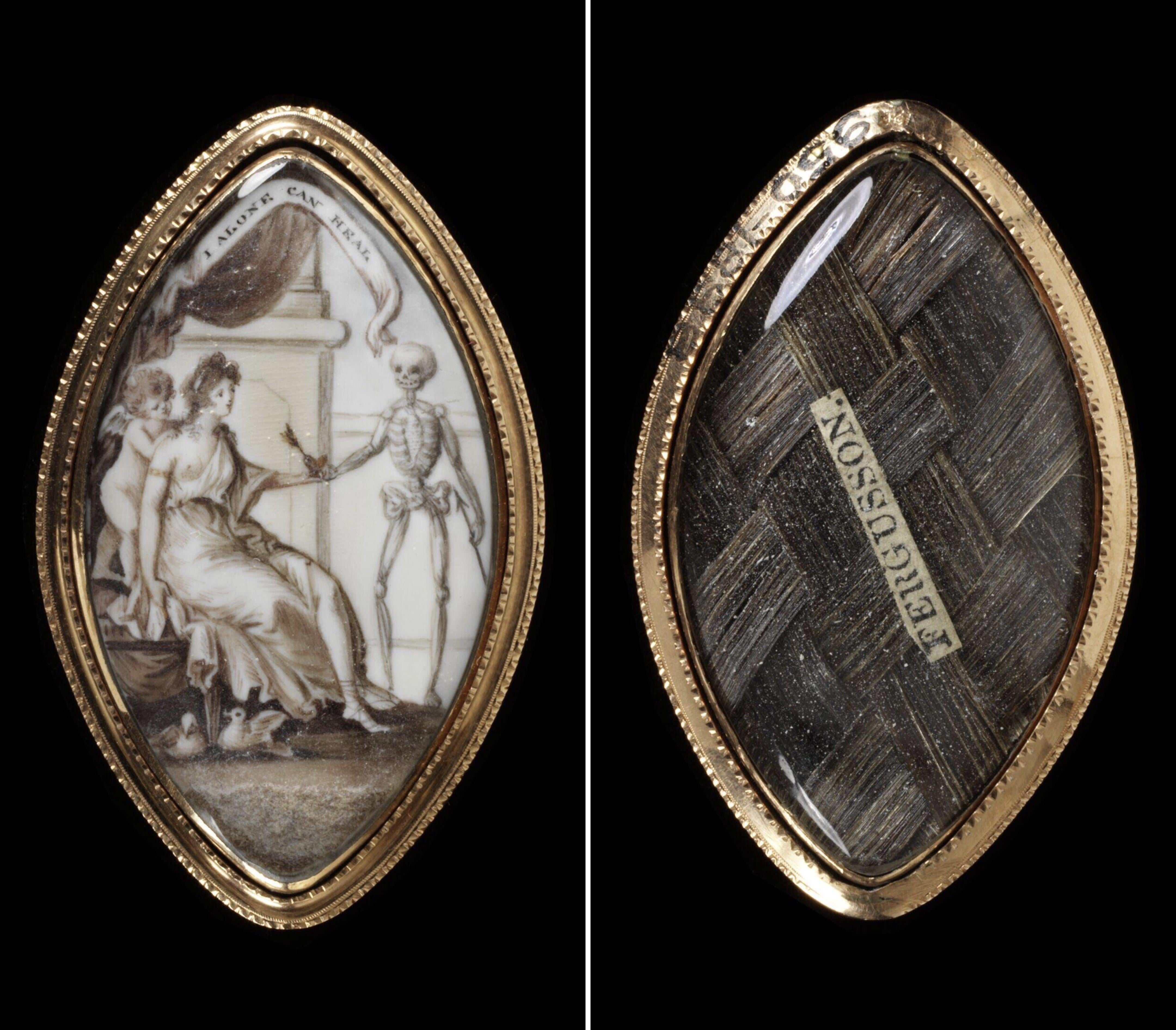
Engraved gold frame, ivory painted with watercolour with a miniature of a woman handing a heart pierced by an arrow to a figure of Death, surmounted by an inscription “I Alone Can Heal” The back of plaited hair crossed by the name Fergusson, England, 1775-1800 [4320 x 3785]
by Circes_season
1 Comment
“Memorial jewellery to honour the dead is one of the largest categories of 18th- century jewellery to survive. Many mourning jewels have inscriptions that record the name and dates of the dead person.
From 1760 there was a new vogue for memorial medallions or lockets. These became especially popular in Britain, though similar work was produced throughout Europe. The lockets could be bought ready made, and the designs were standardised. Neo-classical motifs of funerary urns, plinths and obelisks joined the more traditional cherubs, angels and weeping willows. Hair was preserved as curls within the locket, or cut up and used to create designs.
Although this locket uses much of the imagery of memorial jewellery, the message is one of love. The seated young woman is holding a heart pierced by an arrow. Cupid, the mischievous god of love hides behind her. The figure of death and the inscription ‘I alone can heal’ may suggest that death is the only cure for hopeless love.” From the [V&A Museum](https://collections.vam.ac.uk/item/O126163/locket-unknown/)