
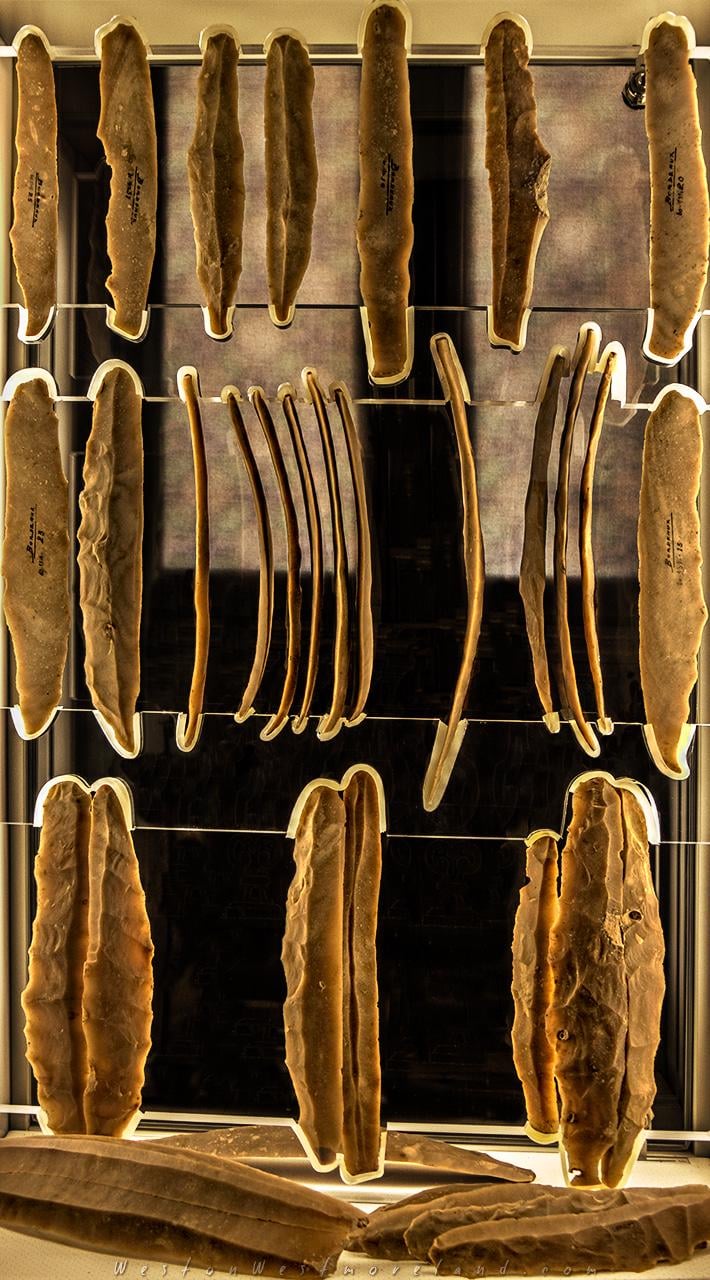
Blades obtained from a single “livre de beurre” (pound of butter) flint core c. 4500 BP, Neolithic. The core was shaped like a short fat baguette ~10″ long from which extremely long blades were produced by indirect percussion. The unusually pure flint that allowed this came from… [1280×853] [OC]
by WestonWestmoreland
1 Comment
…Le Grand-Pressigny, in the Loire Valley, France. The blades were used as knives and were traded extensively across Europe. The peak of production at the quarries occurred ca. 4450-4650 BP, during the Neolithic period.~
The cores found at the Grand-Pressigny were called ‘livre de beurre’ because local farmers thought they resembled a ‘pound of butter’. Blades from this source are found in large numbers on French Neolithic sites but were also traded to Switzerland, Germany, Belgium, and Holland. The “La Creusette” cache of about 138 blades from the Grand-Pressigny workshops was discovered in France in 1970. The blades measure from 25 to 38 cm long. They were not from one reduction event — if this were the case, the blades should conjoin (fit back together) — but few of them do. Rather, they are part of an original production of between 500 and 800 blades struck from between 50 and 80 cores, representing from 1 to 2 months of work by one flintknapper. This gives some indication of the scale of the trade in these items. One archaeologist estimated that 75,000 long blades were made at Grand-Pressigny.
The following explanation of the process is rather dense, so you can see the process in this short [video ](https://www.youtube.com/watch?v=KRHWjgDKxjE)from the Museum at Le Grand-Pressigny instead or as a complement.
Grand-Pressigny flint occurs abundantly as slabs of honey-colored stone from 30-100 cm long. Initial reduction involved preparing a boat-shaped bifacial core measuring up to 38 cm long, 15 cm wide, and 9 cm thick. It was made by hard-hammer percussion. A domed surface was prepared on one face, and the opposite face was minimally flaked, with blades struck lengthwise down the domed face. To do this, a special platform was prepared at one end. This involved careful flaking to produce a dihedral surface with the ridge oriented in line with the central mass down the center of the core face. The platform surface was oriented at about 80-85º to the face, so at nearly a right angle. The apex of this ridge was lightly pecked to create a crushed zone measuring about 7 mm long and 2 mm wide. Pecking roughened the surface and embedded microcracks; when the platform was struck, one of these microcracks would expand to create the blade, requiring less force. Blades were detached by indirect percussion using a soft punch.
The dorsal surface of the first blade consists of the negative scars that defined the central dome on the core face. The core at this point was marked by a single scar down its length. The second blade was detached down one of the arrises bounding one side of that initial scar, and the third blade was detached down the arris bounding the other side. The dorsal surfaces of these two blades are marked by negative scars on one side from the core preparation, and the long negative scar from the previous blade detachment on the other side. The next blade was detached down the long arris created by the prior two removals; this blade has a triangular cross section. The platform was re-formed prior to removing each of these blades, a process that incrementally shortened the core (and the length of the blades that could be removed from it). Blade removal also flattened the core’s domed surface, so the next step involved percussion flaking along the core’s sides to re-form the dome at the middle. Reshaped cores may also retain traces of previous blade removals. Once the reshaping was completed, the knapper could remove another series of blades. The core could usually be reshaped at least twice, and from 10-12 blades might be produced from a good core.
My apologies for inaccuracies and mistakes.