
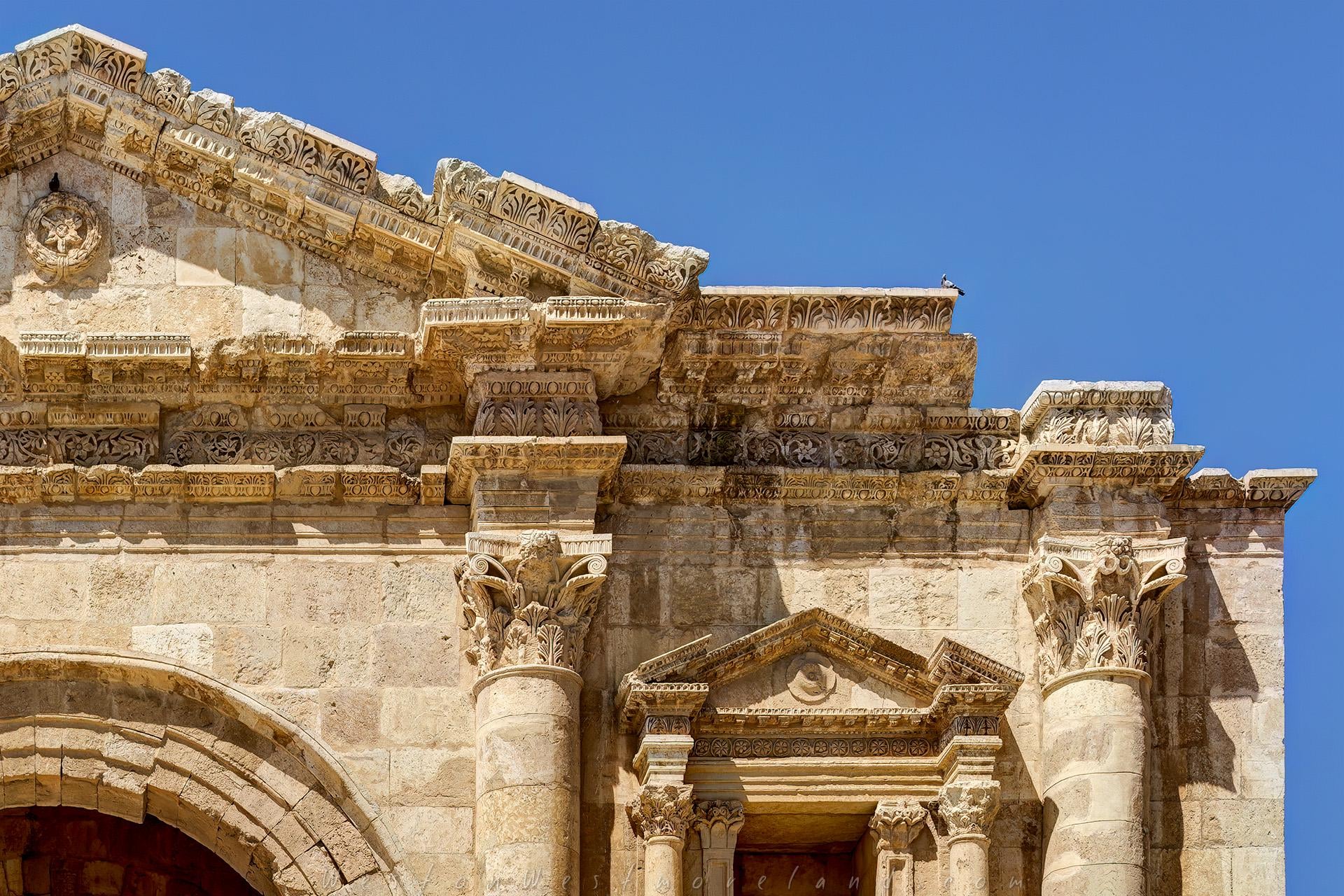
Detail of the different carved motives on the Arch of Hadrian, Gerasa, 129 AD, Jerash, Jordan. This triumphal arch was built to celebrate the visit of the Emperor Hadrian in AD 129–130. At 40Wx34Hx10D yd, it is one of the largest in the Roman Empire… (description in comments) [1920×1280] [OC]
by WestonWestmoreland
2 Comments
…The richly decorated entablature consists of a sequence of various ornamental moldings (including egg-and-dart, dentillation), a frieze in low relief with flowers and foliage, and the cornice decorated with a band of palmettes. Above it rises a flat triangular pediment in the shape of a broken pediment, in which the decorative elements of the entablature continue. In the center, there is only a laurel wreath with a rosette (and a pigeon) in it.
Originally, the Arch of Hadrian was intended to be the city gate of a new southern quarter along the road to Philadelphia, today’s Amman. However, this plan was abandoned soon after the emperor’s visit. Instead, Gerasa grew to the north, where the huge complex of the Sanctuary of Artemis was built, and was extended to the east side of the Chrysorhoas (Gold River, today’s Wadi Jerash). Therefore, the structure built in honor of Hadrian remained freestanding 500 yards from the southern gate of the fortified city.
My apologies for inaccuracies and mistakes.
Crazy that those details are still intact, they look so fine and delicate.. to survive 1900 years is astonishing.