
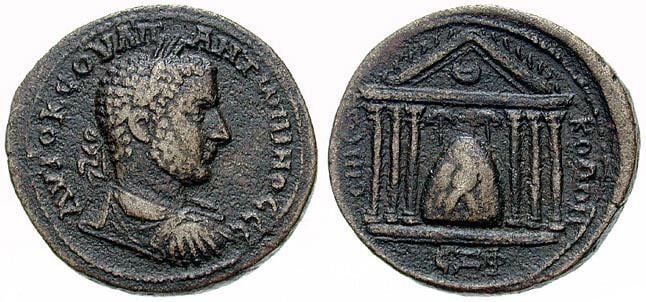
We've all heard of the sacred black stones of antiquity, but the one worshipped at Emesa (modern Homs, Syria) is a fascinating case. This baetyl (baitulos) was a god itself, named Elagabal. And for a brief, chaotic period, it became the supreme deity of the Roman Empire. The man who brought this Syrian god to Rome was the teenage emperor Elagabalus (born Varius Avitus), who served as the stone's high priest. His reign (218-222 AD) was a deliberate and shocking religious revolution. The most powerful description of his devotion comes from the Historia Augusta, a later but detailed historical source. The core of the cult was the physical stone itself. When Elagabalus traveled from Syria to Rome to claim the throne, he did not leave his god behind. The Historia Augusta describes the scene:"He sent a portrait of himself to Rome, in which he was represented in priestly robes… and gave orders that it should be hung in the middle of the Senate-house over the image of Victory… He also built a temple in Rome… and he desired that the sacred relics of the Jews, and the Samaritans, and the rites of the Christians, should also be transferred to this place…But most noteworthy was his proceeding with the god of Emesa, whom he transported to Rome, building a temple for him on the Palatine. And he did nothing of any importance without consulting this god, being himself its priest and in a certain sense its servant. He would often dance around it with cymbals and drums, and his family would join him." The most striking ritual detail involves the procession to Rome. The historian notes the reverence shown to the stone during its journey:"He himself, meanwhile, leading the way in a triumphal procession, would guide the god's chariot, but he would walk backwards, facing the god and holding the reins of the horses." The most powerful man in the Roman world, the Emperor, was not leading the procession facing forward like a conqueror. Instead, he was walking backwards, his entire focus and body oriented not towards Rome, but towards the black stone the true object of veneration.This direct challenge to Roman tradition, along with his erratic behavior, led to his eventual assassination. The stone was sent back to Emesa, and the cult was suppressed. But for four years, a black meteorite from Syria sat at the very heart of Roman power, and an emperor walked backwards for his god. Sources:
· Historia Augusta, Life of Elagabalus, 3, 7, and 25. · Herodian, History of the Roman Empire, Book 5
by Pagan1mperialism