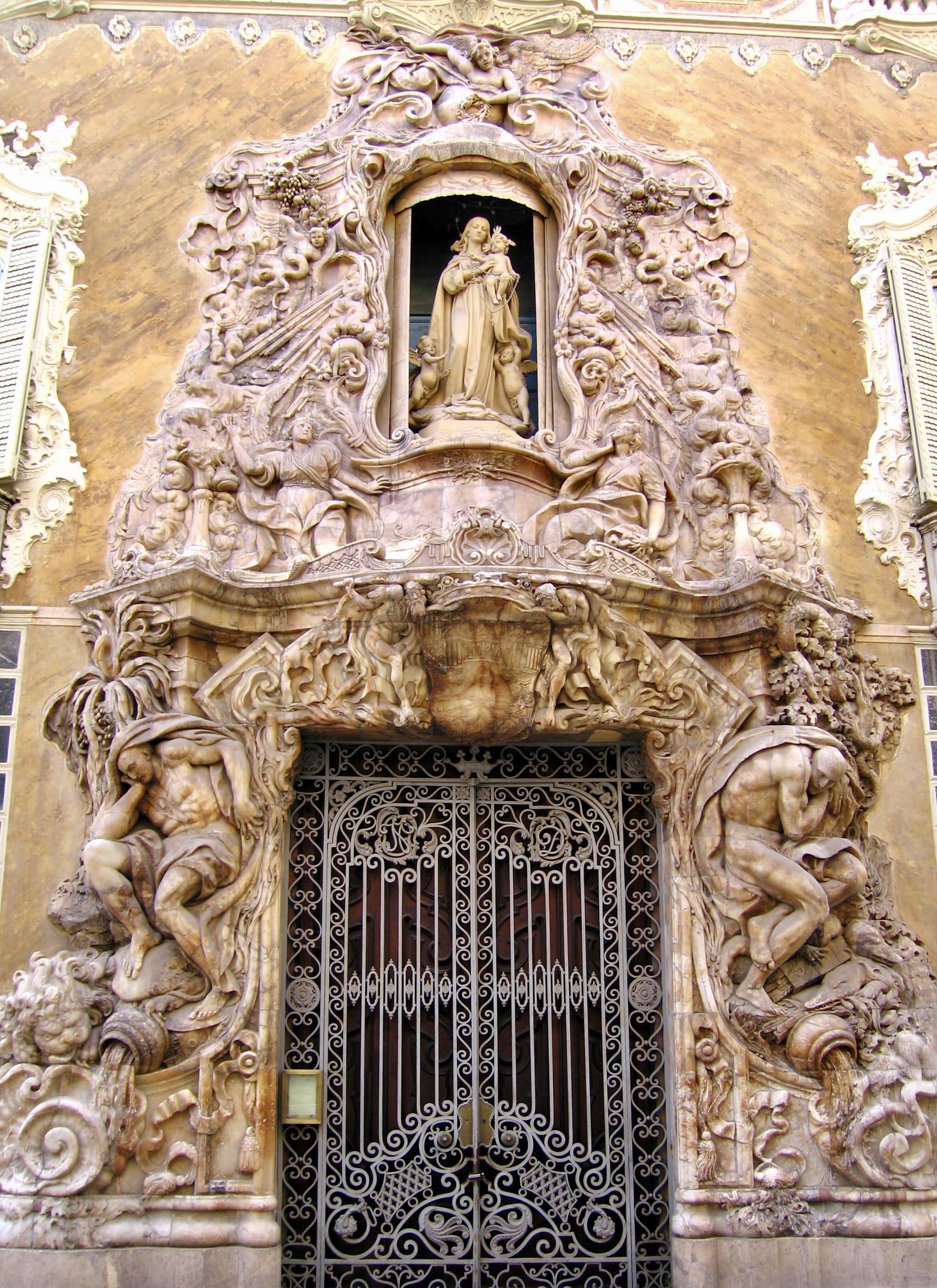
Entrance is made of alabaster by the Valencian, Ignacio Vergara Gimeno, founder and professor of the Royal Academy of Fine Arts of San Carlos, on the design of Hipólito Rovira, protected of the Marquis.
In the composition of this magnificent entrance made in 1745 reference to the two largest rivers of the Valencian community is: the Turia and Júcar, represented by two naked human figures (Atlanteans); under these two buckets pour water in clear reference to the title of the Marquises.
On the right side of the entrance it sees represented two heads of crocodile, a quiver of arrows and a vessel by whose mouth pour the water. On this set one of the two great figures referred to above and higher up decoration of ivy whose trunk it curls a snake.
On the left side, a reclining lion, another vessel pouring water into and other quiver of arrows. On the back of the lion resting the foot on the other giant. Complete the set diverse decoration of plant type and a palm tree.
In the doorpost the complex shield of the Marquises, the shield of the Rabassa de Perellós family and its various noble junctions. Embrace or rather protect the shield, the figures of two savages with maces. So between its quarters it can find the surnames Perellós (represented by some pears), Rabassa, the lineage of the Lanuza, Rocafull, Boil, Hijar and Maza de Lizana among others.
In the upper body of the entrance, in a niche artistic, the image to natural size of the Virgin of the Rosary, chosen as special patron saint by the House of Dos Aguas. At the foot of the Virgin two matrons kneeling, one with a cornucopia (the horn of Almatea) from which it spilling fruits (allegory of Agriculture and Prosperity) and the other with a vessel at its feet from out coins (allegory of Justice and Magnanimity). Flank the Virgin of the Rosary two pairs of small winged sirens. Throughout the entrance the overflowing voluptuousness of the Rococo style. Above the niche where the Virgin, it see represented the image of an angel with a trumpet, is “la Fama” trumpeter that proclaims the greatness of the Marquisate of Dos Aguas also wears a laurel wreath. The Virgin of the Rosary is work in polychrome wood by Ignacio Vergara in 1740 but it disappeared, it now see is a plaster copy made in 1866 by Francisco Cano Molineli. The niche has a lid that allows the concealment of the image; when the Marquises were outside the palace the image of the Virgin was hidden, and if they were inside the palace the image appeared in full view to the people.
Skeeblepop on
Wow, that is stunning!
cree8vision on
Look what you can do when you don’t have television and the internet taking up your time!
We often forget the world is very old and people created amazing things centuries ago.

3 Comments
Entrance is made of alabaster by the Valencian, Ignacio Vergara Gimeno, founder and professor of the Royal Academy of Fine Arts of San Carlos, on the design of Hipólito Rovira, protected of the Marquis.
In the composition of this magnificent entrance made in 1745 reference to the two largest rivers of the Valencian community is: the Turia and Júcar, represented by two naked human figures (Atlanteans); under these two buckets pour water in clear reference to the title of the Marquises.
On the right side of the entrance it sees represented two heads of crocodile, a quiver of arrows and a vessel by whose mouth pour the water. On this set one of the two great figures referred to above and higher up decoration of ivy whose trunk it curls a snake.
On the left side, a reclining lion, another vessel pouring water into and other quiver of arrows. On the back of the lion resting the foot on the other giant. Complete the set diverse decoration of plant type and a palm tree.
In the doorpost the complex shield of the Marquises, the shield of the Rabassa de Perellós family and its various noble junctions. Embrace or rather protect the shield, the figures of two savages with maces. So between its quarters it can find the surnames Perellós (represented by some pears), Rabassa, the lineage of the Lanuza, Rocafull, Boil, Hijar and Maza de Lizana among others.
In the upper body of the entrance, in a niche artistic, the image to natural size of the Virgin of the Rosary, chosen as special patron saint by the House of Dos Aguas. At the foot of the Virgin two matrons kneeling, one with a cornucopia (the horn of Almatea) from which it spilling fruits (allegory of Agriculture and Prosperity) and the other with a vessel at its feet from out coins (allegory of Justice and Magnanimity). Flank the Virgin of the Rosary two pairs of small winged sirens. Throughout the entrance the overflowing voluptuousness of the Rococo style. Above the niche where the Virgin, it see represented the image of an angel with a trumpet, is “la Fama” trumpeter that proclaims the greatness of the Marquisate of Dos Aguas also wears a laurel wreath. The Virgin of the Rosary is work in polychrome wood by Ignacio Vergara in 1740 but it disappeared, it now see is a plaster copy made in 1866 by Francisco Cano Molineli. The niche has a lid that allows the concealment of the image; when the Marquises were outside the palace the image of the Virgin was hidden, and if they were inside the palace the image appeared in full view to the people.
Wow, that is stunning!
Look what you can do when you don’t have television and the internet taking up your time!
We often forget the world is very old and people created amazing things centuries ago.