
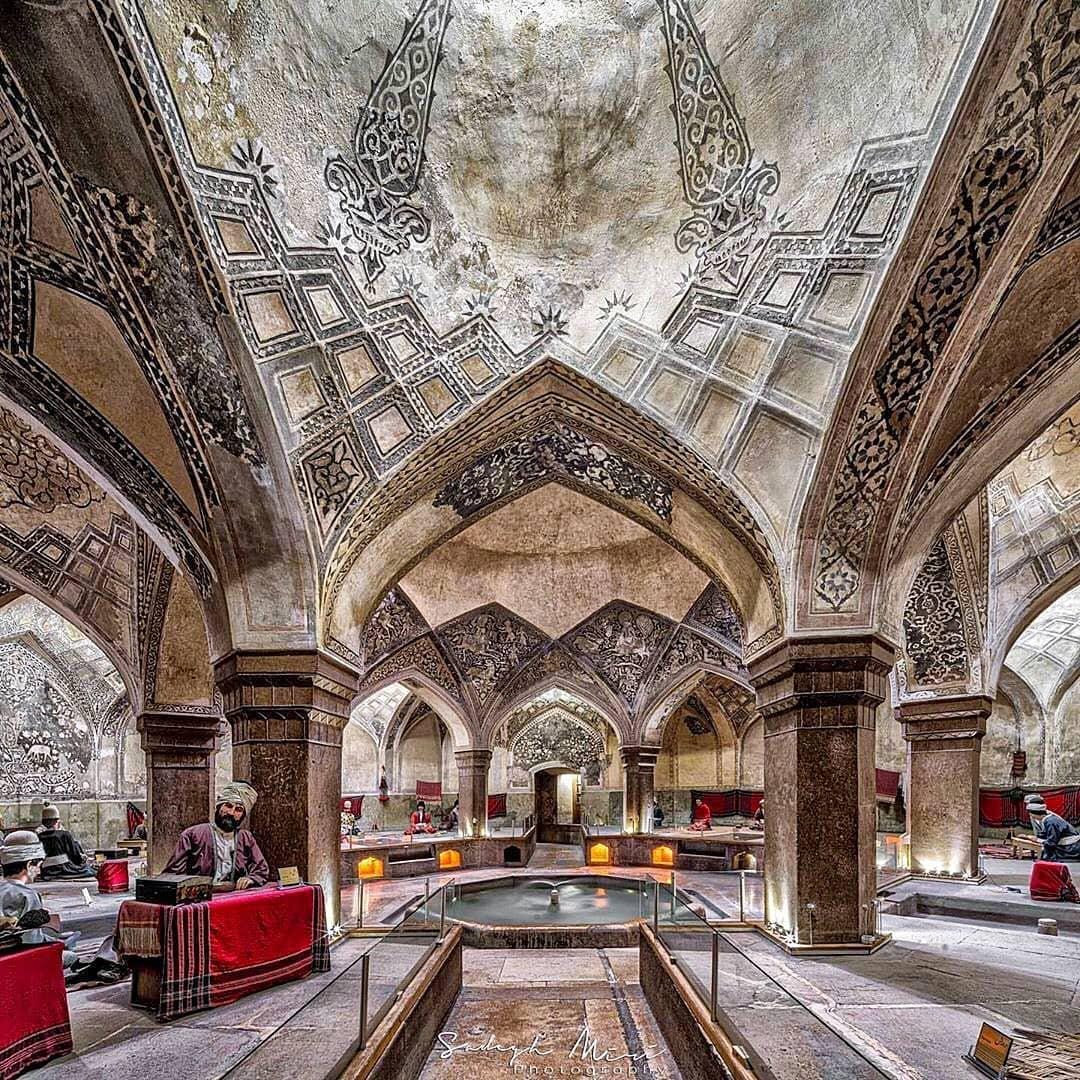
The Vakil Bathhouse, built in Shiraz around 1760, served both the public and Iran’s Zand dynasty, including King Karim Khan. It continued to function as a public bath until 1940, and was converted into a museum in 1971. [1080×1080]
by Party_Judgment5780
1 Comment
The Vakil Bathhouse in Shiraz was commissioned by Karim Khan Zand in the mid-1760s as part of the larger Vakil Complex, which also includes the mosque and bazaar. Built with thick walls, domed ceilings, and an advanced heating system, it was not only a place for bathing but also a social center for the city. The bathhouse has spacious halls, a large changing room, hot and cold chambers, and beautifully decorated vaults with stucco work, tile designs, and stone carvings. Its engineering is sophisticated, with an underground hypocaust system that carried hot air beneath the floors and into the walls, ensuring a comfortable and controlled temperature.
The bathhouse was designed to serve both the public and the Zand court. Ordinary citizens of Shiraz used it daily, while special chambers were reserved for the royal family, including Karim Khan himself. In this way, the Vakil Bathhouse was at once a communal space and a symbol of royal patronage. It continued to function as a public bath until 1940.
By that time, modern plumbing and the arrival of private bathrooms in homes had reduced the need for large public hammams. In the decades that followed, the structure was restored, and in 1971 it was officially converted into a museum. Today, the Vakil Bathhouse stands as both an architectural masterpiece of the Zand era and an anthropological museum.