
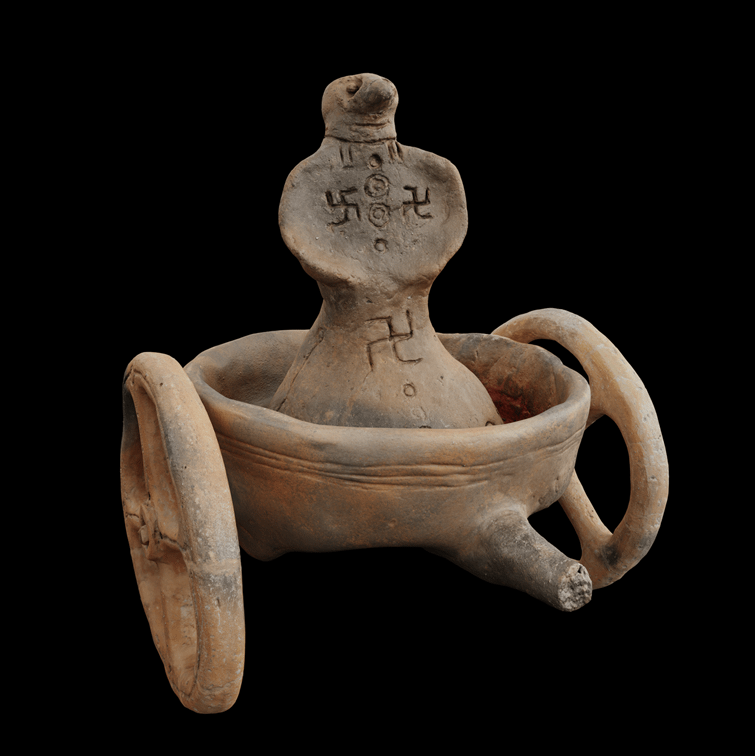
Duplaja Chariot 2 – c. 1600-1200 BC; Found in a ‘cremation cemetery’ of the Encrusted Pottery Culture (Modern Day Hungary/Serbia) [755×756]
by DeepTune_
Duplaja Chariot 2 – c. 1600-1200 BC; Found in a ‘cremation cemetery’ of the Encrusted Pottery Culture (Modern Day Hungary/Serbia) [755×756]
by DeepTune_
2 Comments
**Early Chariots and Religion in South-East Europe and the Aegean During the Bronze Age: A Reappraisal of the Dupljaja Chariot in Context -** [https://www.cambridge.org/core/services/aop-cambridge-core/content/view/DC2A0FC7066548E7C0FED0C9024169B3/S1461957123000396a.pdf/early_chariots_and_religion_in_southeast_europe_and_the_aegean_during_the_bronze_age_a_reappraisal_of_the_dupljaja_chariot_in_context.pdf](https://www.cambridge.org/core/services/aop-cambridge-core/content/view/DC2A0FC7066548E7C0FED0C9024169B3/S1461957123000396a.pdf/early_chariots_and_religion_in_southeast_europe_and_the_aegean_during_the_bronze_age_a_reappraisal_of_the_dupljaja_chariot_in_context.pdf)
The Dupljaja chariots are two unique Bronze Age ceramic models discovered in the village of Dupljaja, located in the South Banat District of Serbia’s Vojvodina province, near the river Karaš. These artifacts date to approximately 1600–1200 BC, placing them around 3,500 to 3,300 years old. They were recovered in the early twentieth century from a cremation cemetery near the village, though no detailed excavation records were kept.
The Dupljaja chariots are considered unique in Bronze Age Europe due to the presence of a charioteer figurine, and they reflect a blend of local traditions and broader pan-European cosmological beliefs. The four-spoked wheels and solar symbolism, such as the cross-in-circle motif, link the chariots to wider Bronze Age religious imagery and the concept of a solar deity. The inclusion of waterfowl on the draught-poles and the bowl-shaped platform, which may have held liquids or grains, further supports a ritual function, potentially related to cosmological or seasonal cycles.
The artifacts are also linked to the myth of Hyperborean Apollo, a solar deity associated with a heavenly chariot drawn by swans, thus, they are seen as evidence of cultural and ideological connections between the Balkans, northern Europe, and the Aegean during the later Bronze Age.
A reminder that the Nazi stole that symbol, and that it had been used so many time before.
Also this look more like a snake than a waterfowl, if you ask me 😀