
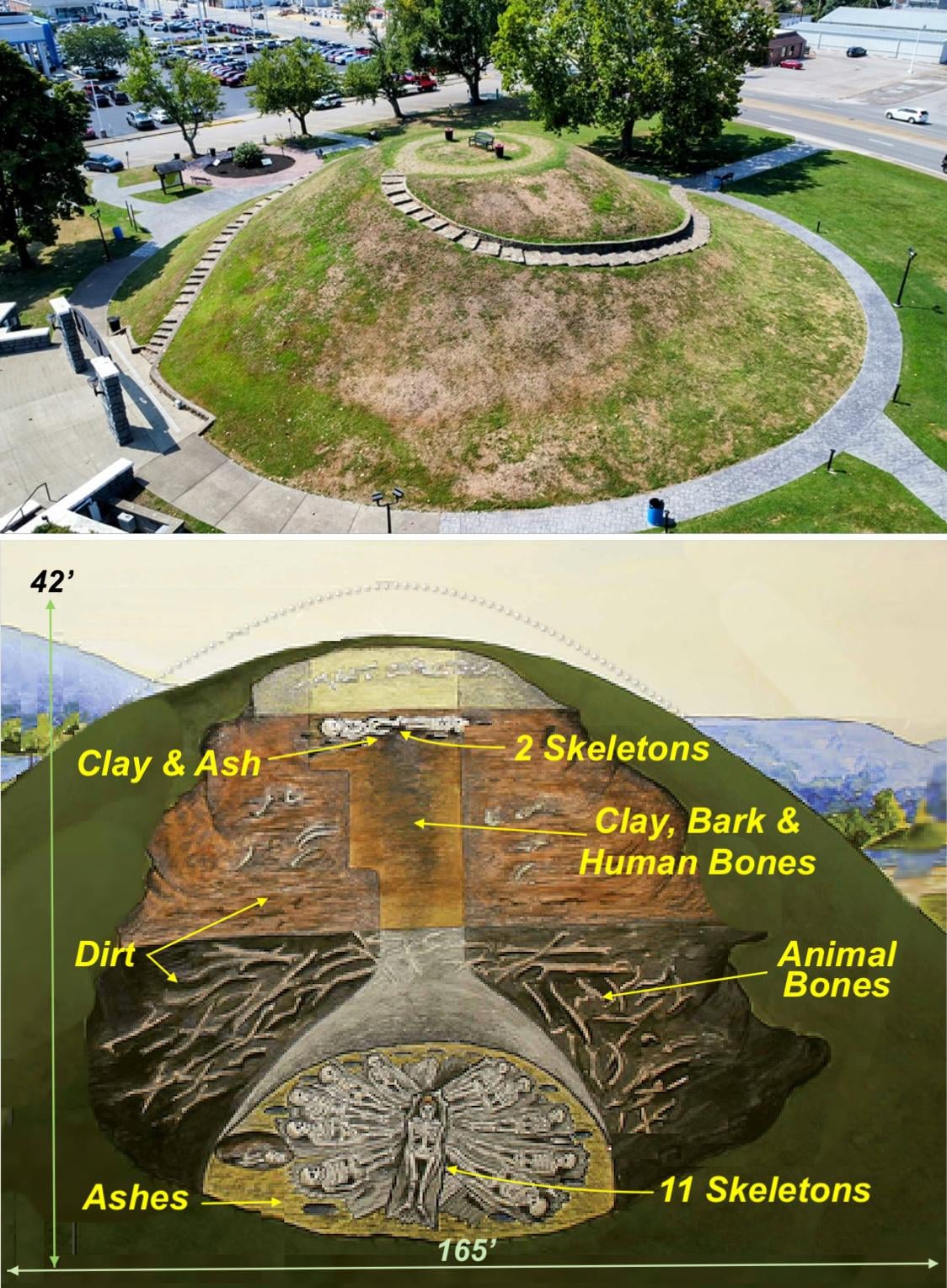
The Criel Mound in West Virginia, built in 250–150 BC. Inside the mound, there was 2 skeletons near the top, and 11 at the base, which consisted of a large skeleton at the center surrounded by 10 others arranged in a spoke-like pattern with their feet pointing toward the central skeleton [1124×1529]
by Fuckoff555
5 Comments
> The Criel Mound was excavated in 1883–84 under the auspices of the US Bureau of Ethnology and the supervision of Col. P.W. Norris. The excavation was performed by Professor Cyrus Thomas of the Smithsonian Institution. Inside the mound, Professor Thomas found thirteen skeletons: two near the top of the mound, and eleven at the base. The skeletons at the base consisted of a single very large but badly decayed skeleton at the center, a “once most powerful man” which according to A.R. Sines who assisted Col. Norris in the excavation, measured “Six feet, 8 3–4 inches” (205 cm) from head to heel (the Smithsonian nomination form added “but the extreme height indicated might have been an exaggeration created by earth pressing down on the burial”).[3][4] This skeleton was surrounded by ten other skeletons arranged in a spoke-like pattern, with their feet pointing toward the central skeleton. The skeletons at the base had been wrapped in elm bark and were lying on a floor of white ash and bark. Several artifacts were found buried with the skeletons, including arrowheads, lanceheads, and shell and pottery fragments. The central skeleton was accompanied by a fish-dart, a lance-head, and a sheet of hammered native copper near the head. Holes found at the base of the mound suggest that the bodies at the base had been enclosed in a wooden vault.
[https://en.m.wikipedia.org/wiki/Criel_Mound](https://en.m.wikipedia.org/wiki/Criel_Mound)
Chris Jennings has several burial mounds on his newest farm. It’s just 500 acres this time, but there’s room for his newest farm project. He just received his first delivery of baby bison.
I’ve never heard of this before. Thank you for sharing, OP!
Always the artists
Wonder why this way?
I’m guessing Natives and maybe these were a loss of war maybe?