
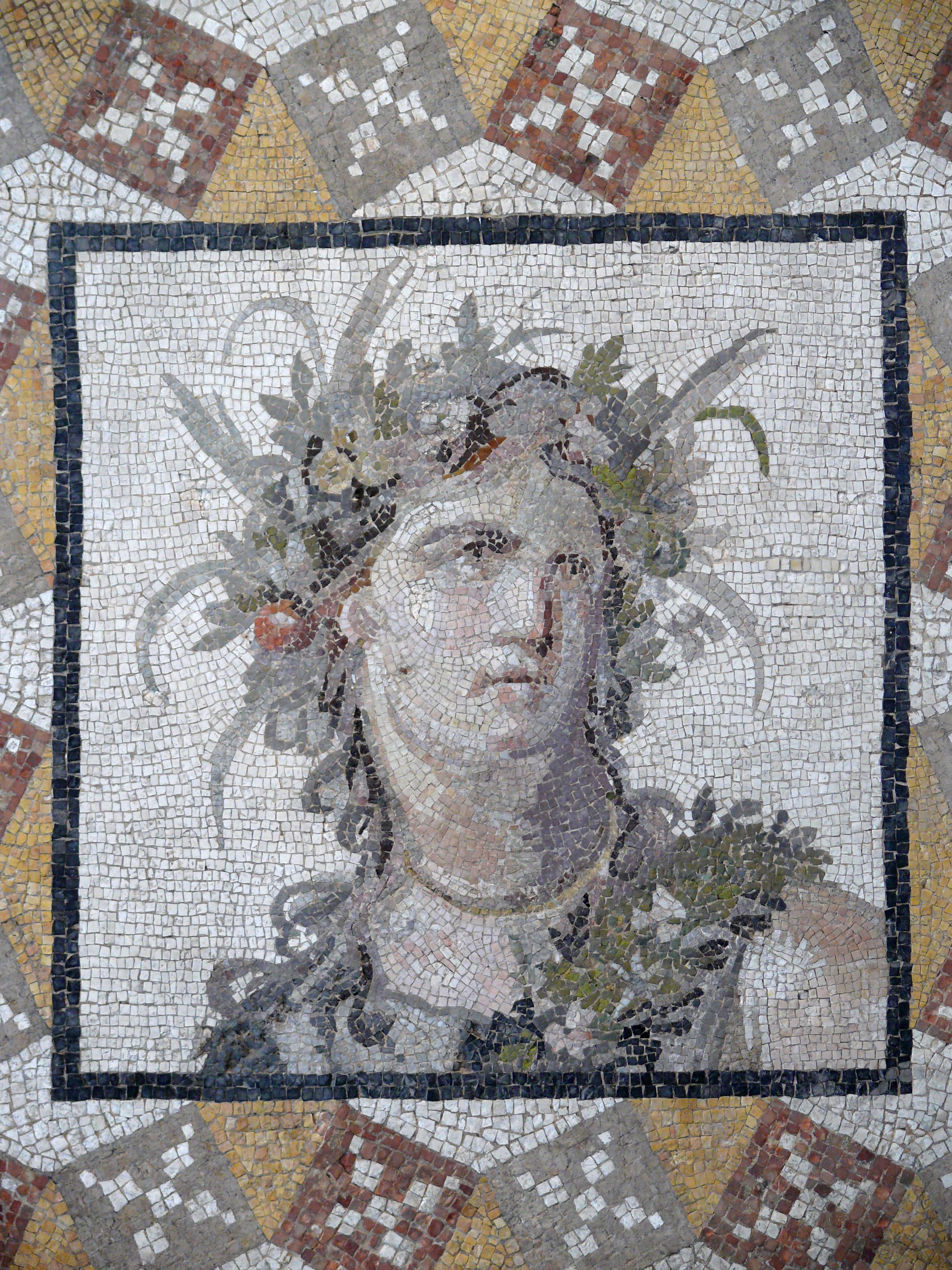
Roman Mosaic Portrait of Copia, Goddess of Abundance and Good Living (2nd Century CE) – One of the Antioch Mosaics at The Met, New York [2736×3648]
by ParkingGlittering211
Roman Mosaic Portrait of Copia, Goddess of Abundance and Good Living (2nd Century CE) – One of the Antioch Mosaics at The Met, New York [2736×3648]
by ParkingGlittering211
4 Comments
I wonder how that would look if it were restored.
The original description describes her as a “generic personification of abundance and good living” [[1]](https://commons.wikimedia.org/wiki/File:So-called_Antioch_Mosaic.jpg#:~:text=found%20in%201937%20in%20part%20of%20a%20Roman%20villa%20excavated%20at%20Daphne%2C%20a%20summer%20resort%20near%20the%20ancient%20city%20of%20Antioch%20(in%20southern%20Turkey).%20The%20central%20emblem%20contains%20the%20bust%20of%20a%20female%20figure%2C%20probably%20a%20generic%20personification%20of%20abundance%20and%20good%20living) which suggests she’s [Abundantia](https://en.wikipedia.org/wiki/Abundantia), also known as Copia which comes from copious.
>Copia, was a divine personification of abundance and prosperity *abundantia* means “abundance” in Latin. She helped protect savings and investments, and assisted with major purchases. She was among the embodiments of virtues in religious propaganda that cast the emperor as the ensurer of “Golden Age” conditions. Abundantia thus figures in art, cult, and literature, but has little mythology as such. [[2]](https://en.wikipedia.org/wiki/Abundantia#:~:text=Copia%2C%5B,has%20little%20mythology)
Cool, Copia is Latin for “abundance” or “plenty”. So that’s where we get the word “copious”.
Dionysus in the Greek version