
The relationship between Great Britain and the Qing Dynasty evolved over several centuries, shaped by diplomacy, trade, military conflict, and the broader dynamics of empire.
Early contact included the 1685 visit of Michael Shen Fu-Tsung, a Chinese Jesuit, to Britain, where he met King James II. Trade officially began in 1699 when the East India Company was permitted to conduct business in Guangzhou (Canton), marking the start of sustained commercial relations.
In 1784, the Lady Hughes Affair, where a British gunner's salute led to unintended deaths, heightened tensions. This foreshadowed the cultural and legal misunderstandings that would plague future interactions. High-level diplomatic efforts followed, such as the Macartney Embassy of 1793 and the Amherst Embassy of 1816, both of which failed to establish equal diplomatic footing with the Qing court.
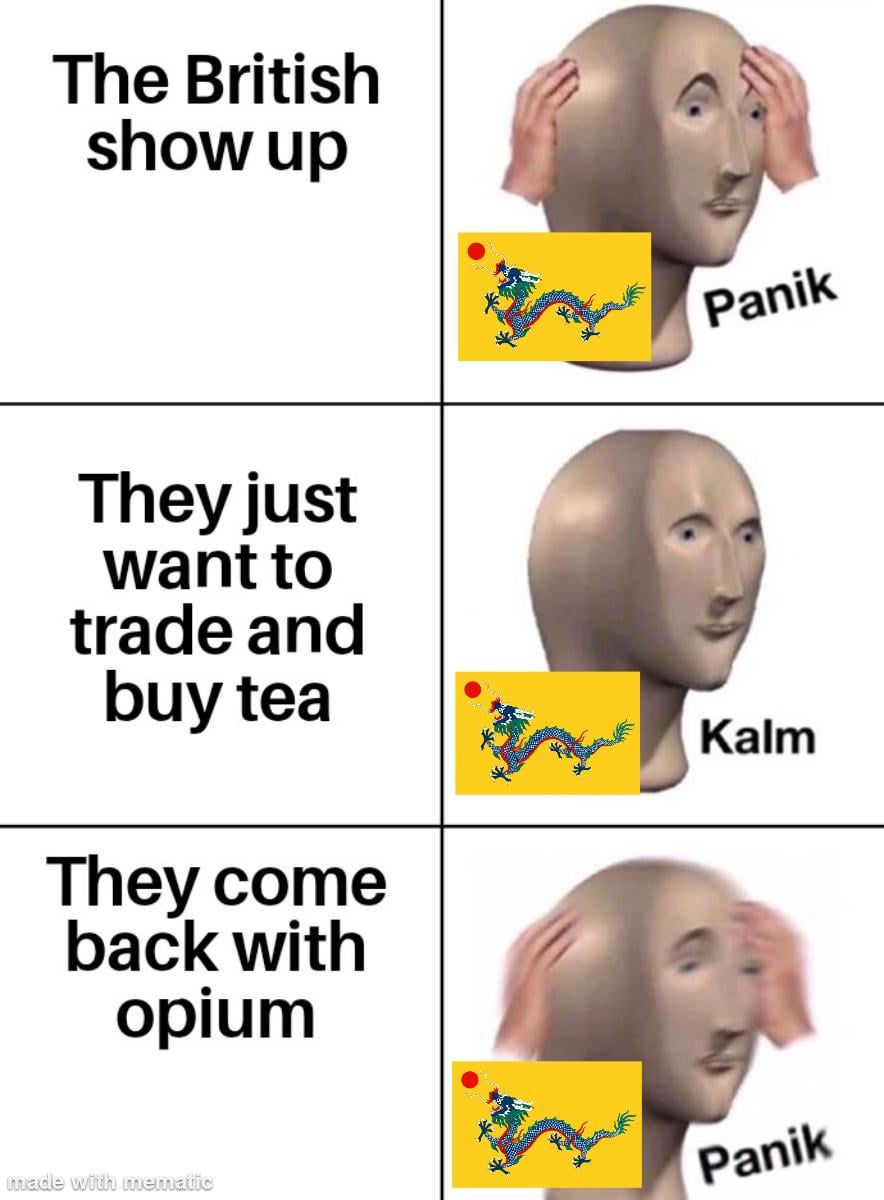
By the 1820s and 1830s, British merchants had turned Lintin Island into a hub for the opium trade.[16][17] This illicit commerce contributed directly to the First Opium War (1839–42). Prior to the war, the East India Company's monopoly on Chinese trade was abolished (1833–35), prompting efforts by successive British governments to maintain peace. However, figures like Lord Napier took a more provocative stance, pushing for deeper market access, despite the Foreign Office under Lord Palmerston favoring a less confrontational approach.
The war culminated in a decisive British victory. British motivations were framed by Palmerston's biographer as a confrontation between a dynamic, modern trading nation and a stagnant autocracy. However, critics such as the Chartists and young William Ewart Gladstone condemned the war as morally reprehensible, pointing to the devastation caused by opium addiction.
by Time-Comment-141
2 Comments
“They come back with opium.” WAY TOO CALM.
The trade good brain chemicals plant for OTHER good brain chemicals plant.