
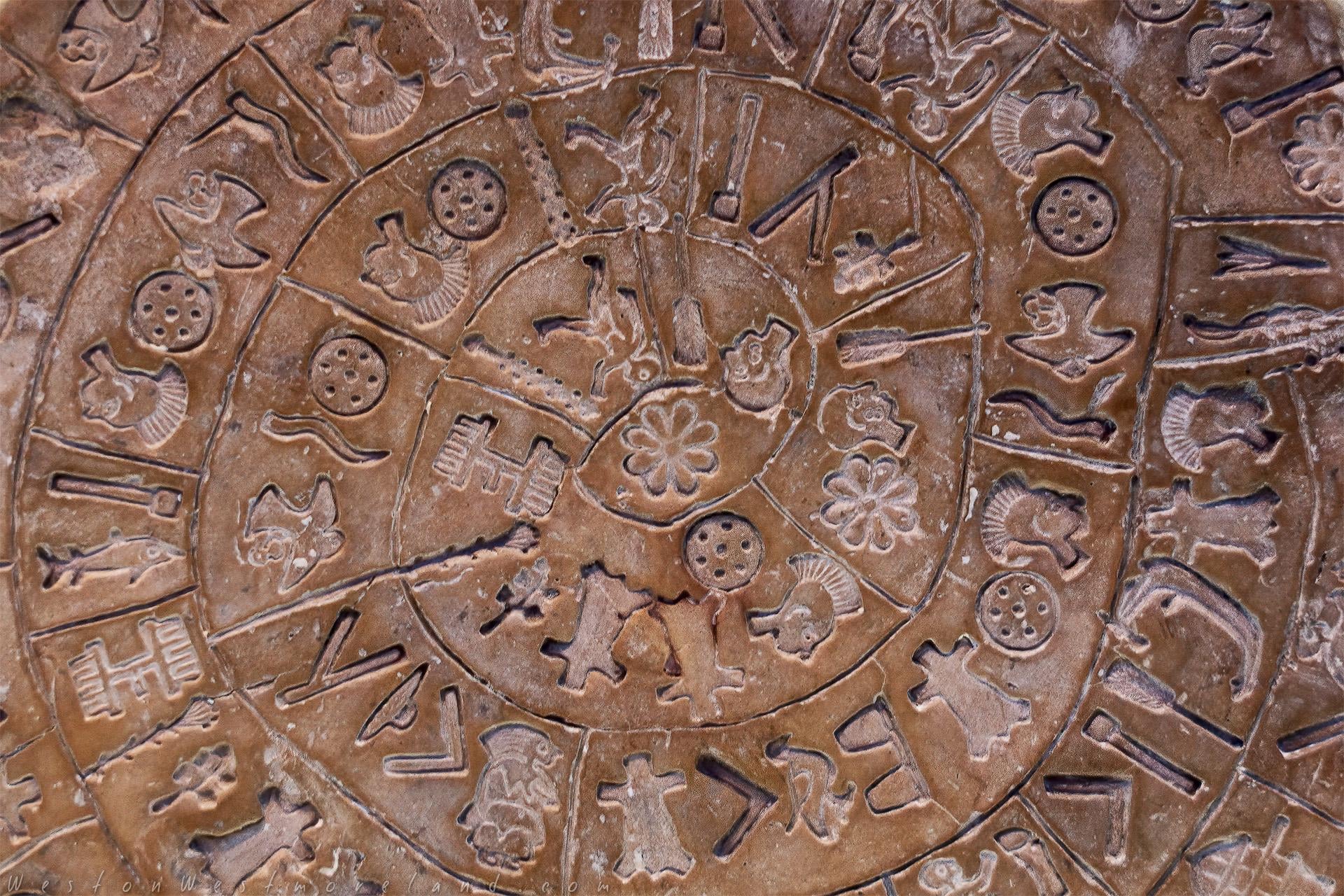
Detail view of some of the enigmatic pictograms stamped in a spiral on the Phaistos Disc, side A, possibly from the middle-late Minoan Bronze Age (1000s BC). One of the most iconic artifacts of the Minoan civilization, its purpose and original place of manufacture remain disputed… [1920×1080] [OC]
by WestonWestmoreland
2 Comments
…The disc was discovered in 1908 during the excavation of the Minoan palace of Phaistos in Crete. It is a rough clay cylinder, about 5.9in in diameter and almost 0.8 thick, with rounded edges. The outline is slightly egg-shaped. While its unique features initially led some scholars to suspect a forgery or hoax, the disk is now generally accepted as authentic by archaeologists.
Both sides of the disc were completed by pressing individual sign stamps, up to a total of 241 occurrences of 45 distinct signs, before firing while the clay was still wet. A vertical line with five dots on the outer edge of each side marks the beginning and the direction of reading of the inscriptions, from the edge of the disc towards the center.
The impressed pictograms, often depicting themes drawn from the natural world or material culture, such as people, birds, plants and ships, are arranged in 61 groups, presumably representing words. These are separated by vertical or radiating incised lines.
Due to its uniqueness, the disc is a fascinating object of study, and there have been many attempts to decipher and interpret the text. The repetition of certain groups of signs, like a refrain (like the “oar-bald man-flower”, or the “cookie-punk” combinations), is the strongest evidence that the inscription is a hymn or incantation.
While it is not clear that it is a script, most attempted decipherments assume that it is; most additionally assume a syllabary, others an alphabet or logography. Experts have not yet reached a definitive conclusion on the contents of the inscription and its possible relationship to the three pre-alphabetic scripts of the prehistoric Aegean, Linear A, Cretan Hieroglyphic and Linear B. This mysterious object captured the imagination of amateur and professional palaeographers, and many attempts have been made to decipher the code behind the disc’s signs.
The Minoan civilization was a Bronze Age Aegean civilization on the island of Crete and other Aegean Islands, flourishing from c. 2700 to c. 1450 BC until a late period of decline, finally ending around 1100 BC.
I uploaded both sides of the disk to ArtefactPorn [here](https://www.reddit.com/r/ArtefactPorn/comments/16p7qe4/the_phaistos_disc_palace_of_phaistos_crete/).
As usual, my apologies for inaccuracies and mistakes.
Clearly, Punk Is Not Dead.