
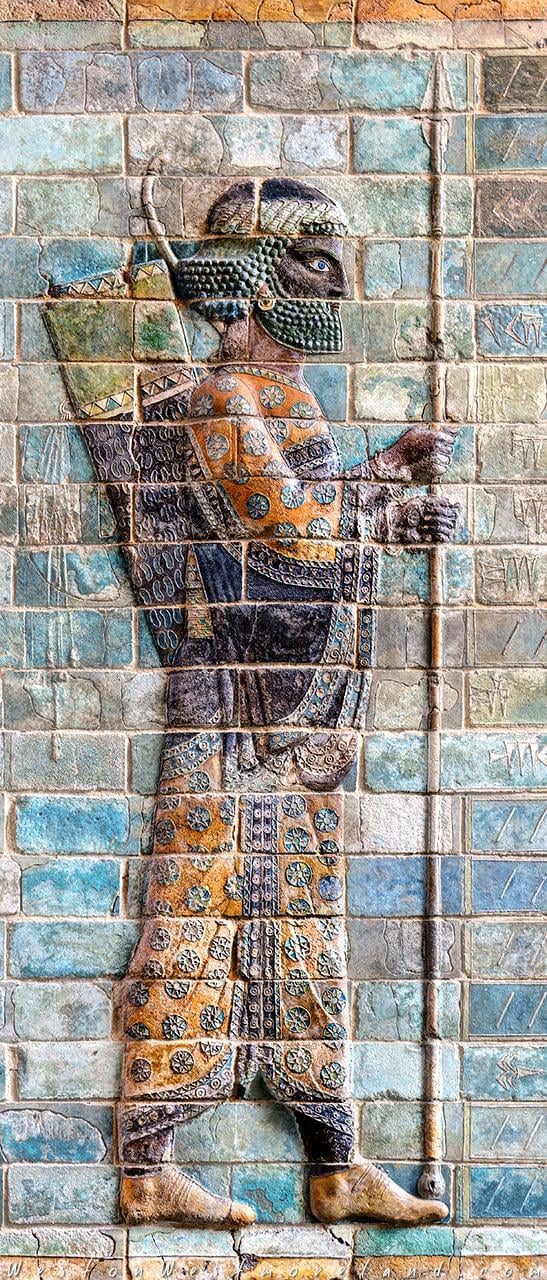
Persian Warrior, Palace of Darius I the Great, Suse. C. 500 BC. Detail of one of the warriors (possible Immortals) depicted on a Glazed brick frieze in one of the capitals of the Achaemenid Empire, probably inspired by the friezes of Babylon, although the technique is different… [1280×547] [OC]
by WestonWestmoreland
5 Comments
…that may be a legacy from the Middle Elamite Period, which saw the appearance of decoration in glazed siliceous brick.
The warriors on the frieze are believed to be The so called *Immortals*, also known as the *Persian Immortals*. This name given by Herodotus to an elite heavily-armed infantry queued unit of 10,000 soldiers in the army of the Achaemenid Empire. This force also conformed the Imperial Guard. Herodotus describes the ‘Immortals’ as a heavy infantry professional corps constantly kept at a strength of exactly 10,000 men. The unit’s name came from the practice of immediately replacing any disabled man, maintaining the corps as a cohesive entity with that constant strength of 10,000. The practical result was this army could not be killed, thus the Immortals. These would be the Immortals the 300 faced at the battle of Thermopylae in the movie.
Darius I (c. 550 – 486 BCE), commonly known as Darius the Great, was the third King of Kings of the Achaemenid Empire, reigning from 522 BCE until his death in 486 BCE. He ruled the empire at its territorial peak, when it included much of West Asia, parts of the Balkans (Thrace–Macedonia and Paeonia) and the Caucasus, most of the Black Sea’s coastal regions, Central Asia, the Indus Valley in the far east, and portions of North Africa and Northeast Africa including Egypt, eastern Libya, and coastal Sudan.
As usual, my apologies for inaccuracies and mistakes.
He carries a lance, a compound bow, and quiver.
The details! All the way down to the ankle bones, fingernails, and positioning of the hands! Fantastic work.
Blue eyes
Stunning