
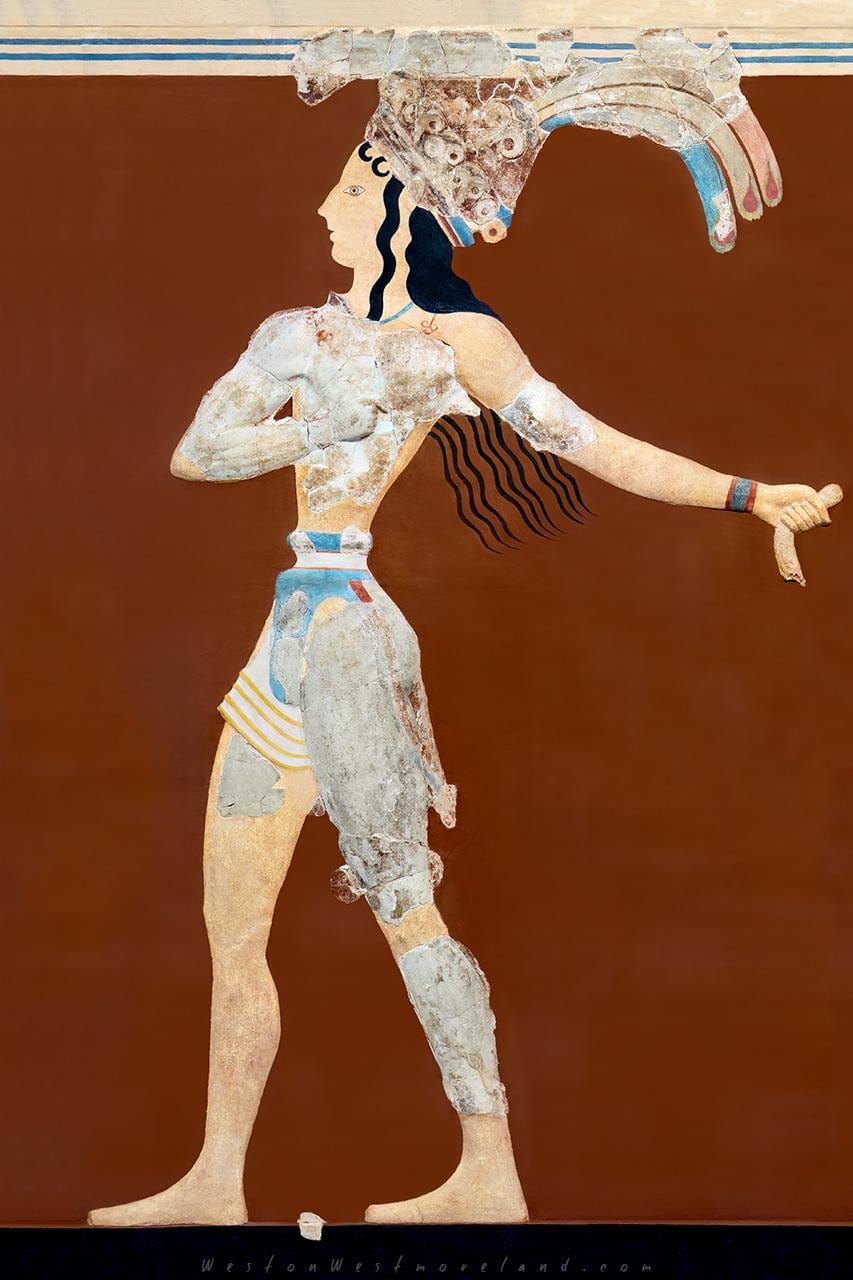
Prince of Lilies fresco, Prince of the Lilies Fresco, Knossos Palace, Crete. 1600 – 1450 BC. Late Bronze Age (Neopalatial period, Late Minoan I period) A celebrated Minoan painting, it was excavated in pieces from the palace of Knossos, capital of the Minoan civilization, in Crete.[1280×853] [OC]
by WestonWestmoreland
2 Comments
…The mostly reconstructed original is now in the Heraklion Archaeological Museum. Though often called a fresco, the figure (not including the flat background) is one of the smaller group of “relief frescos” or “painted stuccos”, as the original parts of the image are built up in plaster to a low relief before being painted.
The Prince of Lilies (or the Lily Prince or Priest-King Fresco) depicts a young man in high relief against a red ground. The life-size male figure, comprised of three non-joining parts, is wearing a colorful loincloth and belt, and a majestic crown of waz-lilies (a sort of mythical-stylized-plant-combo that the Minoans created and that we in the modern world refer to as waz lilies. They’re a combination of lilies and papyrus) and peacock feathers.
The fresco was discovered in the South Wing of the palace of Knossos. Only a few pieces of the original image were excavated; it was probably removed from its wall deliberately during rebuilding or renovating the palace. There have been different suggestions from archaeologists as to the appearance of the original image. According to Arthur Evans, the excavator of Knossos, he was the “Ruler of Knossos”, the “Priest-King”, the personification of religious and temporal power. Other scholars propose different reconstructions of the fragments and interpretations of the fresco, identifying the “Prince” as an athlete, a boxer, or a ruler making a gesture of command, while the luxurious crown is thought to belong to a priestess or a sphinx.
The uncertainty surrounding the fragments may be summarized by the title of a paper published in 2004: “The Priest-King Fresco from Knossos: Man, Woman, Priest, King, or Someone Else?”, though in fact the paper tends to back more of Evans’ conclusions than some subsequent scholars do.
As usual, my apologies for inaccuracies and mistakes.
It looks impressive, but it’s basically a made-up image. It was pieced together from fragments that didn’t belong to the same figure at all, the body, the crown, and the background were all found separately. The restorers in the early 1900s just guessed how it might have looked and filled in the blanks. So what we see today isn’t a real Minoan artwork, but more of a fantasy version based on mismatched pieces.