
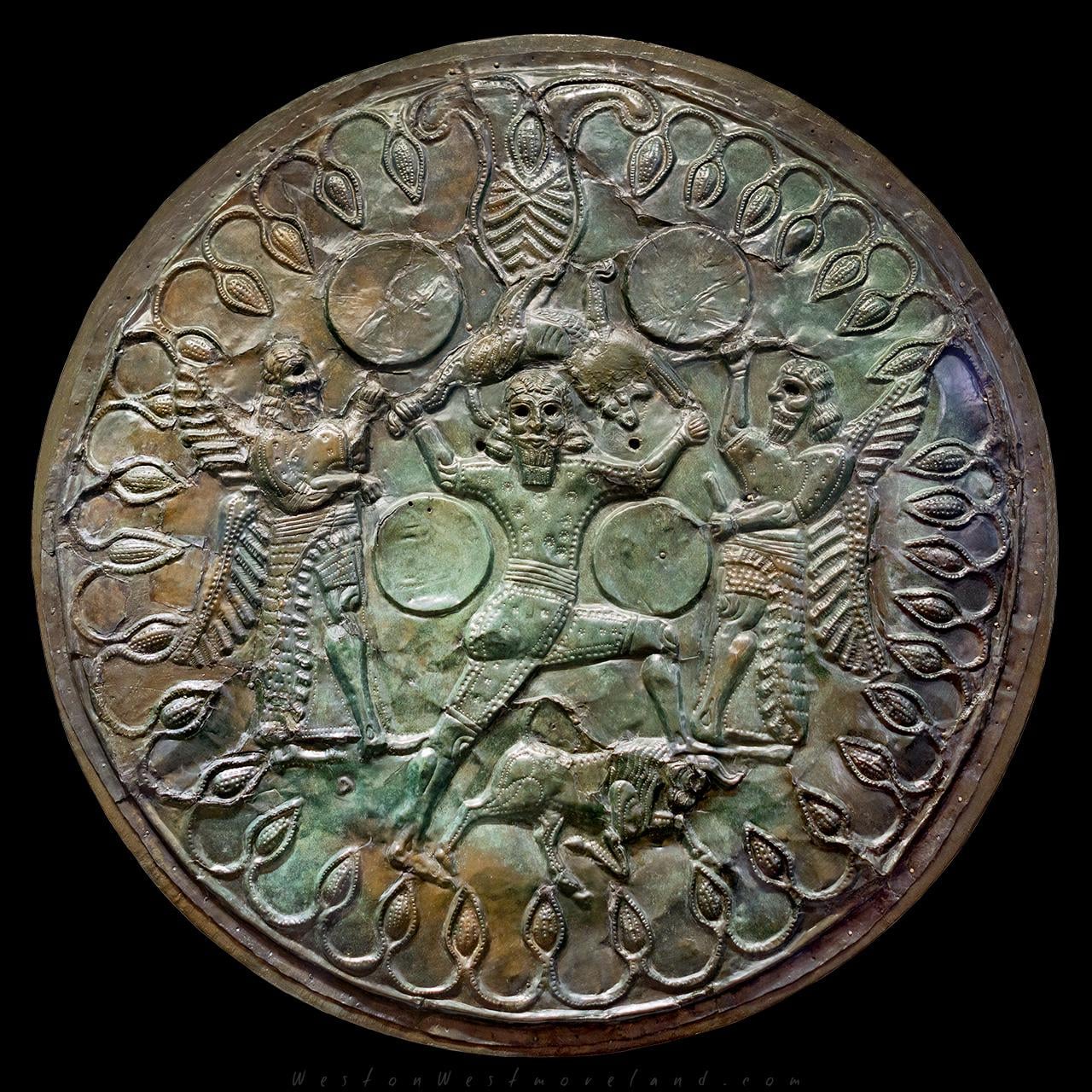
Bronze Drum from the Idaean Cave. In ancient Greece, the tympanon was a type of circular, shallow tambourine, beaten with the palm of the hand or a stick. This one dates from the 8th century BC and is considered the first to appear in Greek art. It is a votive bronze disc found… [1280×1280] [OC]
by WestonWestmoreland
2 Comments
…at the Idaean Cave, a cave on Crete that was a cult site for Zeus.
The drums or shields from the Idaean Cave, among the finest masterpieces of the ancient world, are dated to the 8th and 7th centuries BC and adorned with incised and embossed scenes. They were deposited in the cave as votives, together with a wealth of other offerings, including exceptional examples of ivory, bronze and goldwork of the time.
Among the rich finds of the sacred cave, this bronze tympanon stands out for the religious subject-matter of its elaborate decoration. In the centre of the disc is a commanding, bearded male figure grasping a lion, his left foot treading on a bull. On either side of the central figure are two winged “daemons” of Assyrian origin, holding similar drumlike discs. The composition is framed by an elaborate floral motif. As the Idaean Cave was associated with the myths of the birth and raising of Zeus, the scene on the tympanon is interpreted as the myth of Cretan-born Zeus and the Cureles (or Corybantes). These daemons clashed their swords against their shields to cover the crying of the infant Zeus, who was being raised in the Idaean Cave to protect him from his father Cronus, who devoured his own children.
The uniqueness of the “tympanon”, whose exact purpose is unclear, lies in the fact that it combines the Assyrian, the Minoan and the Doric theological worlds. It may be an Eastern import or the work of a local craftsman with strong Eastern influences.
As usual, my apologies for inaccuracies and mistakes.
The style here is mesopotamian looking