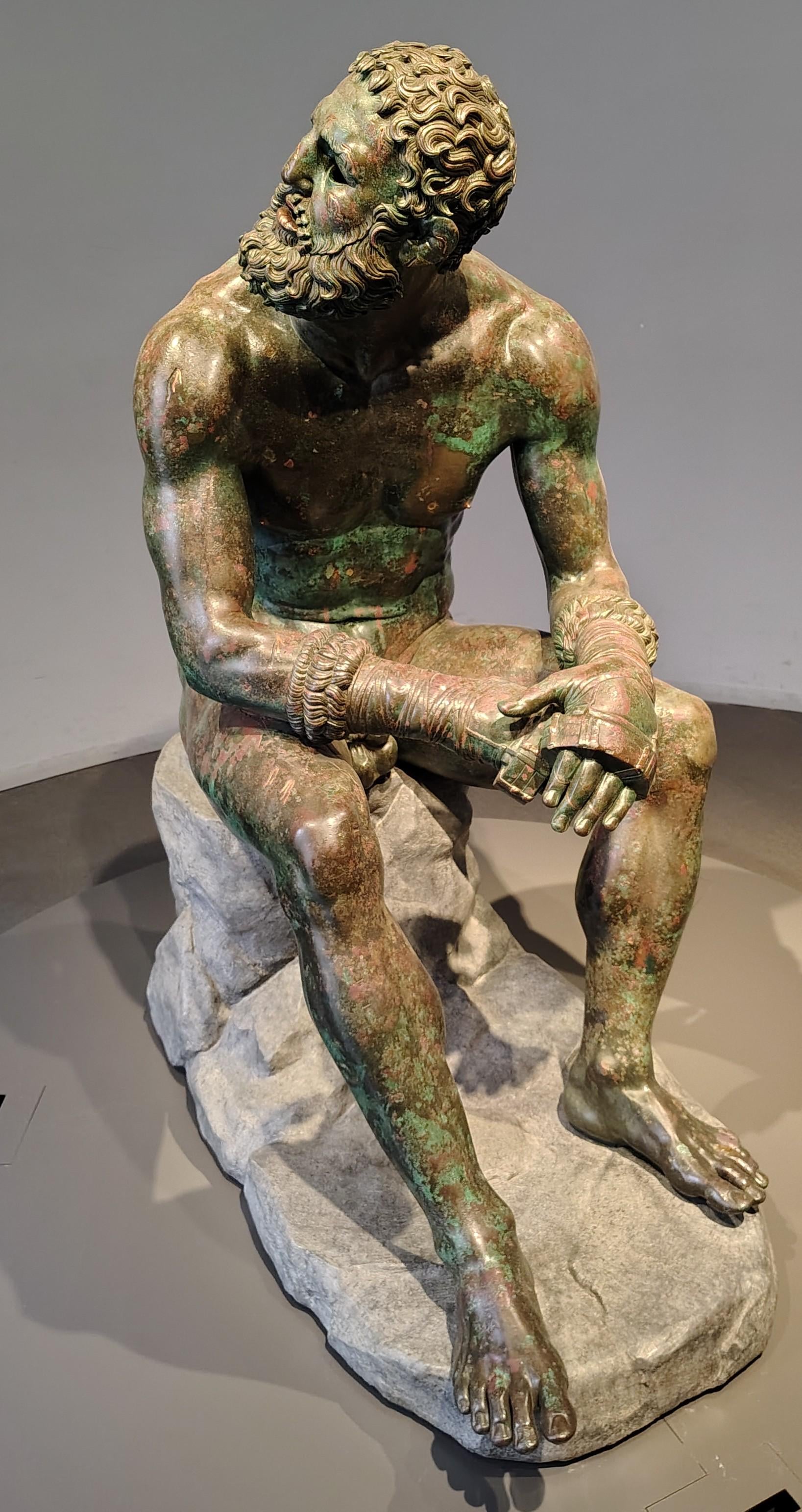
The Boxer at rest, one of the finest examples of bronze sculptures to have survived from the ancient world; now housed in Palazzo Massimo alle Terme, Rome [1637 x 3086] [OC]
by TheSecretMarriage

The Boxer at rest, one of the finest examples of bronze sculptures to have survived from the ancient world; now housed in Palazzo Massimo alle Terme, Rome [1637 x 3086] [OC]
by TheSecretMarriage
3 Comments
Amazing details
From the museum website:
Among the works on display at Palazzo Massimo one of the best known is the bronze statue of the Seated Boxer, a Greek original that most scholars attribute to the late Hellenistic period of the first half of the first century BCE.
Pausanias (VI, 18, 7) recounts that the earliest statues erected to honor victorious athletes were dedicated at Olympia during the 59th and 61st Olympiads and, among them, one represented a boxer.
The statue does not actually show a victorious athlete in the moment of glory, rather a weary fighter resting after, presumably, winning a competition. The exaggerated realism that highlights the signs of wounds and swellings along with the descriptive minuteness in the rendering of the gloves has led to speculation that this was a portrait of Poulydamas, a Thessalian athlete of great strength whose statue displayed in Olympia was an object of popular veneration. However, the face would not seem to faithfully reproduce a portrait, so much as an ideal character, intending to imply precisely the fatigue of the contest that led the boxer to emerge victorious despite his injuries, enduring the blows he received.
The work was brought to Rome in the imperial age and was found in 1885 on the slopes of the Quirinal hill, in excavations that had uncovered the remains of the Baths of Constantine where it was perhaps displayed in the gymnasium, in view of its original function.
You know you’re gay when a thousands-of-years old sculpture does it for you