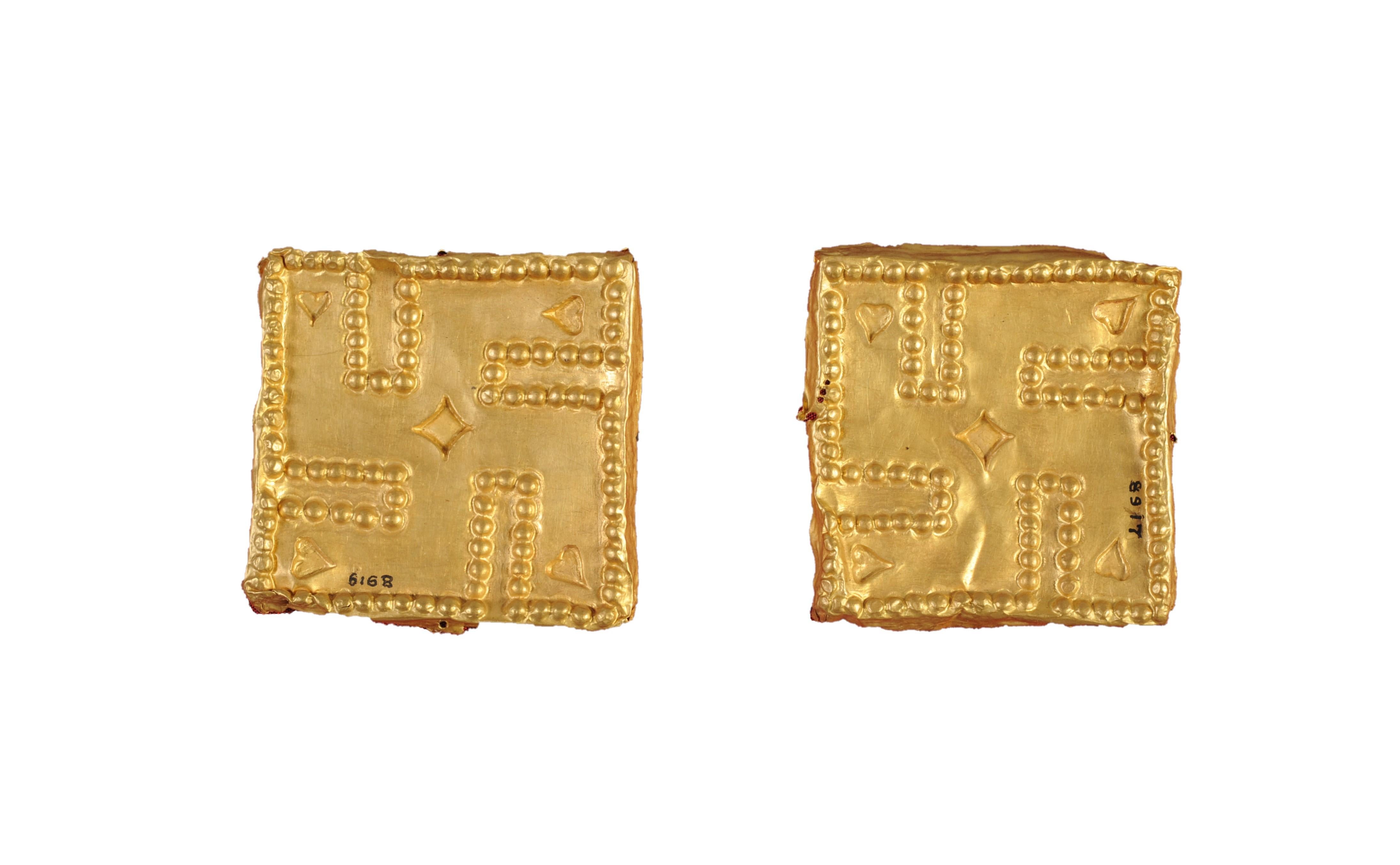
Swastika (Amulet, gold) from Taxila (Sirkap), c. 1st Century BCE (housed in National Museum, Delhi, India) [4382×2708]
by Ironyfree_annie

Swastika (Amulet, gold) from Taxila (Sirkap), c. 1st Century BCE (housed in National Museum, Delhi, India) [4382×2708]
by Ironyfree_annie
2 Comments
The Taxila Jewellery, dating back to 1st century BCE to 1st Century CE is one of the most prized collections of the National Museum that offers insights about the sophisticated and celebrated gold craftsmanship that existed in India. The square amulets in gold depict one of the ancient auspicious symbols ‘swastika’. Depicted as a symmetrically bent cross motif with a variety of geometric details, the ‘swastika’ continues to be one of the most revered symbols in the Indian subcontinent. The swastika motif in these amulets are made in repoussé technique and surrounded by beaded borders. In the center, at the cross of arms, a diamond shaped depression is hollowed out, while the four ends of arms depict heart-shaped depressions. This was originally on a core of lac and has a provision of four copper ring-hooks at the back for convenient attachment.
One of the ICE agents or Maga heads dropped it perhaps.