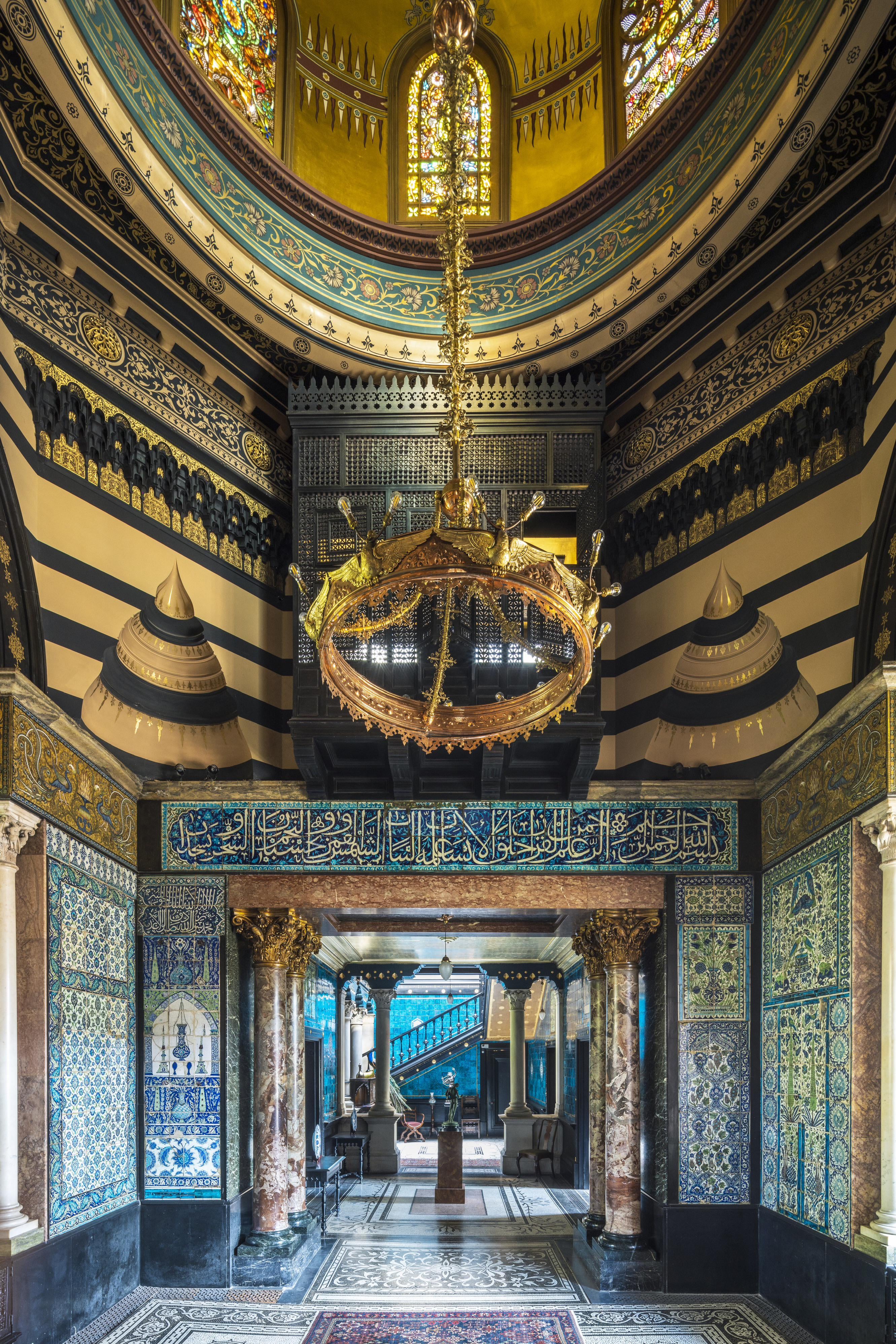
The Arab Hall, Leighton House, 1877-1881. The building was the London home of painter Frederic Leighton, who commissioned the architect and designer George Aitchison to build him a combined home and studio [5464 x 8192]
by Persephone_wanders

The Arab Hall, Leighton House, 1877-1881. The building was the London home of painter Frederic Leighton, who commissioned the architect and designer George Aitchison to build him a combined home and studio [5464 x 8192]
by Persephone_wanders
3 Comments
I would love to know what that script says
Leighton worked closely with his architect George Aitchison. They were inspired by different buildings that they admired on their travels to Palermo, Granada, Istanbul, Cairo and Damascus and other locations.
Leighton collected and purchased many of the tiles himself on his trips to Turkey, Egypt and Syria, as well as asking friends and colleagues to acquire further tiles for him. Caspar Purdon Clarke, who went on to became director of the V&A museum in London, purchased the two matching panels featuring grape motifs on the West wall, in Damascus in 1877.
Leighton travelled to Damascus in 1873 by ship to Beirut, followed by a diligence (stage coach) which took 13 hours. He would have brought back his purchases, carefully packed in wooden crates, in the same way.
Art historians don’t know exactly when Leighton started buying tiles, but it may have been on his 1867 trip to Turkey and Greece. We know that he bought a number of Iznik ceramic plates in Lindos in Rhodes on this trip – these were subsequently hung on the walls of his dining room. He probably bought some tiles while on a trip to Egypt in 1868 and many more while visiting Damascus in 1873. His friend William Wright whom he met on his trip, talks of hunting for ’tiles and plates’ with him in the city. The building of the Arab Hall was mostly finished in 1880 by which time all the tiles were probably in place.
Assembling and arranging the different tiles to create a coherent and harmonious whole was a feat requiring considerable skill and Frederic Leighton and George Aitchison commissioned William De Morgan, an experienced ceramicist who had opened his own studio at 36 Cheyne Row in 1872, to make repairs to the damaged tiles and replacements for the missing ones. De Morgan also created the beautiful deep turquoise tiles which line the walls of the Narcissus Hall and staircase.
The mosaic floors are in the three connecting halls on the ground floor. The black-and-white classical patterns, each one different, were designed by George Aitchison, probably inspired in part by floors he had seen in Italy. In the Arab Hall, the interlinked flower motif border may derive from mosaic decoration in the Dome of the Rock.
Leighton is likely to have seen a gold mosaic frieze at a 12th century palace in Palermo called La Zisa; he visited the city in 1875. The artist Walter Crane whom he commissioned to design the frieze for the Arab Hall mentions being sent a photograph of La Zisa’s mosaic frieze to demonstrate the type of design that he was being asked to produce. The glass mosaic pieces were made in Venice by a firm called Salviati & Co.
The fountain and the chandelier were both made in London. The fountain had a central jet that splashed into the basin and was originally made of white marble; this was eventually replaced with black marble and had goldfish swimming in it. The chandelier was copied from those seen by Leighton in buildings in the Middle East: he made a drawing of a light fixture in the Umayyad Mosque of Damascus. Made by the London firm Forrest and Son, it originally used gas, and was converted to electricity in the 1890s.
The fountain was originally fed from a water tank on the flat roof above the Silk Room, working by pressure. It was modified twice and eventually the fountain was sealed and converted to an electrical pump because the water appeared to be draining into the foundations of the Arab Hall.
There is an account written by one of Leighton’s friends, that after a dinner party one evening, while they were drinking coffee and smoking in the Arab Hall, one of them stepped right into the fountain, disturbing two of the goldfish! This even happens today from time to time as visitors look upwards as they walk into this stunning space. From [RBKC.gov.uk](https://www.rbkc.gov.uk/museums/arab-hall-leighton-house)
This is so fabulous. I am awestruck by the beauty.