In 1391 AD, Amir Timur led an army of thousands against Khan Toktamysh of the Golden Horde. After navigating through the harsh steppe wilderness for months, Timur scaled a nearby hill and had engineers erect a monument. 15th Century Timurid historian Sharaf al-Din Ali Yazdi described the event:
“Timur then ascended a hill, and saw with admiration those vast plains, which for the space they took up, resembled the ocean. He stayed there all the day, and ordered the soldiers to bring stones to that place, where he built a very tall obelisk. And skillful engineers engraved on it the date of the year on which Timur came there at the head of his army, that this structure might remain as a lasting monument to all the ages.”
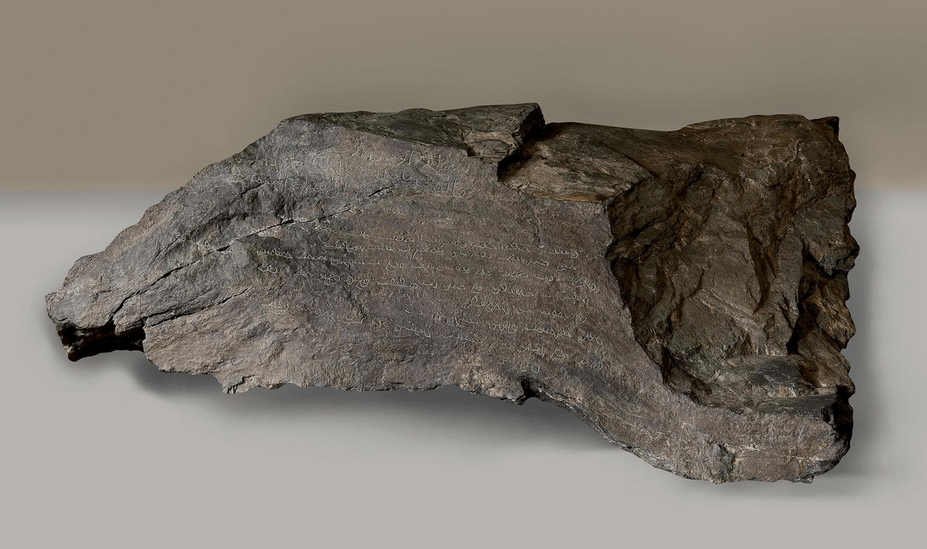
Centuries later, in the year 1935, geologist Kanysh Satpayev found remnants of this very monument. The artifact is known as the “Karsakpay Inscription” or “Timur’s stone” and was unearthed on the left bank of the River Sarysu in modern-day Kazakhstan. On the stone are 11 lines of carved inscription: 3 in Arabic and 8 in Chagatai. They read the following:
“In the name of Allah, the gracious, the merciful! Lord of Existence, Sanctuary of Truth, Vigilant Protector, Almighty and All-Powerful, Wise Giver of Life and Death! In the summer of the 793rd, in the middle month of spring in the year of the sheep, the Sultan of Turan Timur-Beg with 300,000 warriors for Islam rose up against the Bulgar ruler Toktamysh Khan. On reaching this spot, he erected this mound to be a commemorative sign. God willing, the Lord grant justice! May the Lord show mercy to the people of the country! May they remember us with a prayer.”
Today, the Karsakpay Inscription can be seen in the Oriental Art collection at the Hermitage Museum in Saint Petersburg, Russia.The stone is fascinating for many reasons, including the usage of the words “Bulgar” and “Turan.” But it also shows how accurate the early Timurid histories could be, despite often being riddled with exaggerations or legends.

1 Comment
In 1391 AD, Amir Timur led an army of thousands against Khan Toktamysh of the Golden Horde. After navigating through the harsh steppe wilderness for months, Timur scaled a nearby hill and had engineers erect a monument. 15th Century Timurid historian Sharaf al-Din Ali Yazdi described the event:
“Timur then ascended a hill, and saw with admiration those vast plains, which for the space they took up, resembled the ocean. He stayed there all the day, and ordered the soldiers to bring stones to that place, where he built a very tall obelisk. And skillful engineers engraved on it the date of the year on which Timur came there at the head of his army, that this structure might remain as a lasting monument to all the ages.”
Centuries later, in the year 1935, geologist Kanysh Satpayev found remnants of this very monument. The artifact is known as the “Karsakpay Inscription” or “Timur’s stone” and was unearthed on the left bank of the River Sarysu in modern-day Kazakhstan. On the stone are 11 lines of carved inscription: 3 in Arabic and 8 in Chagatai. They read the following:
“In the name of Allah, the gracious, the merciful! Lord of Existence, Sanctuary of Truth, Vigilant Protector, Almighty and All-Powerful, Wise Giver of Life and Death! In the summer of the 793rd, in the middle month of spring in the year of the sheep, the Sultan of Turan Timur-Beg with 300,000 warriors for Islam rose up against the Bulgar ruler Toktamysh Khan. On reaching this spot, he erected this mound to be a commemorative sign. God willing, the Lord grant justice! May the Lord show mercy to the people of the country! May they remember us with a prayer.”
Today, the Karsakpay Inscription can be seen in the Oriental Art collection at the Hermitage Museum in Saint Petersburg, Russia.The stone is fascinating for many reasons, including the usage of the words “Bulgar” and “Turan.” But it also shows how accurate the early Timurid histories could be, despite often being riddled with exaggerations or legends.
Picture and translation taken from the Hermitage Museum’s website:
(https://www.hermitagemuseum.org/digital-collection/91822?lng=en)