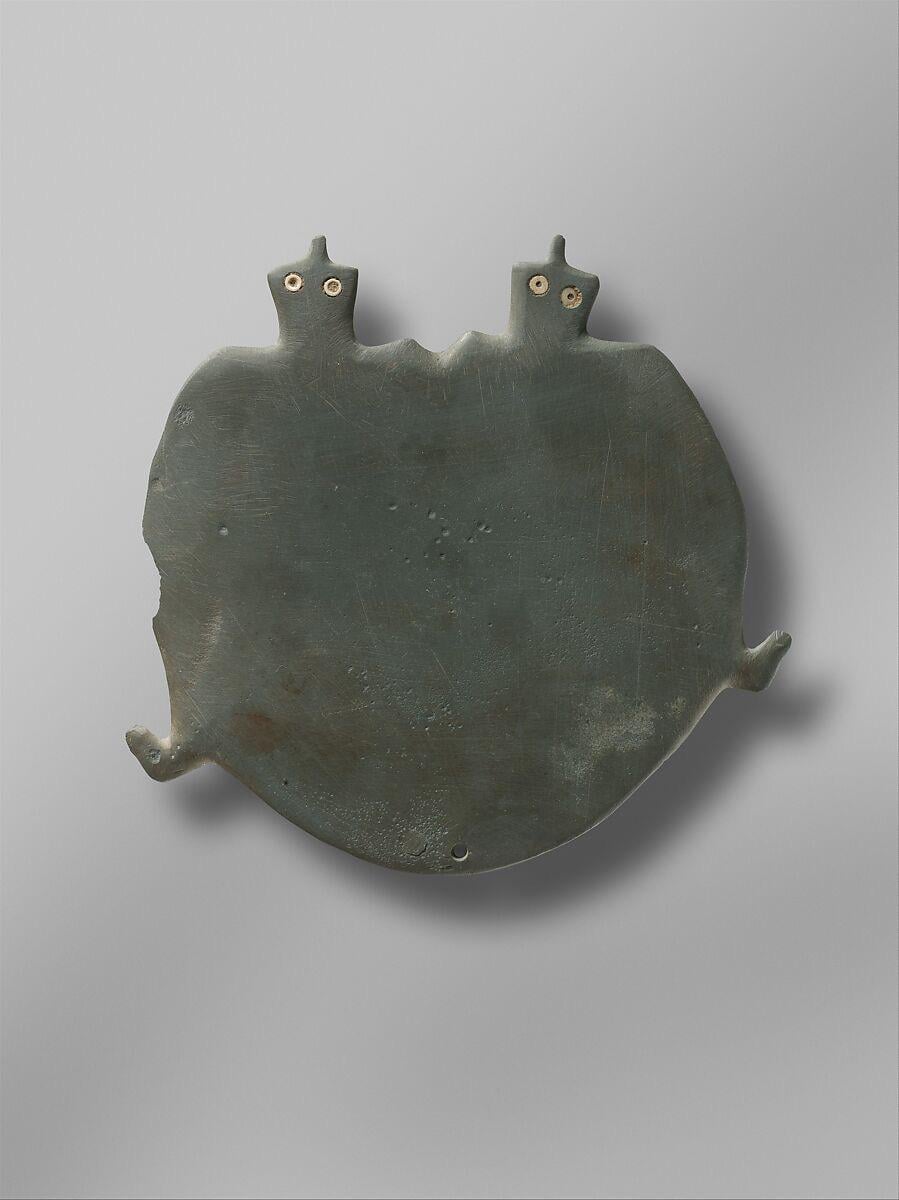
Egyptian Palette Depicting a Pair of perhaps Mating Mud Turtles ca. 3650–3500 BC, MET [899×1200]
by Remote_Finish_9429

Egyptian Palette Depicting a Pair of perhaps Mating Mud Turtles ca. 3650–3500 BC, MET [899×1200]
by Remote_Finish_9429
2 Comments
The large mud turtle, Trionyx triunguis, which inhabited the Nile River and its canals, is the subject of many palettes and this one is quite unusual in depicting a pair. The duo may represent a mating pair linking the palette’s imagery to the concept of fertility and therefore regeneration. In the Pharaonic Period, the turtle had a dual reputation, on one hand the animal was connected to chaos and disorder, and on the other, it could be a potent amulet when the turtle’s negative character was used as a protective force. Given the turtle is the subject of an implement for manufacturing pigment for eye paint, a protective interpretation seems fitting. [Museum link](https://www.metmuseum.org/art/collection/search/544044)
Looks like a two-headed turtle to me. Two-headed hatchlings certainly exist though I don’t know how many make it to maturity.