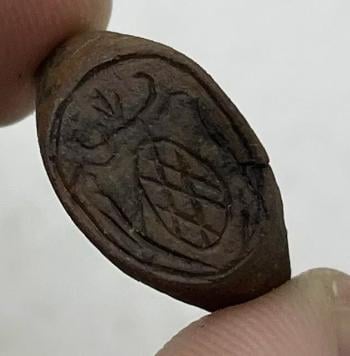
Ancient or medieval ring I purchased with an engraving that looks like a pineapple [350×356]
by hereswhatworks

Ancient or medieval ring I purchased with an engraving that looks like a pineapple [350×356]
by hereswhatworks
7 Comments
my fatass saw a ham
[https://en.wikipedia.org/wiki/Pineapple_mania](https://en.wikipedia.org/wiki/Pineapple_mania)
edit: OP is holding it upside down. The leafs go on the bottom and the fruit sticks up.
Rum ham.
What ancient or medieval culture is this from?
I think in this is meant to be pseudo-heraldry. Tilt your head and look at it as a whole as opposed to individual symbols, resembles a roughly done coat of arms.
You can read an abstract about the phenomenon here:
[https://www.academia.edu/123092652/_Honour_in_the_Eyes_of_Others_a_study_of_pseudo_heraldic_shield_motifs_in_historic_church_graffiti_and_medieval_personal_seals](https://www.academia.edu/123092652/_Honour_in_the_Eyes_of_Others_a_study_of_pseudo_heraldic_shield_motifs_in_historic_church_graffiti_and_medieval_personal_seals)
Where did you get it? Was it authenticated and if so was there a rough date approximation? Keep in mind the medieval period is nearly a thousand years.
Thistle
now, take my comment with a small pinch of salt, and dont treat it with any sort of degree of authority – I am not an archaeologist with a speciality in jewellery, though I do some work in crafts-adjacent fields. Conversely, I do tend to do a fair bit of archaeological object evaluation using things like the Portable Antiquities Scheme, Finds database, etc, so, what I am going to say isnt entirely made up out of my arse.
the form of the ring is not itself intrinsically medieval or pre-medieval in style. the patination, likewise, isnt anything sufficient to identify the dating of it. You’ve given no information on known provenance, or archaeological find-place, which could’ve been used to help narrow down a window of origin, so that cuts out a lot of speculation.
The obvious first point would be if we assume it is a pineapple, that excludes ancient and medieval datings, they werent in europe prior to 1492. Of course it could be somethng else, but, its a detail to keep in mind.
but the art style doesnt jump out at me as being particularly medieval – and the art histoy of the period is something I’m very familliar with. cant really put my finger on it (no pun intended), but its just not quite feeling right for medieval periods. But it does for early modern, post-medieval.
So I cant help suspect its a little bit younger than your seller purported.